334. Efficacy, Safety, and Completion of Modified Short-Course Rifapentine and Isoniazid for Latent Tuberculosis Infection in High-Risk Patients with Rheumatic Disease: A Multicenter Randomized Controlled Trial
lifan zhang, yujie he, wenwen wang, lijun wu, xiaoxia zuo, sheng chen, yanping zhao, ping zhu, hongbin li, xiaoqing liu

TL;DR
A modified 3-month tuberculosis prevention regimen was found to be as effective and safer than a 9-month regimen in high-risk rheumatic disease patients.
Contribution
A modified 3HP regimen was tested and shown to be noninferior to 9-month isoniazid in preventing TB reactivation in rheumatic disease patients.
Findings
The modified 3HP regimen had a 0% active TB rate versus 1.15% in the 9H group.
The modified regimen had lower hepatotoxicity and similar treatment completion rates.
The modified regimen showed a favorable safety profile and high adherence.
Abstract
Patients with rheumatic diseases (RDs) have a high risk of latent tuberculosis infection (LTBI) reactivation. However, research on tuberculosis preventive treatment (TPT) in this specific patient group remains limited. Additionally, the safety of the WHO - recommended 3 - month regimen of weekly rifapentine (RFT) plus isoniazid (INH) (3HP) has raised concerns among the Chinese population. This study aims to evaluate the efficacy, safety, and treatment completion of a modified 3HP regimen to a 9 - month INH monotherapy regimen in this vulnerable population.Flowchart of study participant intervention and follow-up. Flowchart of study participant intervention and follow-up. We conducted a multicenter, open-label, randomized noninferiority trial comparing a modified 3-month regimens of twice weekly RFT at 450mg plus daily INH at a maximum dose of 300mg (3HP-PUMCH) versus 9-month daily…
Genes, proteins, chemicals, diseases, species, mutations and cell lines named across the full text — each resolved to its canonical identifier and authoritative record.
Click any figure to enlarge with its caption.
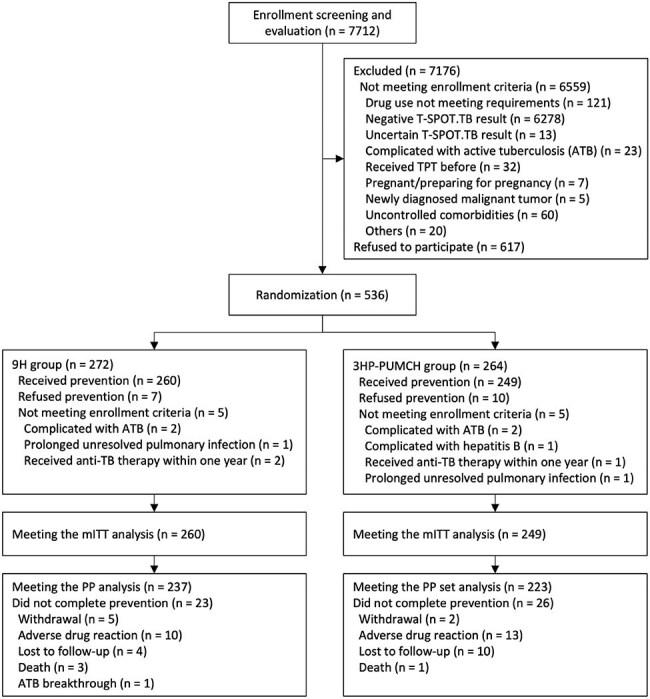 Figure 1
 Figure 2
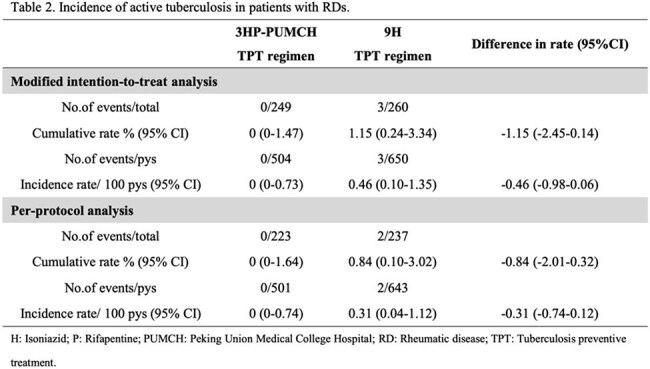 Figure 3
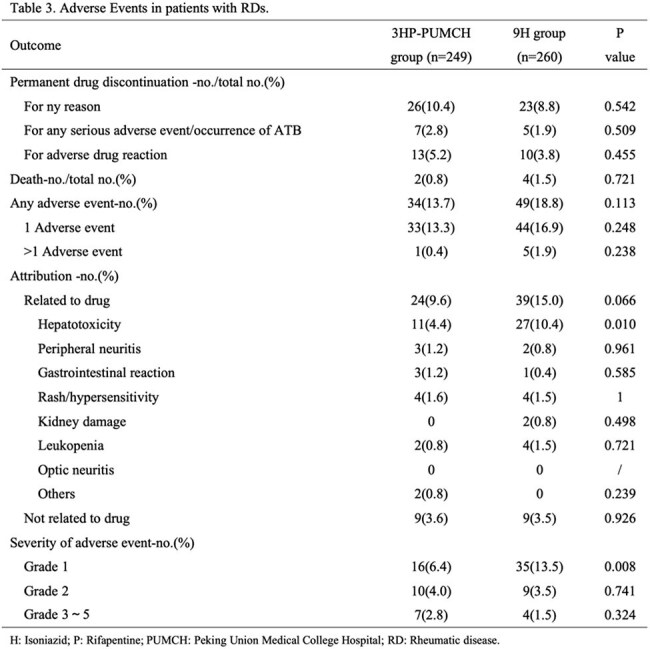 Figure 4
Peer Reviews
No public reviews on file for this paper yet. If you reviewed it on a platform where reviews are public (OpenReview, ICLR, NeurIPS, ICML), you can paste yours below so the community can read it here.
Videos
No videos yet. Explain this paper in a talk, walkthrough, or lecture? Add one.
Taxonomy
TopicsTuberculosis Research and Epidemiology · Infectious Diseases and Tuberculosis · Mycobacterium research and diagnosis