P-1390. Accuracy of computer-aided detection of chest x-rays for pulmonary tuberculosis among adults with Xpert Ultra trace-positive sputum
Joowhan Sung, Annet Nalutaaya, Ronit Dalmat, Caitlin Visek, Mariam Nantale, James Mukiibi, Patrick Biché, Gabrielle Stein, Achilles Katamba, Douglas Wilson, Paul K Drain, Emily A Kendall

TL;DR
This study evaluates how well AI-based chest X-ray analysis helps diagnose tuberculosis in patients with weakly positive sputum tests, finding it has moderate accuracy but limitations.
Contribution
The study provides new evidence on the diagnostic accuracy of AI-based chest X-ray analysis for TB in patients with trace-positive sputum results.
Findings
CAD had an AUC of 0.65 for diagnosing TB using both composite and bacteriologically confirmed definitions.
An X-ray score threshold of 0.5 had 66% sensitivity and 54% specificity for bacteriologically confirmed TB.
CAD performance was higher among patients without prior TB treatment or HIV infection.
Abstract
The clinical significance of low-level positive results from molecular testing of sputum for tuberculosis (TB) remains uncertain, and additional diagnostic testing, such as chest X-ray, might help to guide patient care. In high-TB-burden settings, where radiologists are often unavailable, artificial intelligence-based computer-aided detection (CAD) may be used to analyze chest X-rays, but its accuracy in this context remains unclear.Table 1.TB status determination at three months among outpatients with Xpert Ultra trace-positive sputum – overall and by X-ray score category and/or clinical risk subgroup, using two definitions of TB based on treatment decision with or without bacteriological confirmation.Figure 1.Receiver operating characteristic curves showing the performance of computer-aided detection software (qXR v4) on a baseline X-ray, for classifying bacteriologically confirmed…
Genes, proteins, chemicals, diseases, species, mutations and cell lines named across the full text — each resolved to its canonical identifier and authoritative record.
Click any figure to enlarge with its caption.
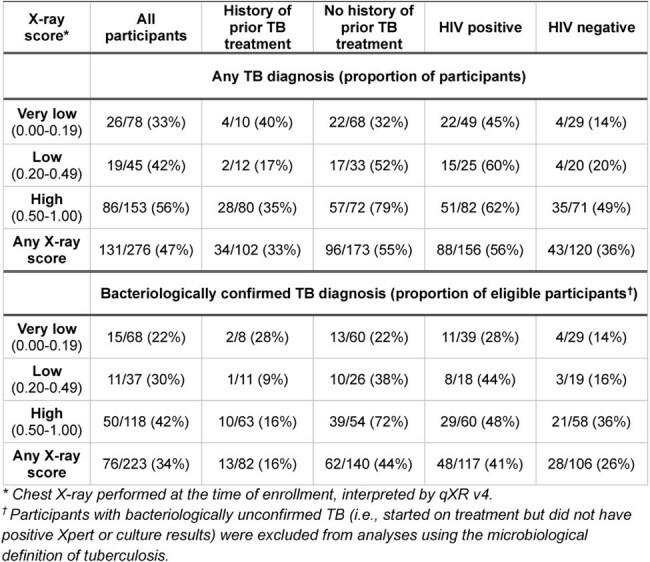 Figure 1
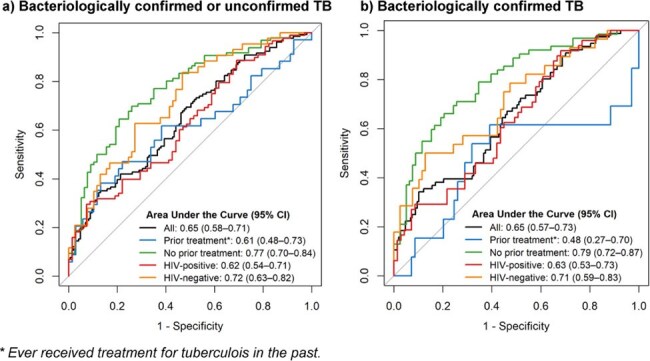 Figure 2
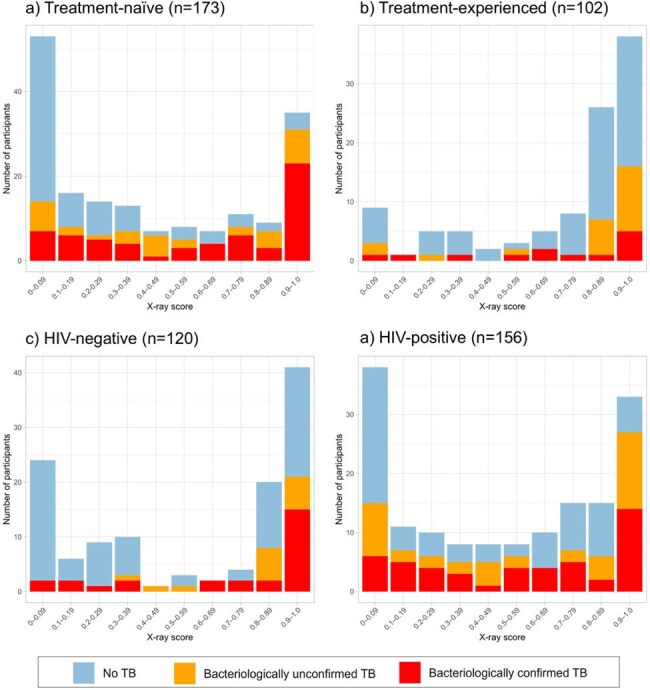 Figure 3
Peer Reviews
No public reviews on file for this paper yet. If you reviewed it on a platform where reviews are public (OpenReview, ICLR, NeurIPS, ICML), you can paste yours below so the community can read it here.
Videos
No videos yet. Explain this paper in a talk, walkthrough, or lecture? Add one.
Taxonomy
TopicsCOVID-19 diagnosis using AI · Image Processing Techniques and Applications · Radiomics and Machine Learning in Medical Imaging