P-48. How Many Lumens Should Be Cultured? Evaluating the Yield of Culturing All Lumens in Febrile Neutropenic Children with Cancer
M U A Y A D ALALI

TL;DR
This study evaluates how many central venous catheter lumens need to be cultured to avoid missing bloodstream infections in children with cancer and fever.
Contribution
Quantifies the risk of missing infections when not culturing all lumens in multi-lumen catheters during febrile neutropenia.
Findings
Culturing one fewer lumen misses 21% of infections in double-lumen catheters.
Excluding two lumens misses 47% of infections in quadruple-lumen catheters.
Missed diagnoses increase significantly with fewer lumens cultured.
Abstract
Culturing all central venous catheter (CVC) lumens is standard in pediatric febrile neutropenia (FN) to optimize catheter-related bloodstream infection (CRBSI) diagnosis. However, this approach increases blood volume use and bottle requirements, raising concerns during shortages like in 2024. Data on the risk of missed CRBSI diagnoses when not all lumens are cultured are limitedTable:Number and Percentage of Missed Episodes Number and Percentage of Missed Episodes This single-center, retrospective study at Riley Hospital for Children (2016–2023) evaluated febrile neutropenia (FN) episodes to determine the proportion of catheter-related bloodstream infections (CRBSI) missed when not culturing all lumens of multi-lumen catheters. Only microbiologically proven CRBSI episodes with simultaneous cultures from all lumens were included. Analysis focused on double-, triple-, and…
Click any figure to enlarge with its caption.
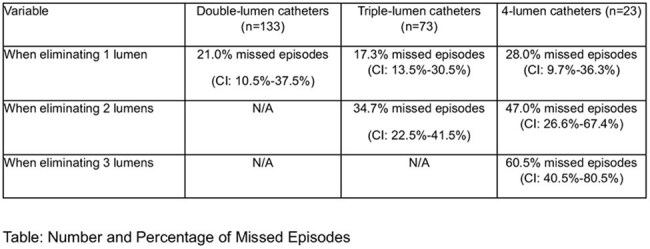 Figure 1
Peer Reviews
No public reviews on file for this paper yet. If you reviewed it on a platform where reviews are public (OpenReview, ICLR, NeurIPS, ICML), you can paste yours below so the community can read it here.
Videos
No videos yet. Explain this paper in a talk, walkthrough, or lecture? Add one.
Taxonomy
TopicsNeutropenia and Cancer Infections · Bacterial Identification and Susceptibility Testing · Neonatal and Maternal Infections