P-623. Development and clinical evaluation of a rapid diagnostic tool for point-of-need detection of Nipah virus
Mohammad Enayet Hossain, Akash Saha, Prakash Ghosh, Arianna Ceruti, Jenifar Quaiyum Ami, Subyeta Binte Sarwar, Wasik Rahman Aquib, Tahmina Shirin, Christina Spiropoulou, Joel M Montgomery, Syed Moinuddin Satter, Ahmed Abd El Wahed, Mohammed Ziaur Rahman

TL;DR
A new rapid diagnostic test for Nipah virus was developed and evaluated, offering fast and accurate detection in clinical settings.
Contribution
The study introduces a novel RT-RAA assay for rapid and field-deployable detection of Nipah virus with high sensitivity in acute cases.
Findings
The RT-RAA assay detected Nipah virus in 15 minutes at 42°C with a detection limit of 50 gene copies/reaction.
The assay showed 100% specificity and 61.4% overall sensitivity, with highest sensitivity in acute cases (100%).
The RT-RAA assay demonstrated 81.1% diagnostic accuracy and is suitable for use in resource-limited settings.
Abstract
Nipah virus (NiV) is a bat-borne, highly pathogenic, stage III emerging zoonotic virus, with more than 70% case fatality rate in Bangladesh. As no treatment or vaccine is available, the rapid diagnosis of suspected cases and specific control measures are imperative for the fast containment of the disease. Current diagnostic methods for NiV, including RT-qPCR and ELISA, are time-consuming and often inaccessible in resource-limited settings. Therefore, development of a fast, sensitive and field-deployable diagnostic tool has been a pressing demand. Diagnostic performance of RT-RAA assay Performance of RT-RAA assay compared to RT-qPCR in detecting NiV in clinical samples stratified by Ct value ranges. (A) Overall positivity rate of Nipah virus in 90 clinical samples as detected by RT-RAA and RT-qPCR assays. (B) Sensitivity of NiV RT-RAA assay in different cases. The chi-square test of…
Genes, proteins, chemicals, diseases, species, mutations and cell lines named across the full text — each resolved to its canonical identifier and authoritative record.
Click any figure to enlarge with its caption.
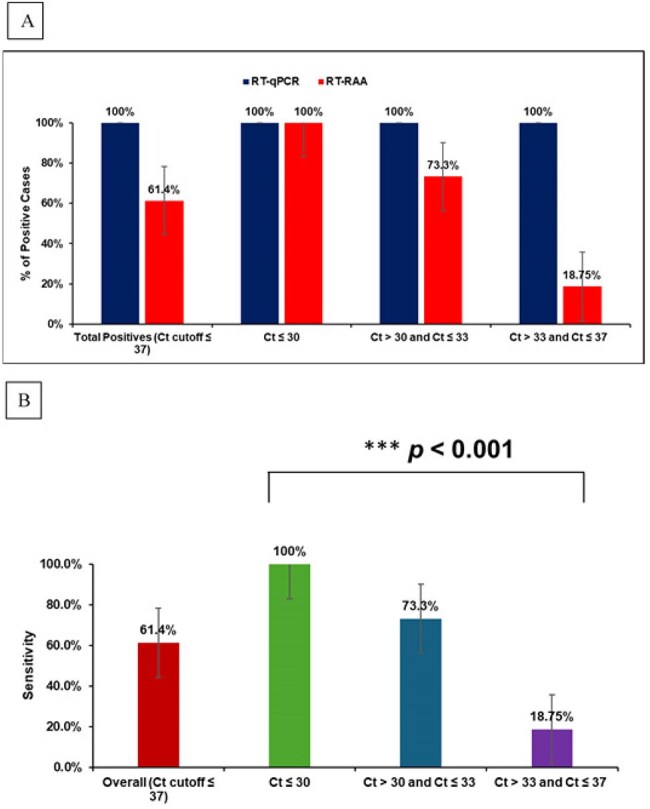 Figure 1
Peer Reviews
No public reviews on file for this paper yet. If you reviewed it on a platform where reviews are public (OpenReview, ICLR, NeurIPS, ICML), you can paste yours below so the community can read it here.
Videos
No videos yet. Explain this paper in a talk, walkthrough, or lecture? Add one.
Taxonomy
TopicsVirology and Viral Diseases · Mosquito-borne diseases and control · Biosensors and Analytical Detection