P-503. Perspectives of Community Health Workers on the Rise of Congenital Syphilis
John M Flores, Nikki Kasal, Alicia Dawdani, Caroline Montag, Declan Quinn, Josie Majowka, Kaitlyn Gomez, Lilly Cheng-Immergluck, John Schneider

TL;DR
Community health workers highlight key barriers like transportation and stigma that contribute to the rise of congenital syphilis, offering insights for targeted interventions.
Contribution
This study provides novel qualitative insights from community health workers on barriers to syphilis care, informing interventions to reduce congenital syphilis.
Findings
Transportation and patient understanding/knowledge were the most frequently cited barriers to syphilis care.
Stigma, mistrust in the medical system, and poor communication were also significant barriers identified by CHWs.
CHWs expressed interest in helping patients overcome barriers through education and improved communication with providers.
Abstract
Congenital syphilis (CS) incidence has been increasing for the past decade. Previous studies have identified various barriers associated with the entry, retention and linkage into care along the CS Prevention Cascade. In order to develop a targeted intervention to engage community health workers (CHWs) on the CS Prevention Cascade, we conducted a qualitative study to gather their perspective on factors associated with the rise of CS.Figure 1:Qualitative Themes of Community Health Worker Perspectives on the Congenital Syphilis Prevention Cascade*Table 1:Perceived barriers to care leading to acquisition of syphilis and other sexually transmitted infection among women of childbearing age, from the perspective of community health workers. Qualitative Themes of Community Health Worker Perspectives on the Congenital Syphilis Prevention Cascade* Perceived barriers to care leading to…
Genes, proteins, chemicals, diseases, species, mutations and cell lines named across the full text — each resolved to its canonical identifier and authoritative record.
Click any figure to enlarge with its caption.
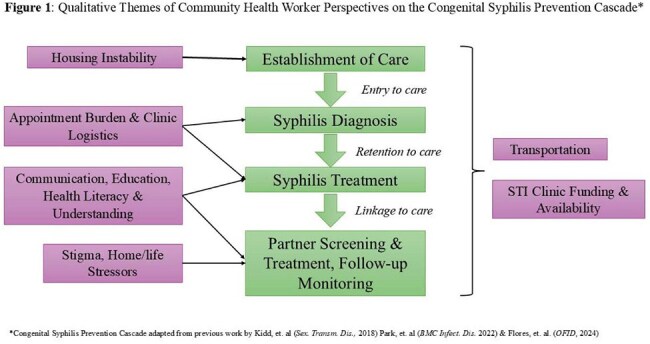 Figure 1
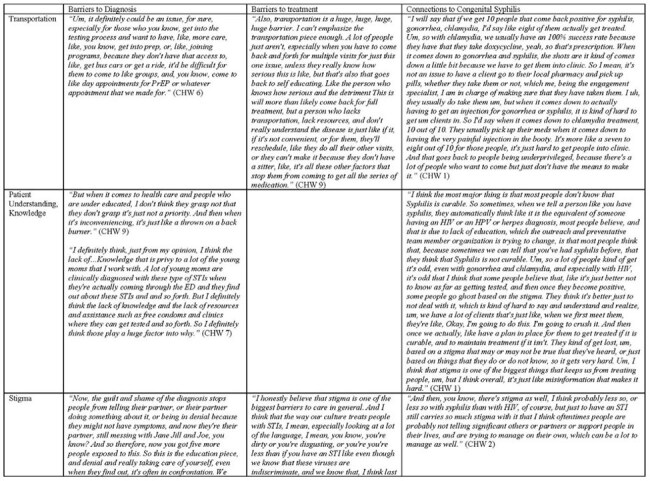 Figure 2
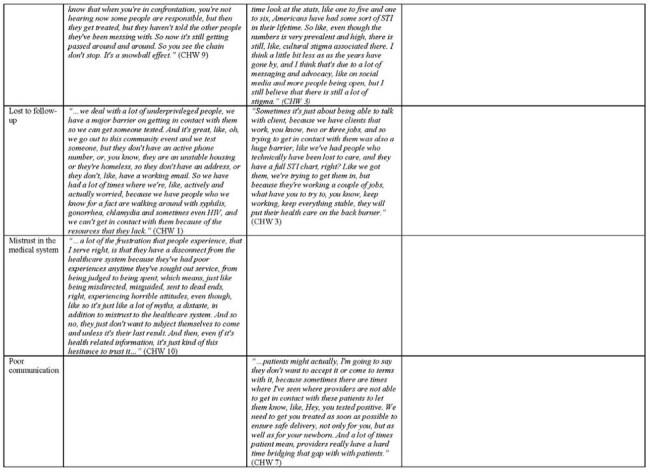 Figure 3
Peer Reviews
No public reviews on file for this paper yet. If you reviewed it on a platform where reviews are public (OpenReview, ICLR, NeurIPS, ICML), you can paste yours below so the community can read it here.
Videos
No videos yet. Explain this paper in a talk, walkthrough, or lecture? Add one.
Taxonomy
TopicsSyphilis Diagnosis and Treatment · Literature Analysis and Criticism · Body Image and Dysmorphia Studies