P-1353. Earlier Cefiderocol Use was Associated with Better Outcomes for Challenging Gram-Negative Bacterial Infections: US Results From the Global Observational PROVE Study
Cornelius J Clancy, Anne Lachiewicz, Stefano Verardi, Karan Gill, Anne Santerre Henriksen, Sean T Nguyen

TL;DR
Earlier use of cefiderocol in treating serious Gram-negative infections in the US was linked to better patient outcomes, especially when used before clinical decline.
Contribution
This study provides new evidence that earlier administration of cefiderocol improves clinical outcomes in patients with challenging Gram-negative infections.
Findings
Clinical cure rates were higher when cefiderocol was used empirically (73.7%) or for documented infections (72.3%) compared to salvage therapy (54.3%).
Patients with respiratory tract infections had a 64.7% clinical cure rate and a 25.7% 30-day mortality rate.
Cefiderocol was used in 33.1% of cases as combination therapy and for a median duration of 10 days.
Abstract
The PROVE study enrolled 508 patients in the USA with serious Gram-negative bacterial infections treated with cefiderocol in routine clinical practice. The clinical outcomes of this subset of patients were assessed. PROVE was an international, retrospective, observational medical chart review study (November 2020–July 2024). Data were analyzed from hospitalized US patients with confirmed Gram-negative bacterial infections, who received cefiderocol for the first time for ≥72 hours. Baseline demographics, clinical characteristics, cefiderocol use, clinical response, clinical cure, and all-cause mortality (ACM) were assessed. Median (interquartile range [IQR]) age of patients was 58 (44–67) years and 61.2% were men (Table 1). The three most frequent concomitant conditions were diabetes mellitus (36.0%), chronic pulmonary disease (25.0%), and sepsis/septic shock (23.2%). Cefiderocol was…
Genes, proteins, chemicals, diseases, species, mutations and cell lines named across the full text — each resolved to its canonical identifier and authoritative record.
Click any figure to enlarge with its caption.
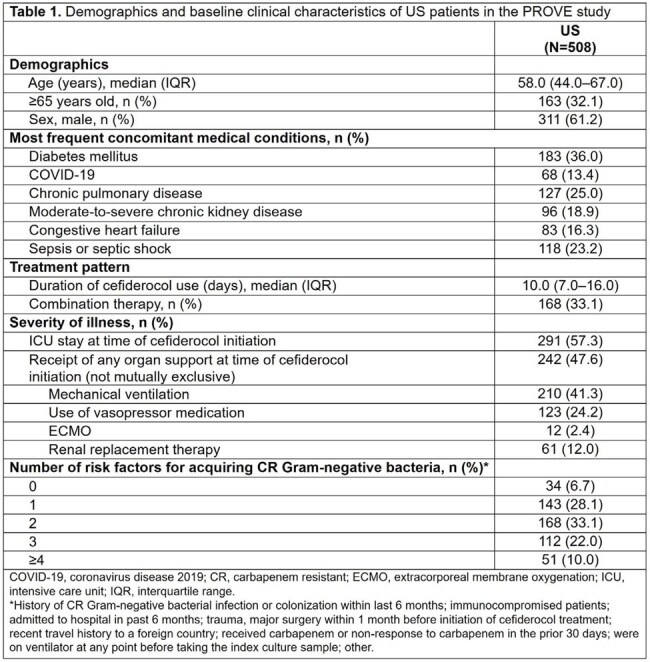 Figure 1
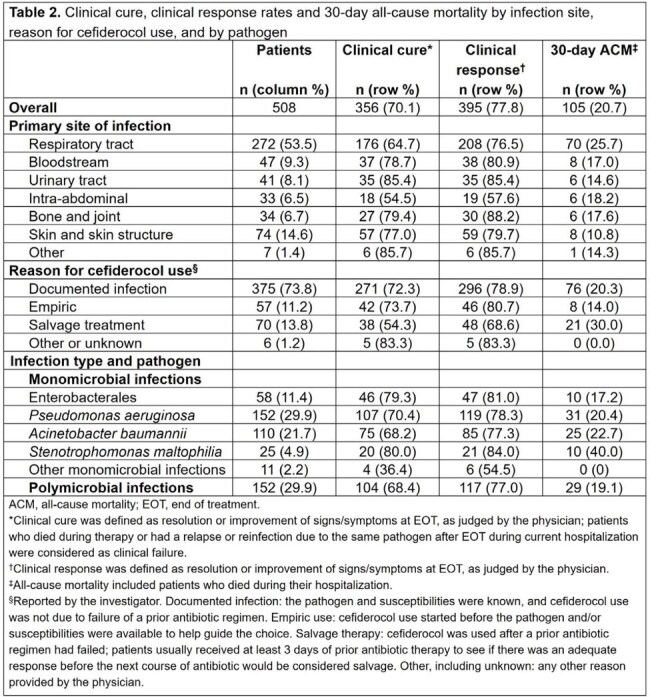 Figure 2
Peer Reviews
No public reviews on file for this paper yet. If you reviewed it on a platform where reviews are public (OpenReview, ICLR, NeurIPS, ICML), you can paste yours below so the community can read it here.
Videos
No videos yet. Explain this paper in a talk, walkthrough, or lecture? Add one.
Taxonomy
TopicsNosocomial Infections in ICU · Antibiotic Resistance in Bacteria · Antibiotics Pharmacokinetics and Efficacy