682. Impact of Antibiotic Time-Out Rounds on Academic Internal Medicine Services
Bradley Lauver, Caroline E Dillon, Jamie Hood, Alejandra Perez-Chapman, Stanley I Martin, Lauren DiMarino

TL;DR
This study shows that implementing Antibiotic Time-Out Rounds in academic internal medicine services improves antibiotic use and resident education.
Contribution
The study introduces and evaluates the impact of Antibiotic Time-Out Rounds in academic internal medicine services.
Findings
83.2% of antimicrobial recommendations were implemented within 48 hours.
ATO reduced the use of high CDI risk antibiotics and increased narrow-spectrum β-lactam use.
Residents showed improved antimicrobial prescribing practices over time.
Abstract
Research indicates various antimicrobial stewardship (ASP) strategies have been effective within medical residency programs1,2. Involving internal medicine (IM) residents in ASP is essential for optimizing antibiotics, reducing resistance, and improving patient outcomes. We introduced Antibiotic Time-Out (ATO) in our academic IM service to promote clinical outcomes and positively influence prescribing habits. Table 1Figure 1:De-Escalate/Escalate Intervention Over Time De-Escalate/Escalate Intervention Over Time The ATO initiative (May 2023-May 2024) aimed to discuss all patients on antimicrobials not already followed by the Infectious Disease (ID) consult service. Patients were presented to an ID physician and pharmacist, who made recommendations such as clarifying diagnoses, performing additional workup, changing antibiotics, adjusting the route or duration, or obtaining formal ID…
Click any figure to enlarge with its caption.
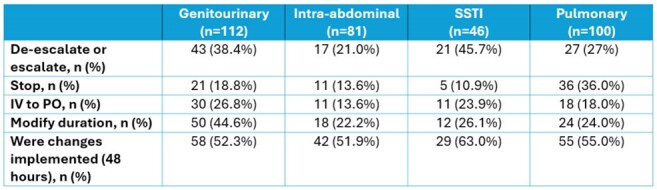 Figure 1
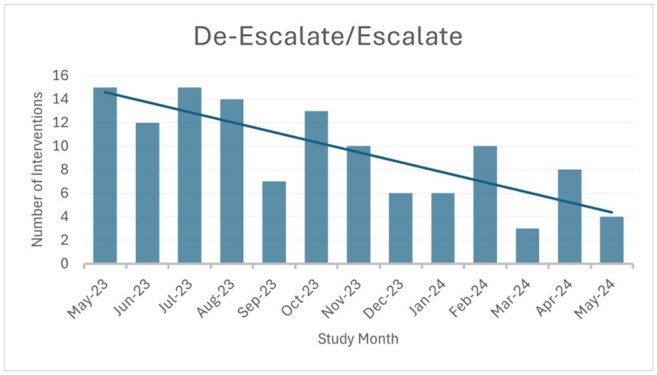 Figure 2
 Figure 3
 Figure 4
Peer Reviews
No public reviews on file for this paper yet. If you reviewed it on a platform where reviews are public (OpenReview, ICLR, NeurIPS, ICML), you can paste yours below so the community can read it here.
Videos
No videos yet. Explain this paper in a talk, walkthrough, or lecture? Add one.
Taxonomy
TopicsAntibiotic Use and Resistance · Bacterial Identification and Susceptibility Testing · Infection Control in Healthcare