P-432. Genotypic Characteristics of Emerging Non-vaccine Serotypes: A Report from Prospective Hospital-based Surveillance for Pediatric Invasive Pneumococcal Diseases in South Korea, 2016-2023
Dayun Kang, Hyun Mi Kang, Dong Hyun Kim, Nam Hee Kim, Yae-Jean Kim, Yun-Kyung Kim, Chun Soo Kim, Han Wool Kim, Su Eun Park, Eun Song Song, Jong Gyun Ahn, Byung Wook Eun, Joon Kee Lee, Jina Lee, Taekjin Lee, Hyunju Lee, Dae Sun Jo, Eun Young Cho, Hye-Kyung Cho, Jae Hong Choi

TL;DR
This study tracks changes in pneumococcal strains in children in South Korea, showing shifts in disease-causing types after vaccine introduction and during the pandemic.
Contribution
The study identifies emerging non-vaccine serotypes and their genotypes in pediatric invasive pneumococcal disease in South Korea.
Findings
Serotype 23B increased significantly during the post-COVID-19 period.
CC166 and CC81 are now dominant clonal complexes in pediatric IPD cases.
Emerging serotypes like 23B and 6C are linked to specific sequence types.
Abstract
In South Korea, the 10-valent and 13-valent pneumococcal conjugate vaccines (PCVs) have been part of the national immunization program since 2014, and 15-valent was recently introduced in 2024. To understand the current dynamics of pneumococcal serotype distribution in South Korea, we investigated the genotypes of Streptococcus pneumoniae isolates from pediatric invasive pneumococcal disease (IPD).eBURST diagram of multilocus sequence typing from invasive pneumococcal isolates, from 2016 to 2023 eBURST diagram of multilocus sequence typing from invasive pneumococcal isolates, from 2016 to 2023 IPD cases from children under 19 years of age were collected through a prospective hospital-based surveillance at 20 hospitals between 2016 and 2023 in South Korea. Serotypes were determined using the Quellung reaction. Genotypes were determined by MLST. Alleles and sequence types were submitted…
Genes, proteins, chemicals, diseases, species, mutations and cell lines named across the full text — each resolved to its canonical identifier and authoritative record.
Click any figure to enlarge with its caption.
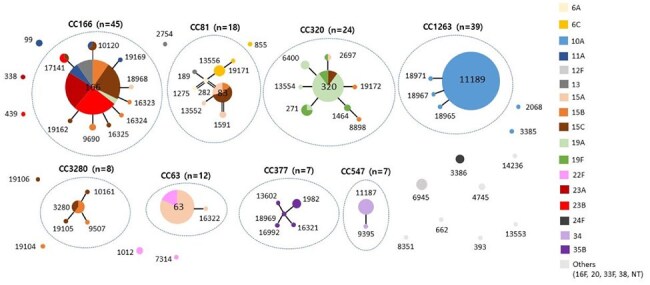 Figure 1
Peer Reviews
No public reviews on file for this paper yet. If you reviewed it on a platform where reviews are public (OpenReview, ICLR, NeurIPS, ICML), you can paste yours below so the community can read it here.
Videos
No videos yet. Explain this paper in a talk, walkthrough, or lecture? Add one.
Taxonomy
TopicsPneumonia and Respiratory Infections · Respiratory viral infections research · Bacterial Infections and Vaccines