79. Shotgun Metagenomics Reveals Microbial Ecological Features Driving Fecal Microbiota Transplantation Success in Carbapenem-Resistant Enterobacteriaceae Carriers
Imchang Lee, Ki Tae Suk, Bong-Soo Kim, Seung Soon Lee

TL;DR
This study finds that the success of fecal microbiota transplantation in clearing antibiotic-resistant bacteria depends on the recipient's initial gut microbes and how well their microbiome aligns with the donor's after treatment.
Contribution
The study identifies pre-FMT microbial features and post-FMT dynamics that predict success in CRE decolonization through shotgun metagenomics.
Findings
Responders showed sustained CRE reduction, increased Actinomycetota and Bacteroidota, and improved alpha diversity.
Post-FMT exposure to antibiotics and PPIs was linked to decolonization failure.
Microbiome alignment with donor profiles and presence of nutrient competitors correlated with successful FMT outcomes.
Abstract
Fecal microbiota transplantation (FMT) is a promising intervention for decolonizing carbapenem-resistant Enterobacteriaceae (CRE); however, predictors of success remain poorly understood. We aimed to identify pre-FMT microbial ecological features, and post-FMT microbiome dynamics associated with FMT efficacy using shotgun metagenomic sequencing. FMT was performed in 21 patients colonized with CRE, using stool from 13 rigorously screened healthy donors. Longitudinal stool samples, collected from pre-FMT through 5 weeks post-FMT, underwent shotgun metagenomic sequencing. Patients were classified as responders (n = 9) or non-responders (n = 12) based on CRE clearance. We assessed taxonomic composition (phylum to species level), alpha diversity, dysbiosis scores, and donor–recipient similarity. Clinical metadata, including post-FMT exposure to antibiotics and non-antibiotic drugs (e.g.,…
Genes, proteins, chemicals, diseases, species, mutations and cell lines named across the full text — each resolved to its canonical identifier and authoritative record.
Click any figure to enlarge with its caption.
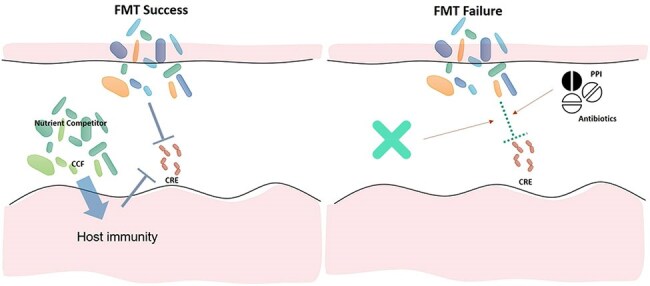 Figure 1
Peer Reviews
No public reviews on file for this paper yet. If you reviewed it on a platform where reviews are public (OpenReview, ICLR, NeurIPS, ICML), you can paste yours below so the community can read it here.
Videos
No videos yet. Explain this paper in a talk, walkthrough, or lecture? Add one.
Taxonomy
TopicsClostridium difficile and Clostridium perfringens research · Antibiotic Resistance in Bacteria · Gut microbiota and health