P-729. Limit of Detection and Inclusivity of a Research-Use-Only (RUO) Prototype of a Multiplexed Sample-to-Answer Diagnostic System for Identification of Sexually Transmitted Infections from Vaginal Swabs and Penile Urine
Kerrin Koch, Marta Mangifesta, Caitlin Castañeda, Lorin Brookes, Cameron Hill, Jeremiah Antosch, Sarah Gross, Ray Kirby Jennings, Jenifer Einstein, Tanner Robinson, Justin Keener, Usha Spaulding, Margarita Rogatcheva

TL;DR
This study evaluates a new diagnostic test for sexually transmitted infections, showing it can detect low levels of multiple pathogens from different sample types.
Contribution
The study presents the limit of detection and inclusivity data for a prototype STI diagnostic panel in a point-of-care setting.
Findings
The limit of detection varied from 0.28 to 275 genome copies per mL across pathogens.
The panel showed no reactivity limitations with 43 tested strains at near-LoD levels.
In silico analysis predicts >99.7% reactivity for three of the four pathogens.
Abstract
Untreated sexually transmitted infections adversely impact sexual health and reproductive outcomes. bioMérieux is developing the BIOFIRE® SPOTFIRE® Sexually Transmitted Infection (STI) Panel, a molecular test designed for a point-of-care setting to detect Chlamydia trachomatis, Mycoplasma genitalium, Neisseria gonorrhoeae, and Trichomonas vaginalis from vaginal swabs (Vswabs) or penile urine collected in eNAT® medium. This study evaluated the limit of detection (LoD) and inclusivity of the pathogen assays in a RUO panel prototype.Table 1.Limit of Detection and Inclusivity Assessment of the RUO BIOFIRE® SPOTFIRE® Sexually Transmitted Infection Panel Limit of Detection and Inclusivity Assessment of the RUO BIOFIRE® SPOTFIRE® Sexually Transmitted Infection Panel Serial dilutions of reference isolates, quantified to determine genome copies using droplet digital PCR assays targeting…
Genes, proteins, chemicals, diseases, species, mutations and cell lines named across the full text — each resolved to its canonical identifier and authoritative record.
Click any figure to enlarge with its caption.
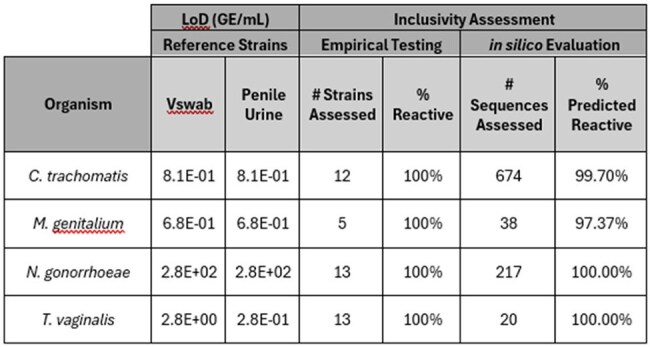 Figure 1
Peer Reviews
No public reviews on file for this paper yet. If you reviewed it on a platform where reviews are public (OpenReview, ICLR, NeurIPS, ICML), you can paste yours below so the community can read it here.
Videos
No videos yet. Explain this paper in a talk, walkthrough, or lecture? Add one.
Taxonomy
TopicsReproductive tract infections research · Bacterial Identification and Susceptibility Testing · Molecular Biology Techniques and Applications