P-1148. Patient Harm Events: Hospital-Onset Bacteremia vs CMS-Reportable Events
Heather Young, Carolyn Valdez, Timothy C Jenkins

TL;DR
This study compares a new hospital-onset bacteremia metric to traditional CMS metrics for identifying healthcare-associated infections and finds differences in event types and infection patterns.
Contribution
The study introduces a laboratory-reported hospital-onset bacteremia metric as a potential alternative to CMS-reportable events for identifying patient harm.
Findings
HOB-only events were more common than CMS-only or Overlap events.
Gram-negative and polymicrobial infections were more prevalent in the CMS-only group.
Switching to HOB would increase identified harm events but may reduce CAUTI and SSI cases.
Abstract
CMS requires hospitals to report rates of CLABSI, CAUTI, SSI after colon surgery and abdominal hysterectomy, hospital-onset MRSA bacteremia, and hospital-onset C. difficile infection (HO-CDI) to NHSN. With any process that requires manual adjudication, discrepancies in data accuracy exist. To identify patient harm and to maximize data accuracy, a laboratory-reported hospital-onset bacteremia (HOB) event has been proposed as an alternative to certain CMS-reportable events. The goal of this study is to compare the performance of the proposed HOB metric with traditional CMS metrics for the identification and prognosis of HAI.Table 1.Source of Infection and HAI Group Source of Infection and HAI Group This is a retrospective cohort study of patients hospitalized between 1/1/22 and 12/31/23 at a 500-bed academic safety net hospital in Denver, CO. Patients >18 years old with a positive…
Click any figure to enlarge with its caption.
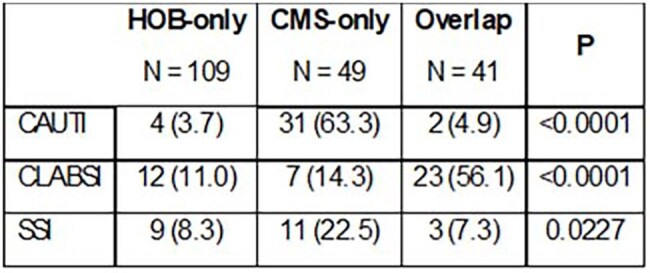 Figure 1
Peer Reviews
No public reviews on file for this paper yet. If you reviewed it on a platform where reviews are public (OpenReview, ICLR, NeurIPS, ICML), you can paste yours below so the community can read it here.
Videos
No videos yet. Explain this paper in a talk, walkthrough, or lecture? Add one.
Taxonomy
TopicsSepsis Diagnosis and Treatment · Urinary Tract Infections Management · Clostridium difficile and Clostridium perfringens research