P-344. Modeling Confirms Islatravir 0.25 mg Administered Daily Has No Adverse Effect on Total Lymphocyte or CD4+ T-cell Counts in People Living with HIV
Brian M Maas, Bill Poland, Michelle M Pham, Martin Johnson, Irene Bae, Seth H Robey, Bhargava Kandala, Xiaowei Zang, Stephanie O Klopfer, Michelle C Fox, Ryan C Vargo

TL;DR
This study confirms that a daily 0.25 mg dose of islatravir does not harm lymphocyte or CD4+ T-cell counts in HIV patients, based on updated modeling and clinical data.
Contribution
The study provides updated pharmacokinetic-pharmacodynamic models confirming the safety of islatravir 0.25 mg in HIV treatment.
Findings
PK-PD models accurately described TLC and CD4 changes across evaluated doses.
ISL 0.25 mg QD is predicted to cause CD4 changes similar to standard ART.
No CD4 reductions expected even at 1.8-fold higher ISL exposure.
Abstract
Islatravir (ISL) is an investigational nucleoside reverse transcriptase translocation inhibitor being evaluated in combination regimens for the treatment of HIV-1. Exposure-dependent decreases in total lymphocytes count (TLC) and CD4+ T-cells (CD4s) were previously observed in clinical development. Pharmacokinetic-pharmacodynamic (PK-PD) models predicted no changes in TLC or CD4s with ISL 0.25 mg once daily (QD), leading to reinitiation of the Phase 3 program with doravirine (DOR). The objectives of this work were to 1) update the previous models with data from the oral DOR/ISL (100/0.25 mg) QD Phase 3 program in virologically suppressed participants, 2) predict TLC and CD4 changes at 48 weeks with ISL 0.25 mg, and 3) identify the ISL-triphosphate (ISL-TP) exposure associated with CD4 changes similar to those with approved antiretroviral therapy (ART). Figure PK-PD dynamics were…
Genes, proteins, chemicals, diseases, species, mutations and cell lines named across the full text — each resolved to its canonical identifier and authoritative record.
Click any figure to enlarge with its caption.
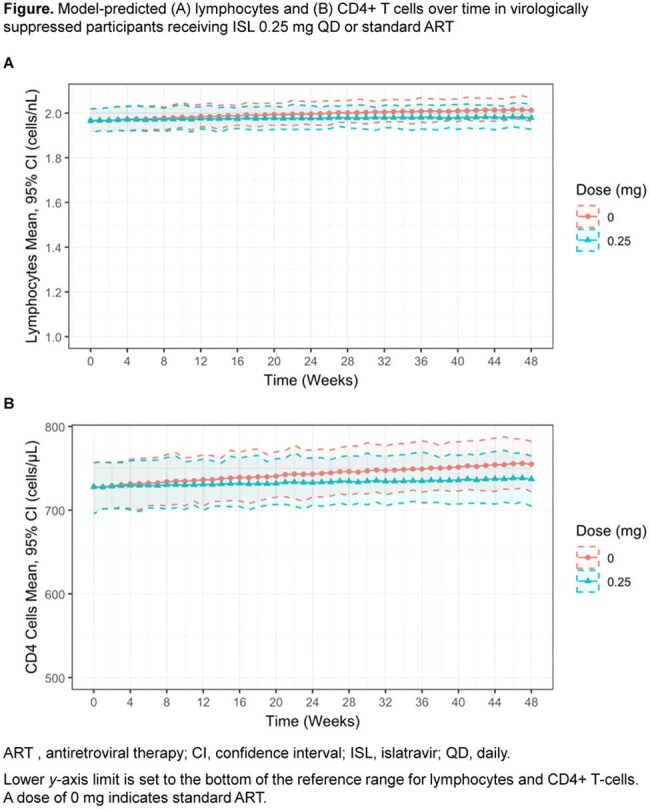 Figure 1
Peer Reviews
No public reviews on file for this paper yet. If you reviewed it on a platform where reviews are public (OpenReview, ICLR, NeurIPS, ICML), you can paste yours below so the community can read it here.
Videos
No videos yet. Explain this paper in a talk, walkthrough, or lecture? Add one.
Taxonomy
TopicsHIV/AIDS drug development and treatment · HIV Research and Treatment · HIV-related health complications and treatments