P-1442. Bivalent RSV Prefusion F-Based Subunit Vaccine Recipients with Chronic Kidney Disease Achieved High Neutralizing Titers One Month After Vaccination
Venkatesh Nadar, Jose F Cardona, Daniel P Eiras, Natalia Castillo-Almeida, Farah Rahman, Tarek Mikati, Vishva Bangad, John Woodside, Hayley Wyper, Maria Maddalena Lino, Elliot N DeHaan, Michael Patton, Kumar Ilangovan, Elena Kalinina, David Cooper, David Radley, Kena A Swanson

TL;DR
A bivalent RSV vaccine was found to produce strong immune responses in people with chronic kidney disease, including those on dialysis.
Contribution
This study demonstrates that RSVpreF vaccine induces high neutralizing antibody levels in CKD patients, including those with end-stage renal disease.
Findings
RSVpreF recipients with CKD had GMTs of 27,875 for RSV A and 36,607 for RSV B, significantly higher than placebo recipients.
Neutralizing titers in CKD patients were comparable to those in a control group without CKD.
No safety concerns were identified in the CKD group receiving RSVpreF.
Abstract
Chronic kidney disease (CKD) is associated with a higher incidence of severe respiratory syncytial virus (RSV) disease leading to hospitalizations, making individuals with CKD particularly vulnerable. Pfizer’s bivalent RSV prefusion F-based subunit vaccine (RSVpreF) has been approved in the United States for the prevention of lower respiratory tract disease (LRTD) caused by RSV in individuals aged 60 years and older, as well as in adults 18 to 59 who are at increased risk for RSV associated-LRTD. The immunogenicity of RSVpreF has been evaluated in healthy adults or those with chronic stable disease aged 60 years and older in the pivotal RENOIR C3671013 efficacy study, as well as in high-risk or renally-impaired adults aged 18 years and older in the MONeT C3671023 study. This analysis aims to evaluate the safety and immunologic response of RSVpreF vaccination in a subset of participants…
Genes, proteins, chemicals, diseases, species, mutations and cell lines named across the full text — each resolved to its canonical identifier and authoritative record.
Click any figure to enlarge with its caption.
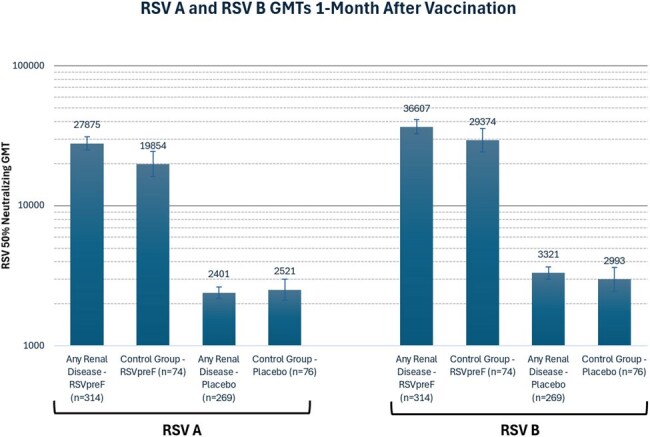 Figure 1
 Figure 2
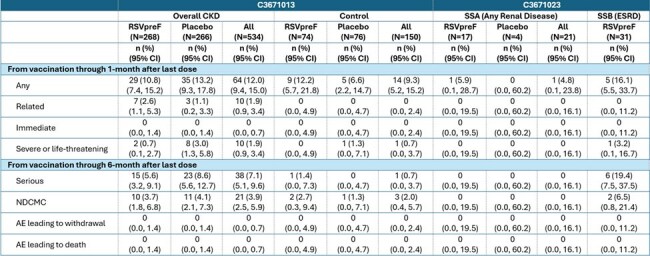 Figure 3
Peer Reviews
No public reviews on file for this paper yet. If you reviewed it on a platform where reviews are public (OpenReview, ICLR, NeurIPS, ICML), you can paste yours below so the community can read it here.
Videos
No videos yet. Explain this paper in a talk, walkthrough, or lecture? Add one.
Taxonomy
TopicsRespiratory viral infections research · SARS-CoV-2 and COVID-19 Research · Intravenous Infusion Technology and Safety