P-111. Safety, Pharmacokinetics, Pharmacodynamics and Immunogenicity of Siltartoxatug, A First-in-Class Anti-Tetanus Monoclonal Antibody: Results of Two Phase I Trials in Australian and Chinese Healthy Adults
Xinyu Liu, Xiaohu Kuang, Charlotte Lemech, Zhigang Liu, Jiyuan Ding, Xia Zhou, Xiaoyi Liu, Yueming Wang, Huaxin Liao, Wanmei wang

TL;DR
A new monoclonal antibody, siltartoxatug, was tested in healthy adults and shown to be safe and effective in providing long-lasting protection against tetanus.
Contribution
Siltartoxatug is a first-in-class monoclonal antibody for tetanus prophylaxis with demonstrated safety and efficacy in Phase I trials.
Findings
Siltartoxatug showed a favorable safety profile with no serious adverse events.
Antibody titers reached protective levels quickly and remained above threshold for over 100 days in most participants.
Pharmacokinetics were consistent across Australian and Chinese populations with no significant ethnic differences.
Abstract
Passive immunization is recommended for tetanus prophylaxis after tetanus-prone wounds in individuals with incomplete or uncertain vaccination history. Although human tetanus immunoglobulin is standard, global supply shortages have constrained its availability. Equine tetanus antitoxin, while available in some regions, carries substantial risks of hypersensitivity reactions and has been withdrawn from developed countries. Siltartoxatug, a first-in-class monoclonal antibody targeting tetanus toxin, was developed to address these limitations as a novel passive immunizing agent. We present Phase I results from two clinical trials conducted in healthy adults in Australia (N=32) and China (N=28). Both were randomized, double-blind, placebo-controlled, dose-escalation trials, with dosing ranges of 10–250 μg/kg in Australian trial and 35–250 μg/kg in Chinese trial. Participants in each cohort…
Genes, proteins, chemicals, diseases, species, mutations and cell lines named across the full text — each resolved to its canonical identifier and authoritative record.
Click any figure to enlarge with its caption.
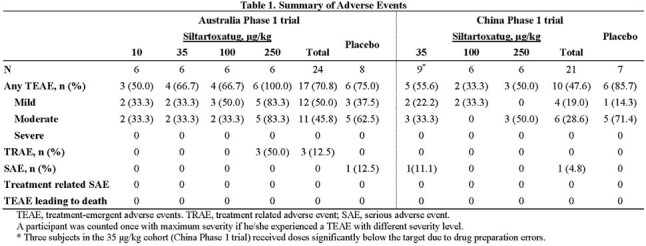 Figure 1
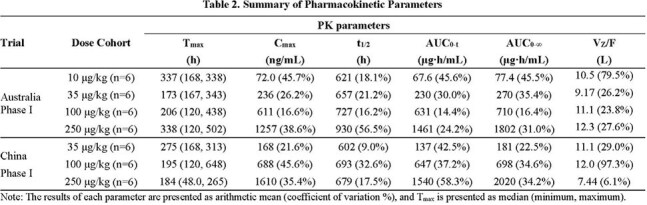 Figure 2
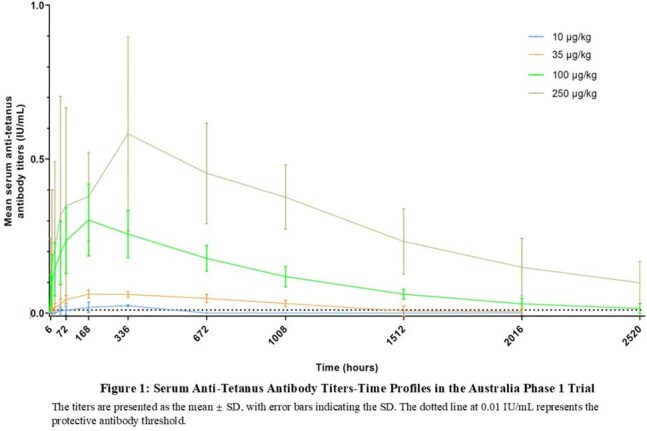 Figure 3
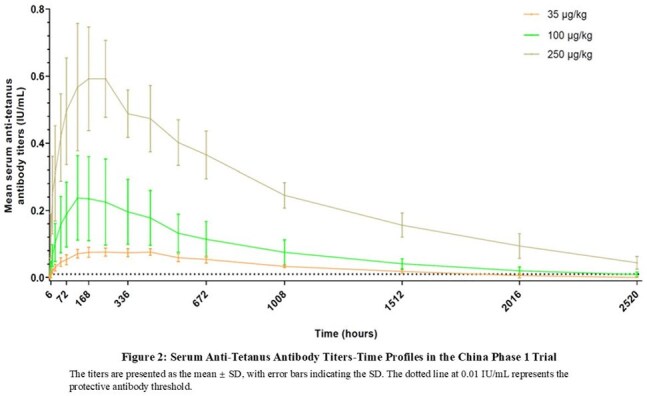 Figure 4
Peer Reviews
No public reviews on file for this paper yet. If you reviewed it on a platform where reviews are public (OpenReview, ICLR, NeurIPS, ICML), you can paste yours below so the community can read it here.
Videos
No videos yet. Explain this paper in a talk, walkthrough, or lecture? Add one.
Taxonomy
TopicsDiphtheria, Corynebacterium, and Tetanus · Botulinum Toxin and Related Neurological Disorders · Intramuscular injections and effects