P-652. Development of a Severity Scoring System for Mycoplasma pneumoniae Infection
Kristen Kelly, Lilly Cheng-Immergluck, Declan Quinn

TL;DR
This paper introduces a new severity scoring system for Mycoplasma pneumoniae infections, combining existing medical scores to better assess illness severity in children.
Contribution
A novel severity scoring system for Mycoplasma pneumoniae, integrating the Westley Croup Score and Phoenix Sepsis Criteria.
Findings
Mycoplasma pneumoniae infection rates have increased significantly in children over the past decade.
19 out of 82 infections (23%) resulted in hospitalization, with most severe cases occurring in 2024.
The proposed MPSS combines vital signs, respiratory distress, mental status, and lab findings to predict illness severity.
Abstract
Mycoplasma pneumoniae (MP) causes ∼2 million infections in the U.S.[1] with increasing rates reported globally in the past few years [2-4]. Rates in children have increased from 1% to 7.2% among age 2-4 and from 3.6% to 7.4% in those 5 -17yo [1]. In Illinois, MP rates are about 5.1%, which is higher than rates of RSV, Flu or Covid [3]. While MP usually presents as “walking pneumonia” in school-aged children, there have been increases in extrapulmonary manifestations. We propose a severity scoring system for MP based off of the Westley Croup Score (WCS) and Phoenix Sepsis Criteria (PSC). Both have assessments of neurologic status. The WCS assesses degrees of respiratory distress. The PSC assesses vitals and state of inflammation.Figure 1.The Mycoplasma Pneumoniae Severity Score (MPSS) The Mycoplasma Pneumoniae Severity Score (MPSS) The MPSS consists of components of the validated WSC…
Genes, proteins, chemicals, diseases, species, mutations and cell lines named across the full text — each resolved to its canonical identifier and authoritative record.
Click any figure to enlarge with its caption.
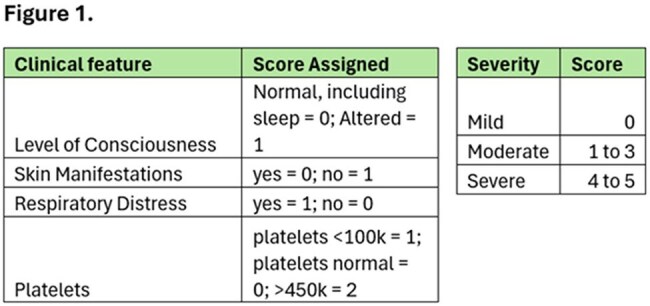 Figure 1
Peer Reviews
No public reviews on file for this paper yet. If you reviewed it on a platform where reviews are public (OpenReview, ICLR, NeurIPS, ICML), you can paste yours below so the community can read it here.
Videos
No videos yet. Explain this paper in a talk, walkthrough, or lecture? Add one.
Taxonomy
TopicsPneumonia and Respiratory Infections · Bacterial Infections and Vaccines · Microbial infections and disease research