P-1069. Patterns and Prevalence of Carbapenemase-Producing Organisms Identified in Nebraska Healthcare Facilities Following Whole Genome Sequencing (2019-2024)
Kathryn C Burbach, Ishrat Kamal-Ahmed, Muhammad Salman Ashraf, Amy Roden, Peter C Iwen, Lacey Pavlovsky, Juan M Teran Plasencia

TL;DR
This study used whole genome sequencing to better detect and understand carbapenem-resistant bacteria in Nebraska healthcare facilities from 2019 to 2024.
Contribution
The study demonstrates the improved detection of carbapenemase-producing organisms using whole genome sequencing compared to traditional methods.
Findings
Whole genome sequencing detected carbapenemase genes in 54.7% of 170 isolates.
E. coli and K. pneumoniae were the most common organisms identified among carbapenemase-producing isolates.
WGS identified 8 carbapenemase-producing organisms missed by the Carba-R test, mainly in Acinetobacter spp.
Abstract
Carbapenemase-producing organisms (CPOs) pose threats to public health, are associated with worse clinical outcomes and heightened risk for transmission. Whole Genome Sequencing (WGS) offers enhanced outbreak detection compared to traditional methods. We evaluate the use of WGS for the detection and characterization of CPOs in Nebraska.Detection of Carbapenemase-Producing Organisms (CPO) Among 170 Carbapenem-Resistant Isolates by Three Test Methods, Nebraska, 2019-2024 Detection of Carbapenemase-Producing Organisms (CPO) Among 170 Carbapenem-Resistant Isolates by Three Test Methods, Nebraska, 2019-2024 This is a retrospective review of clinical and screening isolates submitted to the Nebraska Public Health Laboratory (NPHL) from 2019-2024. Carbapenem-resistant Acinetobacter spp, Enterobacterales (minor exceptions), and Pseudomonas (cefepime resistant) along with other gram-negative…
Genes, proteins, chemicals, diseases, species, mutations and cell lines named across the full text — each resolved to its canonical identifier and authoritative record.
Click any figure to enlarge with its caption.
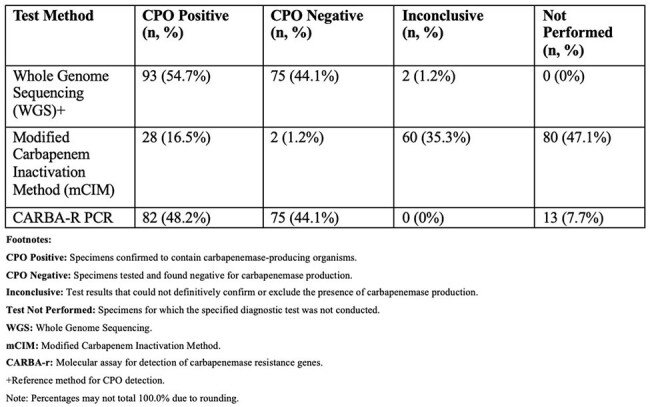 Figure 1
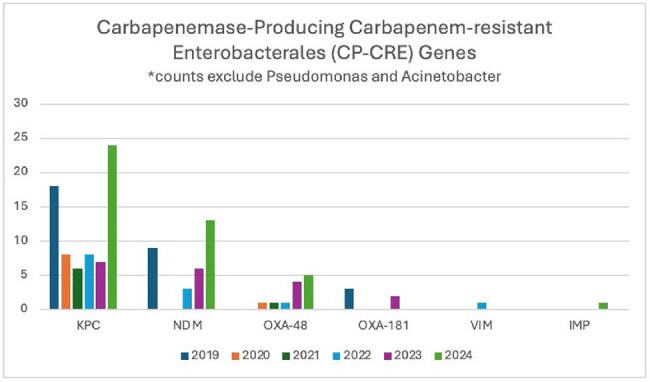 Figure 2
Peer Reviews
No public reviews on file for this paper yet. If you reviewed it on a platform where reviews are public (OpenReview, ICLR, NeurIPS, ICML), you can paste yours below so the community can read it here.
Videos
No videos yet. Explain this paper in a talk, walkthrough, or lecture? Add one.
Taxonomy
TopicsAntibiotic Resistance in Bacteria · Bacterial Identification and Susceptibility Testing · Antibiotic Use and Resistance