P-905. Applying Encounter-level Risk-Adjustment for Standardized Antimicrobial Administration Ratios (SAAR): Is it meaningful?
Rebekah W Moehring, Elizabeth Dodds Ashley, Rachel Addison, Whitney Buckel, Sara E Cosgrove, Eili Klein, Carlos Santos, Michael J Smith, Emily S Spivak, William Trick, David J Weber, Congwen Zhao, Deverick J Anderson, Ben Goldstein, Michael E Yarrington

TL;DR
This study examines how adjusting for patient-specific factors changes how hospitals assess antimicrobial use, finding that most antimicrobial stewardship teams prefer the new method.
Contribution
The study introduces encounter-level risk-adjusted standardized antimicrobial administration ratios (R-SAARs) and evaluates their impact on antimicrobial stewardship assessments.
Findings
Encounter-level risk adjustment changed antimicrobial stewardship program (ASP) assessments and perceptions of antimicrobial use.
Most ASPs preferred the newly derived R-SAARs over traditional SAARs.
R-SAARs provided tighter distributions for commonly used antimicrobial groups compared to traditional SAARs.
Abstract
Whether encounter-level risk-adjustment impacts antimicrobial stewardship program (ASP) assessments and perceptions of standardized antimicrobial administration ratio (SAAR) comparisons is unknown. This retrospective analysis included patient encounter-level data among 50 US hospitals participating in the CDC Epicenters collaborative, including 2022 antimicrobial use (AU), demographics, and diagnosis and procedure categories. We developed two-staged, xgboost machine learning models on 2020-2021 training sets for adult and pediatrics (aged 1-17) to produce expected days of therapy (DOT) for each NHSN antimicrobial group and each 2022 encounter. Observed and expected DOT were aggregated to create ratios (O:E), summarized as “robust” SAARs (R-SAARs) for hospital and unit. Methods and interpretation guidance were provided to ASPs in documents and recorded videos. Two hospital-specific…
Click any figure to enlarge with its caption.
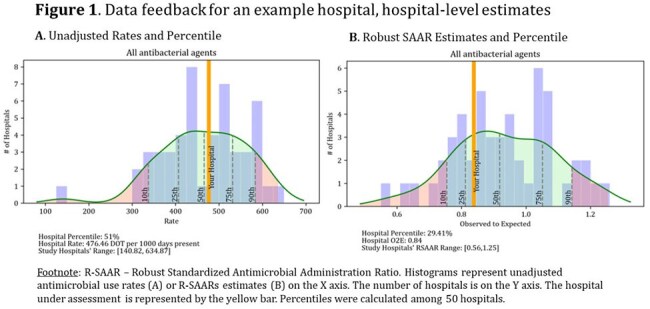 Figure 1
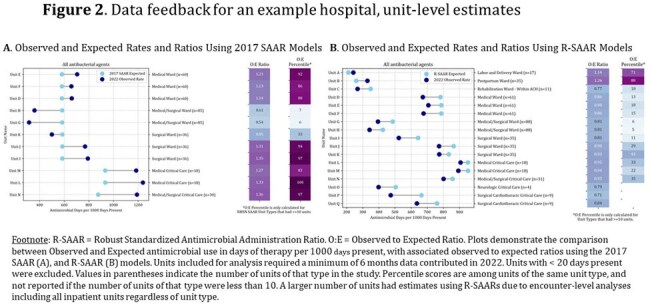 Figure 2
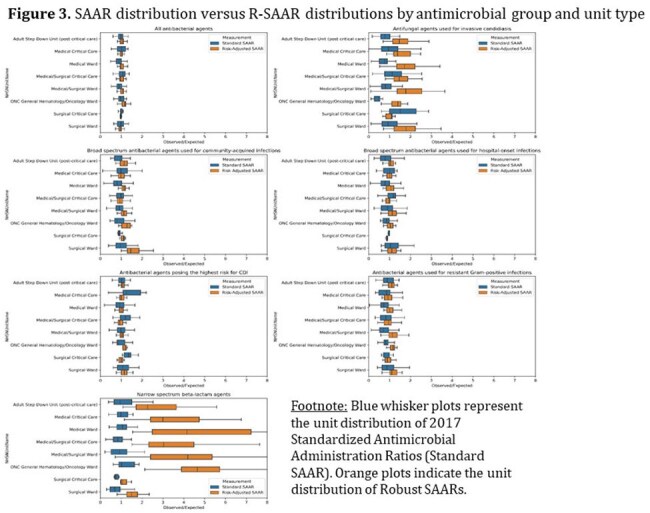 Figure 3
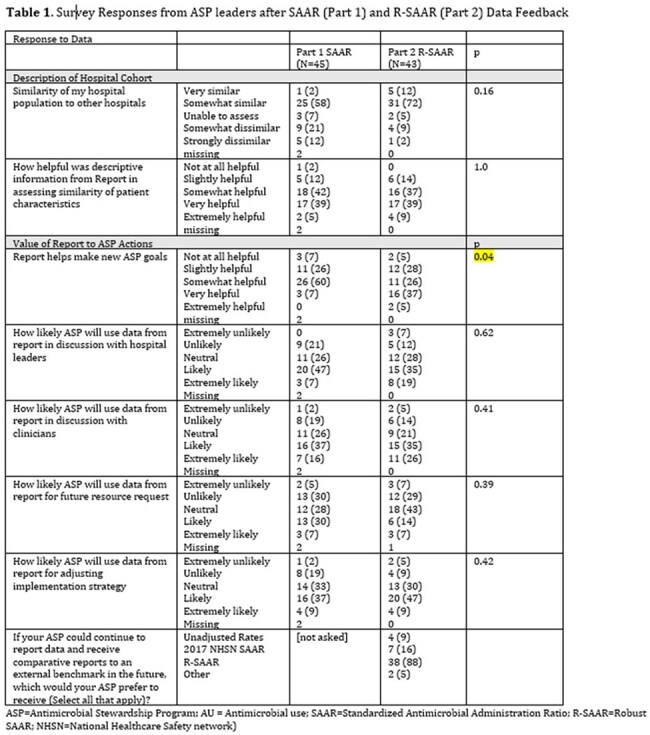 Figure 4
Peer Reviews
No public reviews on file for this paper yet. If you reviewed it on a platform where reviews are public (OpenReview, ICLR, NeurIPS, ICML), you can paste yours below so the community can read it here.
Videos
No videos yet. Explain this paper in a talk, walkthrough, or lecture? Add one.
Taxonomy
TopicsAntibiotic Use and Resistance · Neonatal and Maternal Infections · Sepsis Diagnosis and Treatment