P-1302. Klebsiella pneumoniae Phage Susceptibility Testing (PST): Comparison Between a Spot Plaque Assay and an Optical Density-Based Liquid Assay
Luz Cuello, Robin Patel

TL;DR
This study compares two methods for testing phage susceptibility in antibiotic-resistant Klebsiella pneumoniae to help standardize phage therapy approaches.
Contribution
The study evaluates the agreement between a plaque assay and a liquid assay for phage susceptibility testing using specific cutoff thresholds.
Findings
Using a 4-hour hold time cutoff in the liquid assay showed complete agreement with the plaque assay for three phages.
A 8-hour hold time cutoff in the liquid assay resulted in lower agreement with the plaque assay results.
The plaque assay classified more phage-bacteria combinations as susceptible compared to the liquid assay at the 8-hour cutoff.
Abstract
Phage therapy has gained increasing interest as an approach to treat antimicrobial- resistant bacterial infections. Standardized, reproducible PST methods are needed to rapidly identify active phages for potential clinical use. Here, PST of 24 clinical isolates of carbapenem-resistant K. pneumoniae (CR-Kp) to 6 K. pneumoniae phages (3 from KlebPhaCol and 3 from phage hunting) was assessed using a plaque assay (PA) and a liquid assay (LA), and results compared. Phage Susceptibility Testing: Agreement Between Plaque Assay and Liquid Assay For the PA, 2µL of 10−1-10−8 phage dilutions were spotted on bacterial laws of CR-Kp (double agar overlay), and plaques scored upon overnight incubation at 37°C [0 (no activity), 1+ (lysis from without), 2+ (concentration-dependent lysis), 3+ (clear plaques, small or medium size), 4+ (clear plaques of large size); scores ≥ 2+ were considered…
Genes, proteins, chemicals, diseases, species, mutations and cell lines named across the full text — each resolved to its canonical identifier and authoritative record.
Click any figure to enlarge with its caption.
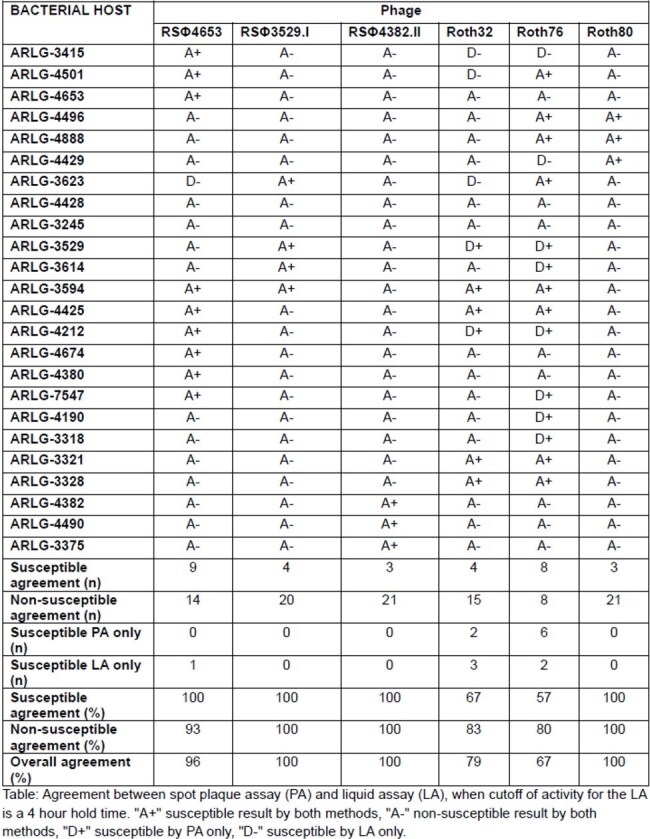 Figure 1
Peer Reviews
No public reviews on file for this paper yet. If you reviewed it on a platform where reviews are public (OpenReview, ICLR, NeurIPS, ICML), you can paste yours below so the community can read it here.
Videos
No videos yet. Explain this paper in a talk, walkthrough, or lecture? Add one.
Taxonomy
TopicsBacteriophages and microbial interactions · Antibiotic Resistance in Bacteria · Vibrio bacteria research studies