Plasma Ptau as a Biomarker of Structural Brain Health in the Community
Jeremy A. Tanner, Sophia Lu, Hugo J. Aparicio, Sara Doyle, Mitzi M. Gonzales, Jayandra Jung Himali, Tiffany F. Kautz, Terrie‐Jeanne Liu, Pauline Maillard, Emer McGrath, Jaime Ramos‐Cejudo, Claudia L Satizabal, Russell P. Tracy, Mohamad Habes, Suzanne E. Schindler

TL;DR
This study explores how plasma biomarkers like Ptau181, GFAP, and NfL relate to brain health in a general population, showing their links to neurodegeneration and vascular disease.
Contribution
The study is the first to evaluate plasma Ptau181's association with brain MRI features in a community-based population and how it modifies the effects of GFAP and NfL.
Findings
Elevated plasma Ptau181 is associated with AD-pattern cortical thickness and cortical atrophy.
GFAP shows stronger associations with brain atrophy in individuals with high Ptau181 and with white matter hyperintensities in those with low Ptau181.
NfL is linked to both neurodegeneration and vascular disease, with stronger effects in those with elevated Ptau181.
Abstract
Plasma ADRD biomarkers are emerging as accessible and cost‐effective diagnostic tools, but data on their relevance in the general population is needed prior to widespread use. Plasma Ptau shows potential for AD screening, yet its association with structural brain changes in community‐based populations remains unclear. Similarly, it is unclear if plasma NfL and GFAP more closely reflect vascular disease or neurodegeneration, and whether this differs in those with, versus without, AD. This study assesses:(1) the association between plasma Ptau181 and brain MRI outcomes and(2) whether elevated Ptau181 modifies the relationship between NfL, GFAP, and brain MRI features in the Framingham Heart Study(FHS), a flagship population‐based cohort. FHS Offspring and Omni 1 Cohort participants (Exam 9;2011‐2014) with available plasma biomarkers, brain MRI, and no confounding neurologic disorders…
Genes, proteins, chemicals, diseases, species, mutations and cell lines named across the full text — each resolved to its canonical identifier and authoritative record.
Click any figure to enlarge with its caption.
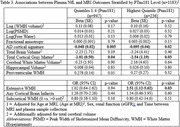 Figure 1
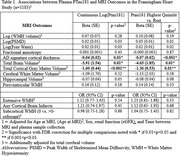 Figure 2
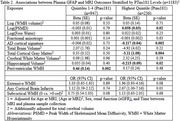 Figure 3
Peer Reviews
No public reviews on file for this paper yet. If you reviewed it on a platform where reviews are public (OpenReview, ICLR, NeurIPS, ICML), you can paste yours below so the community can read it here.
Videos
No videos yet. Explain this paper in a talk, walkthrough, or lecture? Add one.
Taxonomy
TopicsDementia and Cognitive Impairment Research · Functional Brain Connectivity Studies · Parkinson's Disease Mechanisms and Treatments