549. A Phase 2a Randomized, Double-Blind, Controlled Trial of the Efficacy and Safety of an Intravenous (IV) Bacteriophage Cocktail (AP-SA02) vs. Placebo in Combination with Best Available Antibiotic Therapy (BAT) in Patients with Complicated Staphylococcus aureus Bacteremia
Loren G Miller, Stacey Kolar, John Sanders, John Williamson, Paul R Allyn, Jihoon Baang, Paul F Riska, Saima Aslam, George J Alangaden, Jane Wainaina, Colleen S Kraft, Nirja Mehta, Deena Altman, Gary P Wang, Mehdi Mirsaeidi, D Alexander Perry, Jose A Vazquez, Lindsay Nicholson

TL;DR
A clinical trial found that an intravenous bacteriophage cocktail, when combined with standard antibiotics, improved cure rates and safety in patients with severe Staphylococcus aureus infections.
Contribution
This is the first phase 2a trial showing clinical efficacy of an IV bacteriophage cocktail in treating complicated S. aureus bacteremia.
Findings
AP-SA02 combined with antibiotics showed higher cure rates at Day 12 compared to placebo (88% vs. 58%).
No relapses were observed in the AP-SA02 group four weeks post-treatment, while 23-25% relapsed in the placebo group.
Patients receiving AP-SA02 had faster recovery markers, shorter ICU and hospital stays, and no serious adverse events.
Abstract
Complicated Staphylococcus aureus bacteremia (SAB) is a serious, common, and frequently lethal infection. Treatment options are complicated by resistance, drug intolerance, or relapse. Novel therapeutics are urgently needed. We performed a phase 2a randomized, double-blind, controlled trial of the efficacy and safety of an IV bacteriophage cocktail, AP-SA02, q6 hrs x 5 days vs. placebo (2:1 ratio) in combination with BAT in patients with complicated SAB. Clinical response (Table 1) was assessed in the intent-to-treat (ITT) population at Test of Cure (TOC) on Day 12, post-BAT, and End of Study (EOS) four weeks after BAT completion. Safety analysis included data from the Phase 1b trial (n=8). We enrolled 42 patients from 17 sites (95% US), with 29 randomized to AP-SA02 (A) and 13 to placebo (P). MRSA was the pathogen in 39% of the (A) and 44% (P) groups, respectively. Site of infection…
Genes, proteins, chemicals, diseases, species, mutations and cell lines named across the full text — each resolved to its canonical identifier and authoritative record.
Click any figure to enlarge with its caption.
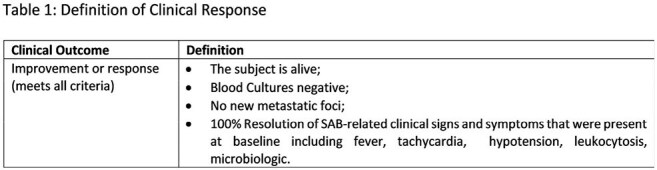 Figure 1
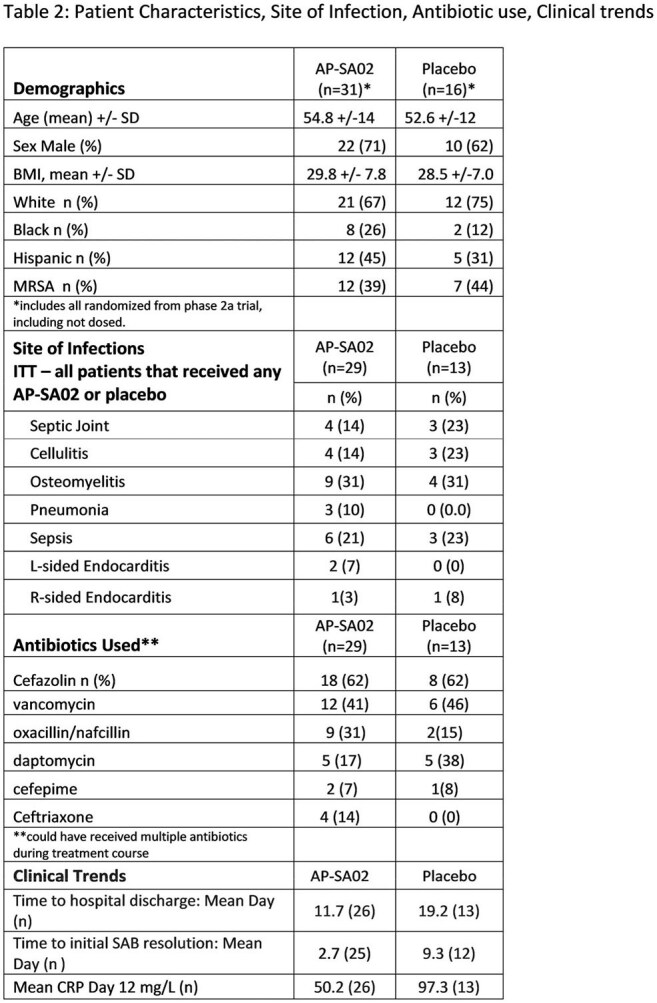 Figure 2
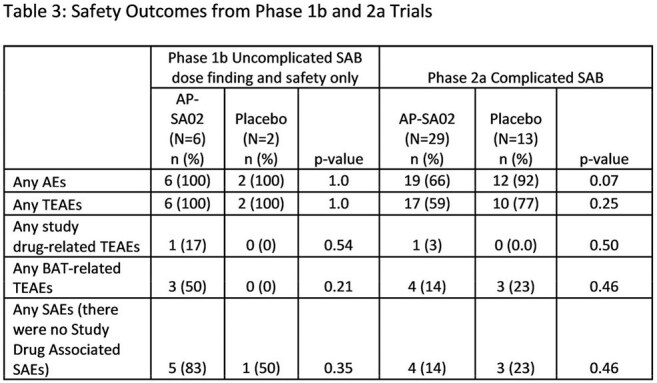 Figure 3
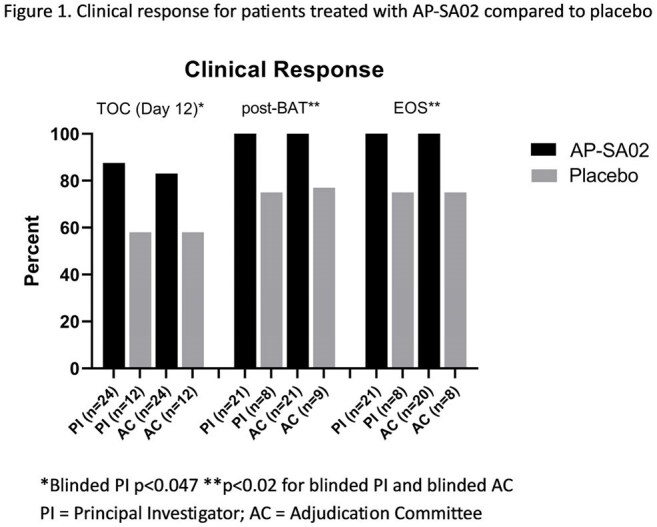 Figure 4
Peer Reviews
No public reviews on file for this paper yet. If you reviewed it on a platform where reviews are public (OpenReview, ICLR, NeurIPS, ICML), you can paste yours below so the community can read it here.
Videos
No videos yet. Explain this paper in a talk, walkthrough, or lecture? Add one.
Taxonomy
TopicsBacteriophages and microbial interactions · Antimicrobial Resistance in Staphylococcus · Clostridium difficile and Clostridium perfringens research