Barriers to Utilizing Breast Cancer Screening Methods Among Adult Females in Taif, Saudi Arabia: A Cross-Sectional Study
Sahar Alnefaie, Suhaiyh S Alotibi, Manar D Almutairi, Najla M Alharthi, Fahad S Altowairqi, Naif F Alahmari

TL;DR
This study explores why adult women in Taif, Saudi Arabia, avoid breast cancer screening, finding that embarrassment and forgetfulness are major barriers.
Contribution
The study identifies specific barriers to breast cancer screening methods in a specific Saudi population using a validated questionnaire.
Findings
Only 4.7% of women reported regular mammography use, while 25.7% perform regular breast self-examinations.
Embarrassment was the main barrier for clinical breast exams and mammography, while forgetfulness hindered self-exams.
Participants showed high awareness of symptoms and risk factors but low screening rates.
Abstract
Introduction Breast cancer (BC) is one of the leading causes of cancer-related deaths worldwide. Screening methods for early detection have significantly reduced mortality rates and improved survival rates associated with this disease. The study presented in this paper aimed to identify the barriers to regular breast cancer screening methods for early detection among adult females in Taif City. Objectives This analytical cross-sectional study sought to identify the most prevalent barriers to the use of various breast cancer screening methods. Methods A cross-sectional study was conducted between January 2024 and November 2024. A validated and pretested questionnaire was utilized for data collection after identifying the participants, who were women aged 18 years and older, residing in Taif City. An online questionnaire was sent out to these 405 females. The questionnaire comprised…
Genes, proteins, chemicals, diseases, species, mutations and cell lines named across the full text — each resolved to its canonical identifier and authoritative record.
Click any figure to enlarge with its caption.
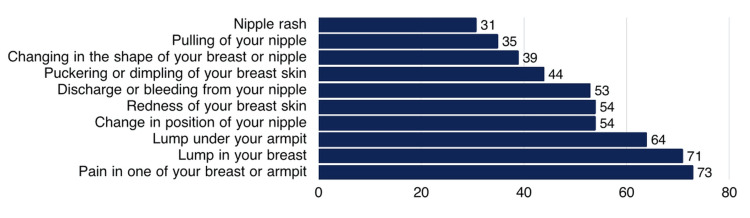 Figure 1
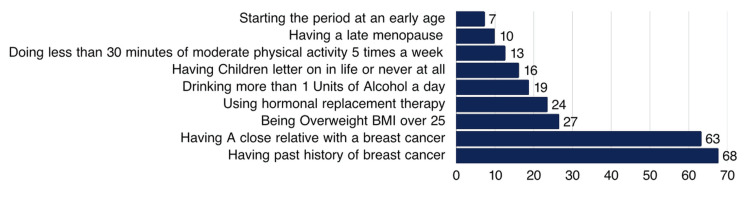 Figure 2
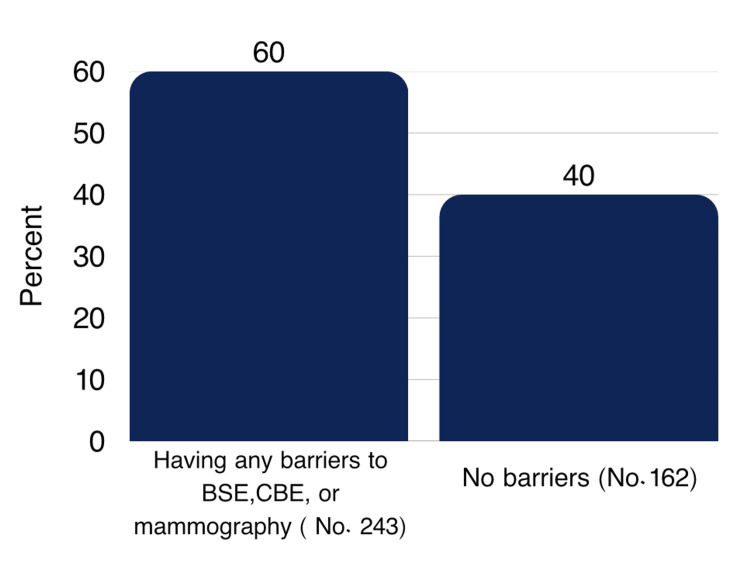 Figure 3
| Variable | N (%) |
| Age | |
| 20-29 | 298 (73.9) |
| 30-39 | 40 (9.9) |
| 40-44 | 29 (7.2) |
| ≥ 45 | 38 (9.4) |
| Marital status | |
| Widower | 2 (0.5) |
| Single | 286 (70.6) |
| Married | 105 (25) |
| Divorced | 12 (3) |
| Educational level | |
| Illiterate | 3 (0.7) |
| Primary | 10 (2.5) |
| Intermediate | 9 (2.2) |
| Secondary | 123 (30.4) |
| University or college and above | 260 (64.2) |
| Do you have a family member or friend experienced breast cancer? | |
| No | 208 (76) |
| Yes | 97 (24) |
| Have you ever been diagnosed with breast cancer? | |
| No | 394 (97.3) |
| Yes | 11 (2.7) |
| Do you know any of the warning signs of breast cancer? | |
| No | 113 (27.9) |
| Yes | 292 (72.1) |
| Do you know any of the risk factors of breast cancer? | |
| No | 176 (43.5) |
| Yes | 229 (56.5) |
| Do you undergo mammography on a regular basis (if you are over 40?) | |
| I am less than 40 years old | 294 (72.6) |
| No | 92 (22.7) |
| Yes | 19 (4.7) |
| Do you have CBE on a regular basis? | |
| No | 373 (92.1) |
| Yes | 32 (7.9) |
| Do you have breast self-examinations on a regular basis? | |
| No | 301 (74.3) |
| Yes | 104 (25.7) |
| Concept | Disagree | Neutral | Agree |
| N (%) | N (%) | N (%) | |
| Susceptibility | |||
| It is likely that I will get breast cancer | 232 (57.3) | 149 (36.8) | 24 (5.9) |
| My chances of getting breast cancer in the next few years are great | 254 (62.7) | 123 (30.4) | 28 (6.9) |
| Seriousness | |||
| The thought of breast cancer scares me | 97 (24) | 116 (28.6) | 192 (47.4) |
| If someone had breast cancer, her whole life would change | 102 (25.2) | 145 (35.8) | 158 (39) |
| Barriers | |||
| BSE barriers: doing breast examination will make me worry about what is wrong with my breast | 117 (28.9) | 125 (30.9) | 163 (40.2) |
| BSE takes too much time | 188 (46.4) | 156 (38.5) | 61 (15.1) |
| It is hard to remember to do a breast examination | 102 (25.2) | 132 (32.6) | 171 (42.2) |
| CBE barriers: It is embarrassing for me to have a breast exam performed by a physician | 126 (31.1) | 128 (31.6) | 151 (37.3) |
| Breast exams performed by a physician can be painful | 185 (45.7) | 138 (34.1) | 82 (20.2) |
| I am afraid I would not be able to go for a breast exam performed by a physician. | 209 (51.6) | 121 (29.9) | 75 (18.5) |
| Breast exam performed by a physician is time-consuming | 160 (39.5) | 158 (39) | 87 (21.5) |
| Mammography barriers: I have other problems more important than getting a mammogram | 171 (42.2) | 164 (40.5) | 70 (17.3) |
| Having a mammogram is too painful | 188 (46.4) | 145 (35.8) | 72 (17.8) |
| I am afraid I would not be able to go to the mammogram appointment | 200 (49.4) | 142 (35.1) | 63 (15.6) |
| Having a mammogram is too embarrassing | 151 (37.3) | 131 (32.3) | 123 (30.4) |
| Having a mammogram takes too much time | 156 (38.5) | 180 (44.4) | 69 (17) |
| Confidence in BSE efficacy | |||
| I could find a breast lump by performing BSE | 97 (24) | 166 (41) | 142 (35.2) |
| I can tell that something is wrong with my breast when I look in the mirror | 93 (23) | 147 (36.3) | 165 (40.7) |
| I can perform BSE correctly | 120 (29.6) | 154 (38) | 131 (32.3) |
| Health motivation | |||
| I exercise at least three times/week | 166 (41) | 115 (28.4) | 124 (30.6) |
| I eat well-balanced meals | 89 (22) | 157 (38.8) | 159 (39.3) |
| Maintaining good health is extremely important to me | 32 (7.9) | 82 (20.2) | 291 (71.9) |
| Variable | Having any barrier to BSE, CBE, or mammography | χ2 | p-value | |
| Yes, N (%) | No, N(%) | |||
| Age | ||||
| 20-29 | 173 (71.2) | 125 (77.2) | 2.06 | 0.56 |
| 30-39 | 26 (10.7) | 14 (8.6) | ||
| 40-44 | 18 (7.4) | 11 (6.8) | ||
| ≥ 45 | 26 (10.7) | 12 (7.4) | ||
| Marital status | ||||
| Widower | 2 (0.8) | 0 (0.0) | 4.13 | 0.247 |
| Single | 164 (67.5) | 122 (75.3) | ||
| Married | 70 (28.8) | 35 (21.6) | ||
| Divorced | 7 (2.9) | 5 (3.1) | ||
| Educational level | ||||
| Illiterate | 0 (0.0) | 3 (1.9) | 7.33 | 0.119 |
| Primary | 8 (3.3) | 2 (1.2) | ||
| Intermediate | 6 (2.5) | 3 (1.9) | ||
| Secondary | 78 (32.1) | 45 (27.8) | ||
| University or college and above | 151 (62.1) | 109 (67.3) | ||
| Do you have a family member or friend experienced breast cancer? | ||||
| No | 180 (74.1) | 128 (79) | 1.3 | 0.254 |
| Yes | 63 (25.9) | 34 (21) | ||
| Have you ever been diagnosed with breast cancer? | ||||
| No | 235 (96.7) | 159 (98.1) | 0.76 | 0.382 |
| Yes | 8 (3.3) | 3 (1.9) | ||
| Do you know any of the warning signs of breast cancer? | ||||
| No | 71 (29.2) | 42 (25.9) | 0.52 | 0.469 |
| Yes | 172 (70.8) | 120 (74.1) | ||
| Do you know any of the risk factors of breast cancer? | ||||
| No | 98 (40.3) | 78 (48.1) | 2.41 | 0.12 |
| Yes | 145 (59.7) | 84 (51.9) | ||
| Do you undergo mammography on a regular basis (if you are over 40)? | ||||
| I am less than 40 years old | 175 (72) | 119 (73.5) | 0.13 | 0.934 |
| No | 56 (23) | 36 (22.2) | ||
| Yes | 12 (4.9) | 7 (4.3) | ||
| Do you have CBE on a regular basis? | ||||
| No | 225 (92.6) | 148 (91.4) | 0.2 | 0.652 |
| Yes | 18 (7.4) | 14 (8.6) | ||
| Do you have breast self-examinations on a regular basis? | ||||
| No | 180 (74.1) | 121 (74.7) | 0.01 | 0.889 |
| Yes | 63 (25.9) | 41 (25.3) | ||
| Variable | Do you undergo mammography on a regular basis (if you are over 40?) | χ2 | p-value | |
| No, N (%) | Yes, N (%) | |||
| Age | ||||
| 20-29 | 293 (75.9) | 5 (26.3) | 39.44 | <0.001 |
| 30-39 | 39 (10.1) | 1 (5.3) | ||
| 40-44 | 24 (6.2) | 5 (26.3) | ||
| ≥ 45 | 30 (7.8) | 8 (42.1) | ||
| Marital status | ||||
| Widower | 1 (0.3) | 1 (5.3) | 35.4 | <0.001 |
| Single | 283 (73.3) | 3 (15.8) | ||
| Married | 92 (23.8) | 13 (68.4) | ||
| Divorced | 10 (2.6) | 2 (10.5) | ||
| Educational level | ||||
| Illiterate | 2 (0.5) | 1 (5.3) | 7.38 | 0.117 |
| Primary | 9 (2.3) | 1 (5.3) | ||
| Intermediate | 8 (2.1) | 1 (5.3) | ||
| Secondary | 117 (30.3) | 6 (31.6) | ||
| University or college and above | 250 (64.8) | 10 (52.6) | ||
| Do you have a family member or friend experienced breast cancer? | ||||
| No | 297 (76.9) | 11 (57.9) | 3.6 | 0.058 |
| Yes | 89 (23.1) | 8 (42.1) | ||
| Have you ever been diagnosed with breast cancer? | ||||
| No | 382 (99) | 12 (63.2) | 17.86 | <0.001 |
| Yes | 4 (1) | 7 (36.8) | ||
| Do you know any of the warning signs of breast cancer? | ||||
| No | 110 (28.5) | 3 (15.8) | 1.45 | 0.228 |
| Yes | 276 (71.5) | 16 (84.2) | ||
| Do you know any of the risk factors of breast cancer? | ||||
| No | 168 (43.5) | 8 (42.1) | 0.01 | 0.903 |
| Yes | 218 (56.5) | 11 (57.9) | ||
| Do you have CBE on a regular basis? | ||||
| No | 365 (94.6) | 8 (42.1) | 18.47 | <0.001 |
| Yes | 21 (5.4) | 11 (57.9) | ||
| Do you have breast self-examinations on a regular basis? | ||||
| No | 296 (76.7) | 5 (26.3) | 24.06 | <0.001 |
| Yes | 90 (23.3) | 14 (73.7) | ||
| Variable | Do you have CBE on a regular basis? | χ2 | p-value | |
| No, N (%) | Yes, N (%) | |||
| Age | ||||
| 20-29 | 282 (75.6) | 16 (50) | 10.51 | 0.015 |
| 30-39 | 35 (9.4) | 5 (15.6) | ||
| 40-44 | 24 (6.4) | 5 (15.6) | ||
| ≥ 45 | 32 (8.6) | 6 (18.8) | ||
| Marital status | ||||
| Widower | 1 (0.3) | 1 (3.1) | 13.52 | 0.004 |
| Single | 271 (72.7) | 15 (46.9) | ||
| Married | 90 (24.1) | 15 (46.9) | ||
| Divorced | 11 (2.9) | 1 (3.1) | ||
| Educational level | ||||
| Illiterate | 2 (0.5) | 1 (3.1) | 5.65 | 0.227 |
| Primary | 8 (2.1) | 2 (6.3) | ||
| Intermediate | 8 (2.1) | 1 (3.1) | ||
| Secondary | 112 (30) | 11 (34.4) | ||
| University or college and above | 243 (65.1) | 17 (53.1) | ||
| Do you have a family member or friend experienced breast cancer? | ||||
| No | 283 (75.9) | 25 (78.1) | 0.08 | 0.774 |
| Yes | 90 (24.1) | 7 (21.9) | ||
| Have you ever been diagnosed with breast cancer? | ||||
| No | 366 (98.1) | 28 (87.5) | 12.58 | <0.001 |
| Yes | 7 (1.9) | 4 (12.5) | ||
| Do you know any of the warning signs of breast cancer? | ||||
| No | 104 (27.9) | 9 (28.1) | 0.001 | 0.977 |
| Yes | 269 (72.1) | 23 (71.9) | ||
| Do you know any of the risk factors of breast cancer? | ||||
| No | 160 (42.9) | 16 (50) | 0.6 | 0.437 |
| Yes | 213 (57.1) | 16 (50) | ||
| Do you have breast self-examinations on a regular basis? | ||||
| No | 295 (79.1) | 6 (18.8) | 16.22 | <0.001 |
| Yes | 78 (20.9) | 26 (81.3) | ||
| Variable | Do you have breast self-examinations on a regular basis? | χ2 | p-value | |
| No, N (%) | Yes, N (%) | |||
| Age | ||||
| 20-29 | 232 (77.1) | 66 (63.5) | 11.31 | 0.01 |
| 30-39 | 30 (10) | 10 (9.6) | ||
| 40-44 | 16 (5.3) | 13 (12.5) | ||
| ≥ 45 | 23 (7.6) | 15 (14.4) | ||
| Marital status | ||||
| Widower | 1 (0.3) | 1 (1) | 14.71 | 0.002 |
| Single | 226 (75.1) | 60 (57.7) | ||
| Married | 69 (22.9) | 36 (34.6) | ||
| Divorced | 5 (1.7) | 7 (6.7) | ||
| Educational level | ||||
| Illiterate | 2 (0.7) | 1 (1) | 2.41 | 0.659 |
| Primary | 8 (2.7) | 2 (1.9) | ||
| Intermediate | 6 (2) | 3 (2.9) | ||
| Secondary | 97 (32.2) | 26 (25) | ||
| University or college and above | 188 (62.5) | 72 (69.2) | ||
| Do you have a family member or friend experienced breast cancer? | ||||
| No | 239 (79.4) | 69 (66.3) | 7.23 | 0.007 |
| Yes | 62 (20.6) | 35 (33.7) | ||
| Have you ever been diagnosed with breast cancer? | ||||
| No | 297 (98.7) | 97 (93.3) | 8.53 | 0.003 |
| Yes | 4 (1.3) | 7 (6.7) | ||
| Do you know any of the warning signs of breast cancer? | ||||
| No | 87 (28.9) | 26 (25) | 0.58 | 0.444 |
| Yes | 214 (71.1) | 78 (75) | ||
| Do you know any of the risk factors of breast cancer? | ||||
| No | 128 (42.5) | 48 (46.2) | 0.41 | 0.52 |
| Yes | 173 (57.5) | 56 (53.8) | ||
| Variable | Category for OR calculation | p-value* | Odds ratio | Lower-upper (CI:95%) |
| Age | Continuous variable- odds decrease with age | 0.44 | 0.88 | (0.65-1.2) |
| Marital status | Married vs. single | 0.906 | 0.96 | (0.57-1.63) |
| Educational level | University vs. below | 0.633 | 1.07 | (0.79-1.47) |
| Do you have a family member or friend experienced breast cancer? | Yes vs. no | 0.294 | 0.76 | (0.46-1.26) |
| Have you ever been diagnosed with breast cancer? | Yes vs. no | 0.606 | 0.66 | (0.14-3.13) |
| Do you know any of the warning signs of breast cancer? | Yes vs. no | 0.301 | 1.27 | (0.8-2.01) |
| Do you know any of the risk factors of breast cancer? | Yes vs. no | 0.077 | 0.68 | (0.45-1.04) |
| Do you undergo mammography on a regular basis ? | Yes vs. no | 0.863 | 1.11 | (0.33-3.74) |
| Do you have CBE on a regular basis? | Yes vs. no | 0.558 | 1.29 | (0.54-3.05) |
| Do you have breast self-examinations on a regular basis? | Yes vs. no | 0.915 | 0.97 | (0.58-1.62) |
| Variable | Category for OR calculation | p-value* | Odds ratio | Lower-upper (CI:95%) |
| Age | Continuous variable-odds increase with age | 0.002 | 2.84 | (1.45-5.56) |
| Marital status | Married vs. single | 0.72 | 1.25 | (0.36-4.22) |
| Educational level | University vs. below | 0.705 | 1.16 | (0.53-2.5) |
| Do you have a family member or friend experienced breast cancer? | Yes vs. no | 0.833 | 0.85 | (0.18-3.84) |
| Have you ever been diagnosed with breast cancer? | Yes vs. no | < 0.001 | 9.45 | (2.59-5.67) |
| Do you know any of the warning signs of breast cancer? | Yes vs. no | 0.279 | 2.47 | (0.47-12.77) |
| Do you know any of the risk factors of breast cancer? | Yes vs. no | 0.791 | 1.22 | (0.26-5.65) |
| Do you have CBE on a regular basis? | Yes vs. no | < 0.001 | 9.5 | (4.1-8.75) |
| Do you have breast self-examinations on a regular basis? | Yes vs. no | 0.197 | 2.64 | (0.6-2.54) |
| Variable | Category for OR calculation | p-value | Odds ratio | 95% CI |
| Age | Continuous variable-odds increase with age | 0.299 | 1.29 | 0.79-2.12 |
| Marital status | Married vs. single | 0.77 | 0.87 | 0.35-2.17 |
| Educational level | University vs. below | 0.154 | 0.67 | 0.38-1.16 |
| Family member/friend experienced breast cancer | Yes vs. no | 0.114 | 0.41 | 0.14-1.23 |
| Previous diagnosis of breast cancer | Yes vs. no | 0.06 | 0.32 | 0.93-3.4 |
| Knowledge of warning signs | Yes vs. no | 0.718 | 0.34 | 0.33-2.11 |
| Knowledge of risk factors | Yes vs. no | 0.689 | 0.83 | 0.34-2 |
| Undergo mammography regularly | Yes vs. no | <0.001 | 9.5 | 4.1-8.75 |
| Breast self-examinations on a regular basis | Yes vs. no | <0.001 | 2.57 | 2.68-4.68 |
| Variable | Category for OR calculation | p-value | Odds ratio (OR) | 95% Confidence interval (CI) |
| Age | Continuous variable -odds increase with age | 0.43 | 1.14 | 0.81-1.62 |
| Marital status | Married vs. single | 0.17 | 1.50 | 0.83-2.70 |
| Educational level | University vs. below | 0.019 | 1.62 | 1.08-2.42 |
| Family member or friend with breast cancer | Yes vs. no | 0.018 | 1.95 | 1.11-3.41 |
| Ever diagnosed with breast cancer | Yes vs. no | 0.566 | 1.62 | 0.31-1.51 |
| Knowledge of the warning signs of breast cancer | Yes vs. no | 0.462 | 1.24 | 0.69-2.21 |
| Knowledge of risk factors of breast cancer | Yes vs. no | 0.477 | 0.82 | 0.49-1.38 |
| Regular mammography | Yes vs. no | 0.197 | 2.64 | 0.60-2.54 |
| Regular clinical breast examination (CBE) | Yes vs. no | <0.001 | 2.57 | 2.68-4.68 |
Peer Reviews
No public reviews on file for this paper yet. If you reviewed it on a platform where reviews are public (OpenReview, ICLR, NeurIPS, ICML), you can paste yours below so the community can read it here.
Videos
No videos yet. Explain this paper in a talk, walkthrough, or lecture? Add one.
Taxonomy
TopicsGlobal Cancer Incidence and Screening · BRCA gene mutations in cancer · Digital Radiography and Breast Imaging
Introduction
Breast cancer is a leading cause of death among women, and early detection has been linked to decreased morbidity and mortality associated with this disease [1]. In 2020, breast cancer affected 2.3 million women and resulted in 685,000 fatalities worldwide, with 2,484 cases reported among adults in Saudi Arabia. By the end of that year, there were 7.8 million women who had survived breast cancer within the previous five years, making it the most prevalent form of cancer globally [2].
A recent study indicated that the increased incidence of breast cancer in countries with a higher Human Development Index (HDI) is attributed to long-standing reproductive and hormonal risk factors (early onset of menstruation, delayed menopause, older age at first childbirth, fewer pregnancies, lack of breastfeeding, menopausal hormone therapy, and use of oral contraceptives) as well as lifestyle risk factors (alcohol consumption, obesity, and lack of physical activity) [3,4].
Early detection of breast cancer and timely treatment are crucial methods to prevent fatalities caused by this disease. The most reliable approach to identifying breast cancer at an early stage is through regular screening tests [5]. The primary diagnostic methods recommended by the World Health Organization are CBE and mammography. Where CBE and mammography are difficult or impossible to avail as options, BSE is suggested as a secondary tool. It is essential for women to regularly undergo mammography and physical breast exams whether done by healthcare professionals or themselves. Women should be familiar with the normal appearance and texture of their breasts to identify any changes [5,6].
There is a paucity of research in Saudi Arabia regarding knowledge, attitudes, and behaviors related to breast cancer. One study, however, observed a higher level of awareness about breast cancer among older women residing in Riyadh. Out of 864 women aged between 20 and 50 years who were involved in this study, 82% were aware of BSE, and 61% had knowledge about mammography. Surprisingly, however, only 41.2% reported having done BSE(s), while only 18.2% had ever undergone a mammography [7].
A study conducted in Al Hassa governorate found that none of the participants reported having mammography as part of their age-specific screening. The majority had decided to undergo a procedure based on what their healthcare provider advised. Mammography was performed for diagnostic purposes in 50.5% of cases, and 32.1% of the 50 years or older participants underwent it as a follow-up [8]. A different study of teachers in their thirties indicated a limited understanding of breast cancer, with only 32.4% knowing about BSE [9].
A study conducted in Jeddah involving 328 participants revealed that the primary obstacle for BSEs was the fear of discovering that something was wrong with their breasts (47%). Similarly, embarrassment was the main hindrance to CBE (45.9%). Conversely, women cited embarrassment (36%) and pain (32.6%) as the main barriers preventing them from undergoing mammography [10].
The present study aimed to evaluate the obstacles that prevent adult females in Taif City, Saudi Arabia, from utilizing breast cancer screening methods.
Materials and methods
Study design and settings
This analytical cross-sectional study was conducted from January 2024 to November 2024 using a pre-tested and validated questionnaire, obtained from a previous research project. It was used without modification and translated into Arabic [11].
Study population
The study included all women aged 18 years and older, residing in Taif City, according to the General Authority for Statistics [12].
Ethical considerations
The study received ethics approval from the Research Ethics Committee at Taif University, Kingdom of Saudi Arabia, IRB approval number (45-345). Adult females in Taif City received the survey questionnaire via social media platforms such as WhatsApp and Snapchat. The participants were informed about the purpose of the study, and the data of only those who provided consent for their data to be used for the study’s purposes were included in the analysis.
Questionnaire structure and content
The questionnaire was divided into three parts (Appendix A, B, C). Part A had questions about the socio-demographic details of the participants, such as age, educational level, and marital status. Part B focused on knowing about the participants’ breast cancer background and screening, including personal experiences and whether a family member or friend was diagnosed with BC. It also assessed participants’ knowledge about warning signs, risk factors, and screening practices such as CBE, BSE, and mammography. Part C contained 22 multiple-choice questions (agree, neutral, or disagree), which recorded participants’ responses according to the modified Champion Health Belief Model Scale (CHBMS) questionnaire, the 22-item Modified Champion Health Belief Model Scale (CHBMS-BC-M) for assessing beliefs toward breast cancer screening. Before data collection, a pilot study involving 20 participants was conducted to refine survey questions and ensure the questionnaire's clarity, consistency, and validity.
Sample size calculation
A sample size of 405 was calculated using the Epi Info application [13].
Statistical analysis
The statistical analysis of data was performed using SPSS (IBM Corp., 2019, IBM SPSS Statistics for Windows, Version 26.0). The Chi-squared test (χ²) was applied to the qualitative data expressed in numbers and percentages to determine the association between the variables. Multivariable logistic regression analysis was conducted to assess the risk factors (independent predictors) vis-à-vis any barriers to regular BSE, CBE, or mammography. The odds ratio (OR) was calculated at a 95% confidence interval (CI) to evaluate these risk factors. A p-value of less than 0.05 was considered statistically significant.
Results
Of the 405 participants, 298 (73.9%) were aged 20-29 years, 286 (70.6%) were single, and 260 (64.2%) had a college or university education. Further, 97 (24.0%) had a family member or friend who was diagnosed with breast cancer, 11 (2.7%) had been diagnosed with breast cancer, and 292 (72.1%) and 229 (56.5%) reported knowledge about breast cancer’s warning signs and risk factors, respectively. Only 19 (4.7%), 32 (7.9%), and 104 (25.7%) had undergone regular mammography, CBEs, and BSEs, respectively (Table 1).
The most commonly recognized BC warning signs included pain in one of the breasts or armpits (297, 73.3%), a lump in the breast (287, 70.9%), and a lump under the armpit (261, 64.4%), as illustrated in Figure 1.
Percentage distribution of participants’ knowledge about BC warning signs (N=405).BC: breast cancer.
Having a history of breast cancer (274, 67.7%) and a close relative who was diagnosed with breast cancer (256, 63.3%) were considered the most significant risk factors (Figure 2).
Percentage distribution of participants’ knowledge about BC risk factors (N=405).BC: breast cancer.
Of the 405 participants, 171 (42.2%) reported that it is hard to remember to perform BSE, 24 (5.9%) believed they were likely to get breast cancer, and 28 (6.9%) perceived a high likelihood of developing BC within the next few years. Additionally, 192 (47.4%) expressed that the thought of breast cancer scares them, and 158 (39%) reported that having breast cancer would change one’s whole life.
Regarding barriers to BSE, 163 (40.2%) felt that doing BSE would make them worry about what is wrong with their breast, and 61 (15.1%) thought that BSE takes too much time. Concerning CBE barriers, 151 (37.3%) found it embarrassing to have a breast exam performed by a physician, 82 (20.2%) believed that breast exams are painful, 75 (18.5%) were afraid they would not be able to go to a physician for a breast exam, and 87 (21.5%) considered it time-consuming. Furthermore, 70 (17.3%) reported having other problems more important than getting a mammogram done, 72 (17.8%) said that mammography is too painful, 123 (30.4%) found it too embarrassing, 63 (15.6%) were unable to turn up for their mammography appointment, and 69 (17%) believed that getting a mammogram done takes too much time.
Regarding participants’ confidence in BSE’s efficacy, 143 (35.2%) reported that they could find a breast lump by performing BSE, 165 (40.7%) stated they could tell if something was wrong with their breasts when looking at them in the mirror, and 130 (32.2%) felt they could perform BSE correctly.
Health motivations included exercising at least three times per week (124, 30.6%), eating well-balanced meals (159, 39.3%), and maintaining good health, being extremely important to them (291, 71.9%) (Table 2).
243 (60%) of the participants faced barriers to getting BSE, CBE, or mammography done (Figure 3).
Prevalence of barriers to BSE, CBE, or mammography.BSE: breast self examination, CBE: clinical breast examination.
Although the prevalence of barriers to BSE, CBE, or mammography was higher among those aged 20-29 years, being single, having had higher education, not having a family member or friend who was diagnosed with breast cancer, and never being diagnosed with breast cancer were not significantly related to the prevalence of barriers to BSE, CBE, and mammography (p< 0.05). Similarly, no significant relationship was found between the prevalence of barriers to BSE, CBE, or mammography and participants’ knowledge of BC warning signs or risk factors or their regular participation in BC screening tests (p< 0.05) (Table 3).
Among the participants over 40 years, those aged 45 years or more, those married, those not diagnosed with BC, and those who had CBE or BSE regularly (p< 0.05) were quite regular in undergoing mammography (Table 4).
The incidence of regular CBE was significantly higher among the participants aged 20-29 years, those who were single, those diagnosed with breast cancer, or those who performed BSEs regularly (p< 0.05) (Table 5).
The incidence of regular BSE was significantly higher among the participants aged 20-29 years, those who were single, those with a family member or friend who was diagnosed with breast cancer, or those diagnosed with BC (p< 0.05) (Table 6).
Multivariable logistic regression analysis was performed to identify risk factors associated with barriers to regular BSE, CBE, or mammography among the study participants. None of the studied variables were found to be independent predictors of the barriers to regular BSE, CBE, or mammography (p< 0.05). However, for undergoing mammography regularly, older age (≥ 45 years), previous diagnosis of breast cancer, or undergoing CBEs regularly were identified as independent predictors (p< 0.05). An independent predictor for undergoing CBEs regularly was also doing BSEs regularly (p< 0.05). Further, the independent predictors for doing BSEs regularly were having a higher level of education (university or college and above), having a family member or friend who was diagnosed with breast cancer, or undergoing CBEs regularly (p< 0.05) (Tables 7, 8, 9, 10).
Discussion
The present study aimed to identify the barriers that prevent adult women in Taif from undergoing regular breast cancer screenings. It focused on the most common obstacles that hinder the use of various screening methods. The study also examined the social and demographic factors influencing women’s decisions regarding screening. The results indicated that participants had a good level of awareness about BC, including its symptoms and risk factors. A study conducted in Jeddah, which has been referred to earlier, also found that the women participants had a strong understanding of BC [10]. In contrast, a study conducted on female patients at primary healthcare centres in Najran revealed that more than half of the participants had a low level of knowledge about BC and screening methods [14].
Despite the noticeable increase in knowledge about breast cancer and various screening methods, such awareness remains insufficient to facilitate early detection and treatment.
The present study highlights significant awareness among participants regarding the barriers to BC. The results of the present study showed that several barriers affected the ability of women in Taif City to undergo screening; half of the participants expressed anxiety about performing BSE(s), while the majority felt embarrassed about undergoing CBE(s) conducted by a physician. Regarding screening for a mammogram, most participants did not report any specific barriers that prevented them from undergoing mammography.
Previous studies have shown regional differences in awareness. A study conducted in Oman found that the most common barriers related to BCs were personal, including embarrassment about breast exams, fear of a cancer diagnosis, and concerns about side effects from treatments like mastectomy, chemotherapy, and radiation [15]. Similarly, a study of Palestinian women in the West Bank identified a mix of cultural and personal barriers to screening, such as limited medical facilities, cost and accessibility issues, inaccurate knowledge, and fear of diagnosis or treatment side effects [16]. Additionally, a recent study in Saudi Arabia highlighted the fear of diagnosis, embarrassment, and lack of awareness as major barriers to BCs [17]. These findings emphasize the impact of demographic and professional factors on awareness, suggesting that the recent increase in local percentages indicates a gradual and promising rise in public awareness.
The present study found that undergoing mammography was higher among women aged 45 and older, married women, and those with higher educational levels. Similar findings in other studies reported an association between sociodemographic factors and the likelihood of undergoing mammography [18]. However, the present study’s results indicate limited recourse to mammography in the Taif region despite the availability of free health services. According to a study of Saudi women aged 50 years or older, the low rate of opting for mammography is not unique to the Taif region [19]. Our research shows that having a family member who was diagnosed with BC is a factor that encourages women to undergo mammography regularly. Some other studies concerning women in Saudi Arabia reported contrary results [20]. Hence, we must enhance awareness and knowledge about BC risk factors in our community. More than half of the participants who undergo mammography regularly also undergo CBE and do BSE, indicating their concern about BC and attention to personal health.
Regarding CBE, almost half of the women who undergo CBEs are between the ages of 20 and 29. This finding is similar to that of a study conducted in Yemen that reported limited practice of CBE among older women [21]. Further, more than half of the participants who undergo CBEs have higher educational qualifications. Thus, younger age, single marital status, and a higher level of education are strong factors associated with regular CBE. Moreover, women with a positive family history of BC reported lower rates of CBE compared to those without such a history, possibly due to a lack of knowledge about the importance of family history as a significant risk factor for BC. The aforementioned study addressing participants’ knowledge of BC risk factors in Oman also found that less than half of the participants believed they were at risk of BC if a relative was diagnosed with BC [15]. However, in general, most women who undergo CBEs and even those who do not have a good understanding of BC warning signs and risk factors.
Regular BSE was notably higher among younger, single women and those with a close personal experience of breast cancer, reflecting that the majority of respondents are aware of BSE [22]. The findings of the present study revealed that none of the studied variables were independently associated with barriers to doing BSEs and undergoing CBEs or mammography regularly. However, our results showed significant predictors for undergoing mammography, CBEs, and BSEs regularly, indicating that certain factors may play an influential role in motivating women toward regular breast cancer screening. Older age (≥ 45 years), previous breast cancer diagnosis, and regular CBE emerged as predictors for undergoing mammography regularly [10]. The present study also found that regular BSE was an independent predictor of regular CBE. Higher education, personal connections to breast cancer survivors, and regular CBE were all associated with doing BSEs regularly. Higher education often correlates with increased health awareness and access to health information, fostering proactive health behaviors. Additionally, knowing someone affected by breast cancer may raise awareness and perceived risk, promoting preventive actions.
Our study identified barriers that prevent adult women in Taif City from undergoing regular breast cancer screenings. Participants generally demonstrated a good awareness of symptoms and risk factors. However, the present study has some limitations that future research should address, such as the potential for bias due to its cross-sectional design, which precludes establishing causality. Additionally, some factors, such as the quality of services provided and the skills of healthcare providers, were not considered in the present study. Therefore, further research in this area should focus on examining these other important aspects to better understand them and address them as required.
Conclusions
The present study showed that its female participants had a high level of awareness regarding breast cancer symptoms and risk factors, but this awareness did not translate into consistent screening behaviors. It also revealed several barriers affecting the ability to undergo screening: half of the participants felt anxious about performing BSE, while the majority felt embarrassed about undergoing CBE. While some women reported embarrassment and pain as barriers to mammography, the majority did not report specific barriers. However, the overall screening rate in the region remains low despite the availability of health services. Additional efforts are needed to increase women’s awareness about the importance of breast cancer screening and encourage their participation in such screenings through targeted campaigns on social media, in shopping malls, and at universities. It is also essential to evaluate the quality of screening services to ensure they meet international standards, thereby supporting effective early detection and improving health outcomes.
The reference list from the paper itself. Each links out to its DOI / PubMed record.
- 1Breast cancer screening for women at average risk 2015 guideline update from the American Cancer Society JAMA Oeffinger KC Fontham ET Etzioni R 1599161431420152650153610.1001/jama.2015.12783 PMC 4831582 · doi ↗ · pubmed ↗
- 2World Health Organization. Breast cancer 7 2023 2023 https://www.who.int/news-room/fact-sheets/detail/breast-cancer
- 3Global Cancer Statistics 2020: GLOBOCAN estimates of incidence and mortality worldwide for 36 cancers in 185 countries CA Cancer J Clin Sung H Ferlay J Siegel RL Laversanne M Soerjomataram I Jemal A Bray F 2092497120213353833810.3322/caac.21660 · doi ↗ · pubmed ↗
- 4Breast cancer risk by age at birth, time since birth and time intervals between births: exploring interaction effects Br J Cancer Albrektsen G Heuch I Hansen S Kvåle G 1671759220051559709710.1038/sj.bjc.6602302 PMC 2361726 · doi ↗ · pubmed ↗
- 5American Cancer Society. American Cancer Society recommendations for the early detection of breast cancer 11 2023 https://www.cancer.org/cancer/types/breast-cancer/screening-tests-and-early-detection.html
- 6Evaluation of conventional training in Clinical Breast Examination (CBE)Work Veitch D Goossens R Owen H Veitch J Molenbroek J Bochner M 6476566220193110405010.3233/WOR-192899 PMC 6597979 · doi ↗ · pubmed ↗
- 7Knowledge of breast cancer and its risk and protective factors among women in Riyadh Ann Saudi Med Alam AA 2722772620061688308210.5144/0256-4947.2006.272PMC 6074496 · doi ↗ · pubmed ↗
- 8Breast cancer knowledge, risk factors and screening among adult Saudi women in a primary health care setting Asian Pac J Cancer Prev Amin TT Al Mulhim ARS Al Meqihwi A 133138102009 https://journal.waocp.org/?sid=Entrez:Pub Med&id=pmid:19469641&key=2009.10.1.13319469641 · pubmed ↗