Defining regional tau‐PET positivity cut points in atypical AD
Neha Singh‐Reilly, Stephen D. Weigand, Amanda Tapia, Ryota Satoh, Jonathan Graff‐Radford, Mary M. Machulda, Christopher G Schwarz, Clifford R. Jack, Val J Lowe, Keith A. Josephs, Jennifer L. Whitwell

TL;DR
This study improves detection of atypical Alzheimer's disease by defining new thresholds for tau-PET scans in specific brain regions.
Contribution
The paper introduces regional tau-PET positivity cut points to better identify atypical Alzheimer's disease cases.
Findings
Regional tau-PET positivity in temporal-fusiform and parahippocampal regions best differentiates atypical AD from cognitively unimpaired individuals.
Using regional thresholds identified 97% of atypical AD cases, outperforming traditional medial-temporal ROI methods.
Focal non-temporal tau patterns in atypical AD are better captured by regional analysis than standard approaches.
Abstract
Atypical clinical presentations of Alzheimer's disease (AD) are associated with heterogeneous patterns of cortical tau‐PET uptake. The medial‐temporal (MTL) meta‐ROI is typically used to determine tau‐PET abnormality in AD, but this approach may not detect focal uptake in atypical patients. Our goal was to develop regional tau‐PET cut‐points and determine whether the number of positive regions better captures positive tau‐PET signal in atypical AD. 127 amyloid‐positive atypical AD (visual=68, language=39, motor=15, others=5) and 62 amyloid‐negative cognitively unimpaired (CU) individuals were recruited by the Neurodegenerative Research Group, Mayo Clinic, and underwent, amyloid‐PET and 18F‐AV‐1451(tau)‐PET. Images were parcellated using the modified Harvard‐Oxford atlas and we focused on 67 AD‐specific regions. Rather than using the average SUVR across voxels within a region to…
Genes, proteins, chemicals, diseases, species, mutations and cell lines named across the full text — each resolved to its canonical identifier and authoritative record.
Click any figure to enlarge with its caption.
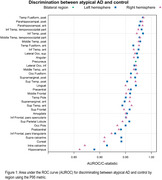 Figure 1
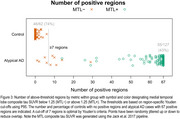 Figure 2
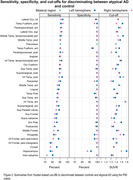 Figure 3
Peer Reviews
No public reviews on file for this paper yet. If you reviewed it on a platform where reviews are public (OpenReview, ICLR, NeurIPS, ICML), you can paste yours below so the community can read it here.
Videos
No videos yet. Explain this paper in a talk, walkthrough, or lecture? Add one.
Taxonomy
TopicsDementia and Cognitive Impairment Research · Alzheimer's disease research and treatments · Intracerebral and Subarachnoid Hemorrhage Research