APOE Genotype Modulates the Relationship Between Plasma p‐tau217 and Amyloid Burden in Alzheimer's Disease
Han‐Kyeol Kim, Jae Hoon Lee, Joong‐Hyun Chun, Mina Park, You Jin Kim, Tim West, Kristopher M. Kirmess, Philip B. Verghese, Daniel Connell, Joel B. Braunstein, Young Hoon Ryu, Chul Hyoung Lyoo, Hanna Cho

TL;DR
This study shows that the APOE gene type affects how well plasma p-tau217 reflects amyloid buildup in Alzheimer's disease.
Contribution
The study reveals that plasma p-tau217's correlation with amyloid burden varies significantly by APOE genotype, particularly in non-E4 carriers.
Findings
The E2+ group showed the strongest correlations between plasma p-tau217 and amyloid burden.
E3/E3 carriers had stronger p-tau217 correlations than E4+ carriers.
Plasma p-tau217 is a more sensitive biomarker for amyloid pathology in non-E4 carriers.
Abstract
This study aimed to investigate the differential association between plasma p‐tau217 and amyloid burden across Apolipoprotein E (APOE) genotypes. A total of 234 participants were included in the study, undergoing 18F‐florbetaben (FBB), 18F‐flortaucipir (FTP) PET, and plasma biomarker assessments, including %p‐tau217, p‐tau217, and APS2. Participants were categorized based on their APOE genotype: E2+ (E2/E2, E2/E3), E3/E3, and E4+ (E3/E4, E4/E4). The relationship between FBB centiloid values, FTP temporal meta‐region‐of‐interest (ROI) SUVR values, and plasma biomarkers was analyzed across these genotypes, and differences in correlations were assessed using Fisher's Z test. The association between plasma p‐tau217 and amyloid burden varied significantly across APOE genotypes. The E2+ group exhibited the strongest correlations between FBB centiloid values and plasma biomarkers (r=0.923…
Genes, proteins, chemicals, diseases, species, mutations and cell lines named across the full text — each resolved to its canonical identifier and authoritative record.
Click any figure to enlarge with its caption.
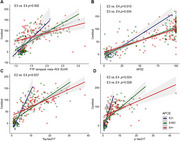 Figure 1
Peer Reviews
No public reviews on file for this paper yet. If you reviewed it on a platform where reviews are public (OpenReview, ICLR, NeurIPS, ICML), you can paste yours below so the community can read it here.
Videos
No videos yet. Explain this paper in a talk, walkthrough, or lecture? Add one.
Taxonomy
TopicsAlzheimer's disease research and treatments · Dementia and Cognitive Impairment Research · Parkinson's Disease Mechanisms and Treatments