Default mode network connectivity responses to glucose ingestion in cognitively unimpaired older adults with and without type 2 diabetes
Amaryllis A Tsiknia, Victoria R Tennant, Sammantha Nimmo, Choo Phei Wee, Giovanni Trejos, Lorena Contreras, Wendy J Mack, Matthew Borzage, Hussein N Yassine, Meredith N. Braskie

TL;DR
This study examines how the brain's default mode network responds to glucose in older adults with and without type 2 diabetes, revealing distinct connectivity patterns.
Contribution
The study identifies unique neural responses to glucose ingestion in type 2 diabetes patients compared to non-diabetic individuals.
Findings
Diabetic participants showed increased DMN connectivity with the cerebellum and superior frontal gyrus after glucose ingestion.
Non-diabetic participants exhibited increased DMN connectivity with the lateral occipital cortex and middle temporal gyrus after glucose ingestion.
Glucose ingestion caused decreased connectivity in different brain regions depending on diabetes status.
Abstract
Type 2 diabetes mellitus is a risk factor for incident dementia including Alzheimer's disease (AD) dementia, but the mechanism is not clear. Abnormalities in brain default mode network (DMN) connectivity are associated both with T2DM and with increased risk for AD dementia. We explore the response of the DMN to acute glucose ingestion in diabetic versus non‐diabetic older adults to better understand the brain's neurovascular response to glucose and ultimately relate that response to longitudinal cognitive and brain changes. We scanned (3T Siemens Prisma MRI) N = 59 cognitively unimpaired older (50‐65 years) adults (N = 26 with T2DM, N = 33 non‐diabetic). Each received a fasting resting‐state functional MRI (rs‐fMRI) scan, a 75g glucose tolerance test, a two‐hour break and then a post‐glucose rsfMRI scan. Rs‐fMRI analyses were performed using FSL software with a posterior cingulate…
Genes, proteins, chemicals, diseases, species, mutations and cell lines named across the full text — each resolved to its canonical identifier and authoritative record.
Click any figure to enlarge with its caption.
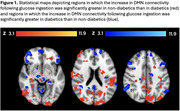 Figure 1
Peer Reviews
No public reviews on file for this paper yet. If you reviewed it on a platform where reviews are public (OpenReview, ICLR, NeurIPS, ICML), you can paste yours below so the community can read it here.
Videos
No videos yet. Explain this paper in a talk, walkthrough, or lecture? Add one.
Taxonomy
TopicsFunctional Brain Connectivity Studies · Dementia and Cognitive Impairment Research · Advanced MRI Techniques and Applications