The Down Alzheimer Barcelona Neuroimaging Initiative (DABNI): Ten Years of Progress in Understanding Alzheimer's in Down Syndrome
Laura Videla, Bessy Benejam, Isabel Barroeta, Susana Fernandez, Javier Arranz, Íñigo Rodríguez‐Baz, José Enrique Arriola‐Infante, Lucía Maure‐Blesa, Laura Del Hoyo, Lídia Vaqué‐Alcázar, Mateus Rozalem Aranha, Alejandra O. Morcillo‐Nieto, Sara E Zsadanyi, Valle Camacho

TL;DR
The DABNI study tracks Alzheimer's in people with Down syndrome over ten years, revealing disease progression patterns and biomarkers for better treatment strategies.
Contribution
DABNI is one of the largest longitudinal studies on Alzheimer's in Down syndrome, offering insights into disease progression and biomarkers.
Findings
AD progression is rare before age 40 but increases significantly after age 50.
Neuropsychological assessments and biomarkers show strong diagnostic performance for symptomatic AD.
A prolonged and predictable preclinical phase of AD was observed, similar to autosomal dominant AD.
Abstract
Down syndrome (DS) is a form of genetically determined Alzheimer's disease (AD). Understanding the natural history and biomarker specificities in this population can offer insights into AD pathogenesis and potential treatment targets. The Down Alzheimer Barcelona Neuroimaging Initiative (DABNI) is a prospective longitudinal cohort of adults with DS that builds on a population‐based health plan screening for neurological conditions (Figure 1). Conducted at the Alzheimer‐Down Unit, the study aims to elucidate the natural history of AD in DS through multimodal biomarker investigations and support clinical trials. Participants undergo neurological and neuropsychological evaluations, blood and cerebrospinal fluid collection, structural 3T brain MRI, PET imaging ([18F]FDG‐PET, amyloid‐PET or tau‐PET), as well as electroencephalography and video‐polysomnography examinations. The DABNI cohort…
Genes, proteins, chemicals, diseases, species, mutations and cell lines named across the full text — each resolved to its canonical identifier and authoritative record.
Click any figure to enlarge with its caption.
 Figure 1
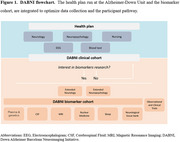 Figure 2
Peer Reviews
No public reviews on file for this paper yet. If you reviewed it on a platform where reviews are public (OpenReview, ICLR, NeurIPS, ICML), you can paste yours below so the community can read it here.
Videos
No videos yet. Explain this paper in a talk, walkthrough, or lecture? Add one.
Taxonomy
TopicsDown syndrome and intellectual disability research · Disability Rights and Representation · Elder Abuse and Neglect