Oxidative Addition of C‐F Bonds to the Phosphoranide Ion [P(C2F5)2F2]−
Lukas Hartmann, Beate Neumann, Hans‐Georg Stammler, Mira Kessler, Berthold Hoge

TL;DR
This paper reports a new method for breaking strong C-F bonds using a phosphoranide ion, enabling the functionalization of fluorinated compounds under mild conditions.
Contribution
The first anionic P(III) species capable of oxidative addition to C-F bonds is presented.
Findings
The [P(C2F5)2F2]− anion reacts with fluorinated arenes, olefins, and acid fluorides to form hexacoordinated P(V) phosphates.
The resulting trifluorophosphates are colorless, thermally stable, and bench stable.
This method expands the tools available for functionalizing strong C-F bonds.
Abstract
Oxidative additions of C─Hal bonds (Hal = F, Cl, Br, I) are widely known for a variety of transition metal complexes owing to their range of oxidation states and flexible coordination sphere. Low valent main group element compounds were shown to mimic this reaction behavior, due to the propensity of changing their oxidation state and coordination number by +2. Yet the addition to C─F bonds is especially challenging due to a large bond dissociation energy. While several examples are known for compounds from group 13 and 14, only few reports demonstrate this type of reaction for compounds from group 15. Herein we report the first anionic P(III) species undergoing an oxidative addition of C─F bonds. The tetracoordinated [P(C2F5)2F2]−‐anion reacts readily with fluorinated arenes, olefins, and acid fluorides yielding respective hexacoordinated P(V) phosphates under mild conditions. The…
Genes, proteins, chemicals, diseases, species, mutations and cell lines named across the full text — each resolved to its canonical identifier and authoritative record.
Click any figure to enlarge with its caption.
 SCHEME 1
 SCHEME 2
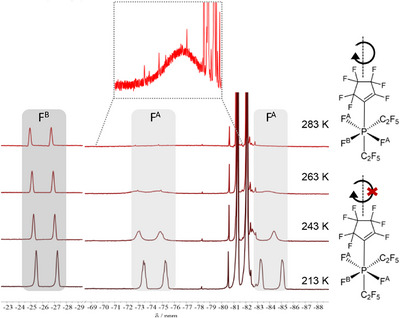 FIGURE 1
 SCHEME 3
 SCHEME 4
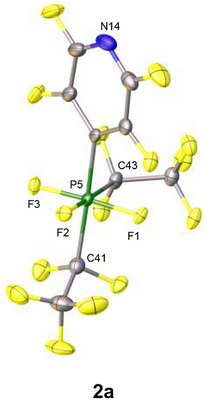 FIGURE 2
|
|
|
|
1
|
1
| |
|---|---|---|---|---|---|
| 2a | −148.7 | −117.4 | −82.0 | −72.0 | −24.9 |
| −117.0 | −80.2 | 892 | 847 | ||
| 2b | −152.4 | −118.5 | −82.0 | −86.0 | −34.5 |
| −117.1 | −80.9 | 863 | 842 | ||
| 2c | −151.2 | −118.6 | −82.0 | −77.5 | −25.7 |
| −117.1 | −81.1 | 859 | 838 | ||
| 2d | −152.2 | −117.7 | −82.1 | −77.1(br) | −47.1 |
| −117.3 | −81.0 | 897[
| 906 | ||
| 2e | −151.1 | −117.6 | −82.1 | −89.2 | −47.0 |
| −117.2 | −81.0 | 898 | 906 |
Peer Reviews
No public reviews on file for this paper yet. If you reviewed it on a platform where reviews are public (OpenReview, ICLR, NeurIPS, ICML), you can paste yours below so the community can read it here.
Videos
No videos yet. Explain this paper in a talk, walkthrough, or lecture? Add one.
Taxonomy
TopicsSynthesis and characterization of novel inorganic/organometallic compounds · Inorganic Fluorides and Related Compounds · Phosphorus compounds and reactions
Introduction
1
Oxidative additions often represent pivotal steps in catalytic reactions and activations of small molecules such as H_2_, CO_2_, and NH_3_ introducing a simple way for functionalization of unreactive substrates [1, 2]. This mechanistic step, crucial for various catalytic transformations, is well known across several transition metals owing to their multiple stable oxidation states and variable coordination spheres [3, 4]. The oxidative addition step is particularly demanding in the context of C─F bonds due to their inherently high bond dissociation energy [5]. Yet, this obstacle has spurred intensive research in the last decades [4, 6, 7, 8, 9].
More recently, the development of transition‐metal‐free strategies for the activation of otherwise inert bonds has emerged. Amid these efforts, main‐group element compounds offer potential alternatives, although their application has been restricted by limitations in oxidation states and coordination numbers. Nevertheless, low‐valent compounds in low oxidation states, as they are reported for most group 13 [10, 11, 12, 13, 14] and 14 [15, 16, 17, 18, 19, 20] elements, have been proven to undergo oxidative additions.
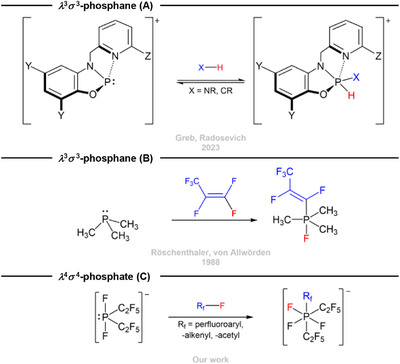
Examples of oxidative addition reactions involving group 15 compounds remain scarce, particularly in the context of C─F bonds [21, 22, 23, 24, 25, 27]. While phosphenium cations have been documented to undergo oxidative additions to different E─H bonds (E = B, C, Si, N), the activation of C─F bonds has not been elucidated [26, 27]. Reaction of P(CH_3_)3 with hexafluoropropene yielding the respective phosphorane, reported by the group of röschenthaler, was the first example of a neutral phosphane undergoing oxidative addition of a C─F bond [23]. Additionally, radosevich and co‐workers reported a geometrically constrained triaminophosphane that underwent oxidative addition to aryl‐C─F bonds, while the group of dobrovetsky demonstrated the same reactivity for a cationic phosphane [24, 25]. Moreover, pang et al. demonstrated the ability of a bismuthinidene to undergo oxidative addition of aryl─C─F bonds [28]. Recently our group reported on the tris(pentafluoroethyl)silanide anion reacting with alkenyl─ and aryl─C─F bonds via oxidative addition [29].
Based on these findings, we aim to extend the oxidative addition reactions from cationic and neutral phosphorus compounds to an anionic P(III) species. The synthesis of the [P(C_2_F_5_)2_F_2]^−^ anion as its [EtP_4_H]^+^ salt ([EtP_4_H] = [{(Et_2_N)_3_P = N}3_P = N(H){C(CH_3)3}]), along with a study of its ligand properties, has recently been reported by our group [30, 31].
Results and Discussion
2
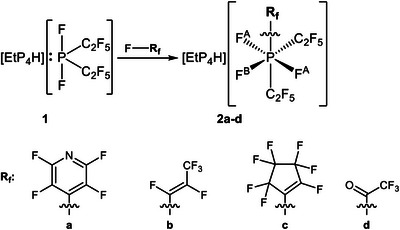
The difluorobis(pentafluoroethyl)phosphoranide, [P(C_2_F_5_)2_F_2]^−^, reacts with pentafluoropyridine (a) as well as hexafluoropropene (b), octafluorocyclopentene (c), and trifluoroacetylfluoride (d) (Scheme 2). Moreover, a reaction with hexafluoropropeneoxide leads to the formation of a carbonylphosphate. These results underscore the versatility of main‐group element compounds in bond activation chemistry.
Examples for oxidative addition reactions by a cationic phosphenium (A) [27], a neutral phosphane (B) [23], and an anionic phosphoranide (C).
All reactions exhibit rapid kinetics, achieving completion within hours at room temperature. The respective phosphates were analyzed by multinuclear NMR spectroscopy and single crystal X‐ray diffraction analysis.
Phosphates 2a‐d (Scheme 2) give rise to signals between −148 ppm and −152 ppm in the ^31^P NMR spectra, typical for hexavalent P(V) phosphates. A large triplet of doublet splitting caused by coupling between the central phosphorus atom and directly bonded fluorine atoms (F** ^A^ , F ^B^ **) suggest two types of fluorine atoms. In the ^19^F NMR spectra F^B^ is strongly shifted toward lower field in comparison to F^A^ (Table 1). The CF_2_ units within the C_2_F_5_ groups exhibit two distinct resonances in the ^19^F NMR spectrum, indicating chemical inequivalence of the two groups. Based on these NMR spectroscopic data, a meridional arrangement in solution is suggested, which is consistent with other trifluoroorganylphosphates [32, 33].
Reaction of phosphoranide 1 with different fluorinated substrates yielding the respective oxidative addition products.
The ^19^F NMR spectroscopic analysis of phosphate 2c revealed a pronounced temperature dependence. At room temperature, the resonance of fluorine atom B appears as a doublet at −25.7 ppm with a ^1^ J F,P coupling constant of 838 Hz, whereas the signal for fluorine atoms A is observed as a single broad resonance at −77.5 ppm without resolved couplings (Figure 1). Upon cooling to 213 K, three distinct doublets emerge (−84.2 ppm, −72.2 ppm, and −25.6 ppm) corresponding to the three fluorine atoms at the phosphorus center. Thus, at low temperatures the rate constants for the exchange processes are decreased sufficiently to resolve the coupling patterns.
Section from the 19F NMR spectrum of phosphate 2c at different temperatures. Rotation of the cyclopentenyl substituent restricted at low temperatures.
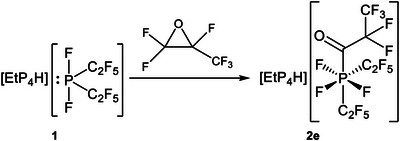
Reaction of phosphoranide 1 with perfluoropropene oxide did not afford the direct oxidative addition product but instead yielded carbonylphosphate 2e (Scheme 3).
Reaction of phosphoranide 1 with hexafluoropropene oxide yielding phosphate 2e.
A feasible pathway for this transformation may proceed though isomerization of hexafluorenepropene oxide, which has been reported in the literature to occur in the presence of nucleophiles (Scheme 4) [34]. The resulting acid fluoride could then react analogously to trifluoroacetyl fluoride to furnish phosphate 2e.
Possible reaction pathway for the reaction of phosphoranide 1 with hexafluoropropene oxide.
Molecular composition of phosphates 2a‐e was confirmed via high precision elemental analysis and single crystals, suitable for X‐ray diffraction analyses, were obtained for phosphates 2a,b, and 2d. However, a detailed discussion of the structural parameters of phosphates 2b and 2d is not possible due to the use of many restraints (structures depicted in the Supporting Information, Figure S25).
Molecular structure in the solid state of phosphate 2a. Thermal ellipsoids are shown at the 50% probability level. [EtP4H]+ cation and minor occupied disordered atoms are omitted for clarity (See Supporting Information for further information). Selected bond lengths and angles are compiled in the Supporting Information Table (S1).
The solid‐state structures of phosphates 2a (Figure 2), 2b, and 2d reveal central phosphorus atoms adopting a regular octahedral coordination environment [35]. The meridional arrangement, that had already been observed in solution, is retained in the solid state, with the newly introduced substituent positioned trans to one of the C_2_F_5_ groups. The P─F bond lengths in 2a fall within a rather narrow range of 161.1(2)–161.7(2) pm, which is notably shorter than the P─F bonds in phosphoranide 1 (183.6(5) pm and 173.2(6) pm), in line with the expectations [30]. Remaining structural parameters do not show noteworthy deviations and will therefore not be discussed in detail.
Conclusion
3
In summary, we have demonstrated that the difluorobis(pentafluoroethyl)phosphoranide [P(C_2_F_5_)2_F_2]^−^ undergoes oxidative addition to C─F bonds, thus establishing the first anionic P(III) species capable of this transformation. The resulting hexacoordinated P(V) phosphates are bench‐stable, colorless solids and were characterized by multinuclear NMR spectroscopy. The molecular composition was confirmed by elemental analysis, whereas single‐crystal X‐ray diffraction confirmed the molecular structures of phosphates 2a, b, and 2d. This reactivity highlights the versatility of main‐group element compounds and expands their applicability in the activation of strong C─F bonds.
Conflicts of Interest
The authors declare no conflict of interest.
Supporting information
Supporting Information file 1: Additional references cited within the Supporting Information [36, 37, 38]
Supporting Information file 2: chem70542‐sup‐0002‐DataFile.zip
The reference list from the paper itself. Each links out to its DOI / PubMed record.
- 1H. Valdés , M. A. García‐Eleno , D. Canseco‐Gonzalez , and D. Morales‐Morales , “Recent Advances in Catalysis with Transition‐Metal Pincer Compounds,” Chemcatchem 10 (2018): 3136–3172.
- 2P. Sreejyothi and S. K. Mandal , “From CO 2 Activation to Catalyic Reduction: A Metal Free Approach,” Chemical Science 11 (2020): 10571–10593.34094313 10.1039/d 0sc 03528 a PMC 8162374 · doi ↗ · pubmed ↗
- 3J. A. Labinger , “Tutorial on Oxidative Addition,” Organometallics 34 (2015): 4784–4795, 10.1021/acs.organomet.5b 00565. · doi ↗
- 4L. M. Rendina and R. J. Puddephatt , “Oxidative Addition Reactions of Organoplatinum(II) Complexes With Nitrogen‐Donor Ligands,” Chemical Reviews 97 (1997): 1735–1754, 10.1021/cr 9704671.11848891 · doi ↗ · pubmed ↗
- 5Y. G. Lazarou , A. V. Prosmitis , V. C. Papadimitriou , and P. Papagiannakopoulos , “Theoretical Calculation of Bond Dissociation Energies and Enthalpies of Formation for Halogenated Molecules,” Journal of Physical Chemistry A 105 (2001): 6729–6742, 10.1021/jp 010309 k. · doi ↗
- 6J. K. Stille and K. S. Y. Lau , “Mechanisms of Oxidative Addition of Organic Halides to Group 8 Transition‐Metal Complexes,” Accounts of Chemical Research 10 (1977): 434–442, 10.1021/ar 50120 a 002. · doi ↗
- 7T. Schaub , M. Backes , and U. Radius , “Catalytic C−C Bond Formation Accomplished by Selective C−F Activation of Perfluorinated Arenes,” Journal of the American Chemical Society 128 (2006): 15964–15965, 10.1021/ja 064068 b.17165711 · doi ↗ · pubmed ↗
- 8M. F. Kuehnel , T. Schlöder , S. Riedel , et al., “Synthesis of the Smallest Axially Chiral Molecule by Asymmetric Carbon–Fluorine Bond Activation,” Angewandte Chemie International Edition 51 (2012): 2218–2220, 10.1002/anie.201108105.22267021 · doi ↗ · pubmed ↗