Transient RBBB and Temporary LBBB Following Transcatheter Aortic Valve Replacement
Jiayu Liang, Suxin Luo, Bi Huang

TL;DR
A patient developed temporary heart conduction issues after a heart valve procedure, highlighting the need for careful monitoring and extended pacemaker use.
Contribution
This case report highlights the rare sequence of transient RBBB followed by LBBB after TAVR and suggests extended monitoring and pacemaker use.
Findings
An 82-year-old patient developed transient RBBB followed by persistent LBBB after TAVR.
Both conduction abnormalities resolved within a month.
New-onset RBBB may predict subsequent LBBB, requiring extended monitoring.
Abstract
Post-transcatheter aortic valve replacement (TAVR) conduction disturbances typically manifest as left bundle branch block (LBBB). Sequential right bundle branch block (RBBB) followed by LBBB is extremely rare. An 82-year-old female developed transient RBBB 1 hour after TAVR, followed by persistent LBBB 1 day later. Both conduction abnormalities resolved at the 1-month follow-up. New-onset RBBB may herald subsequent LBBB, warranting extended monitoring periods. RBBB is uncommon after TAVR, but it should not be underestimated. In patients with RBBB following the procedure, prolonging the duration of temporary pacemaker implantation may be a prudent and clinically reasonable strategy.
Genes, proteins, chemicals, diseases, species, mutations and cell lines named across the full text — each resolved to its canonical identifier and authoritative record.
Click any figure to enlarge with its caption.
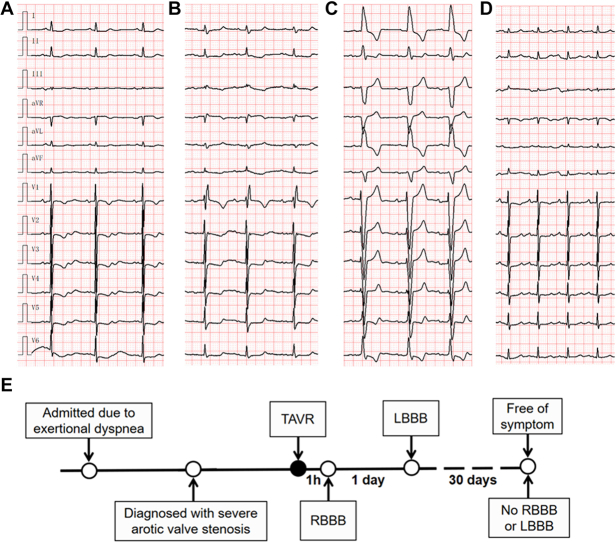 Figure 1
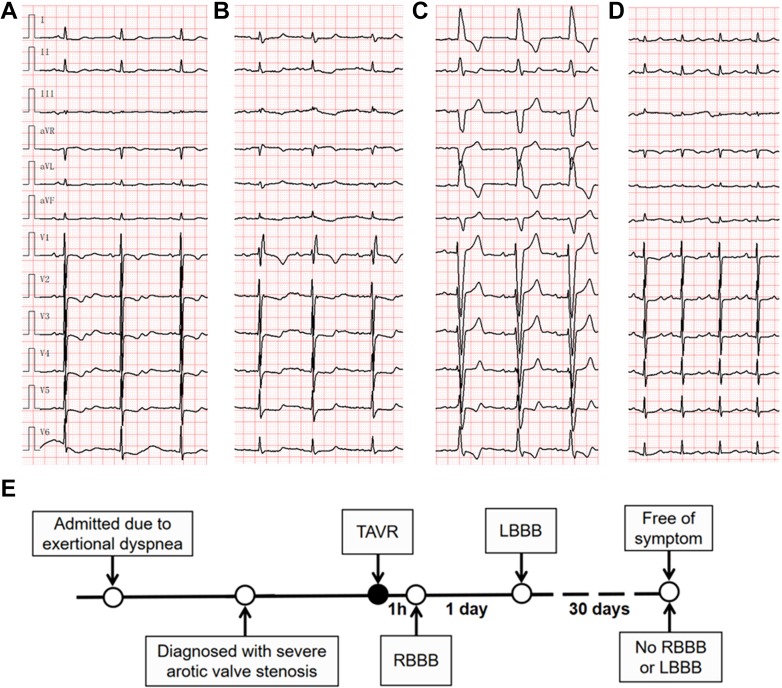 Figure 2
Peer Reviews
No public reviews on file for this paper yet. If you reviewed it on a platform where reviews are public (OpenReview, ICLR, NeurIPS, ICML), you can paste yours below so the community can read it here.
Videos
No videos yet. Explain this paper in a talk, walkthrough, or lecture? Add one.
Taxonomy
TopicsCardiac Valve Diseases and Treatments · Cardiac, Anesthesia and Surgical Outcomes · Cardiac Imaging and Diagnostics
An 82-year-old woman was admitted due to exertional dyspnea. Transthoracic echocardiography revealed the aortic valve area was 0.4 cm^2^. The patient successfully underwent transcatheter aortic valve replacement (TAVR) and had a self-expanding 23.5 × 46-mm Venus A-Valve implanted. The patient was implanted with a temporary pacemaker during the procedure, which was retained post TAVR. The electrocardiogram (ECG) before TAVR is shown in Figure 1A. One hour after the TAVR procedure, the ECG showed complete right bundle branch block (RBBB) (Figure 1B).Take-Home Messages
- •Right bundle branch block is uncommon after transcatheter aortic valve replacement, but it should not be underestimated.
- •In patients with right bundle branch block following the procedure, prolonging the duration of temporary pacemaker implantation may be a prudent and clinically reasonable strategy. Figure 1. Electrocardiographic Changes Before and After Transcatheter Aortic Valve Replacement(A) ECG showed no atrioventricular block before TAVR; (B) ECG showed RBBB after TAVR; (C) RBBB changed from RBBB to LBBB 1 day after TAVR; (D) atrioventricular block disappeared during follow up. (E) Timeline of the patient's diagnostic and treatment. LBBB = left bundle branch block; RBBB = right bundle branch block; TAVR = transcatheter aortic valve replacement.
Which of the following is correct regarding the clinical significance of RBBB post TAVR?
- (A)Does not increase the risk of permanent pacemaker implantation (PPI).
- (B)Not related to the damage of the cardiac conduction system.
- (C)Prolonged monitoring with a temporary pacemaker may be necessary.
- (D)Requires immediate treatment with PPI.
The correct answer is C.
For this patient, 1 day after TAVR, ECG displayed complete left bundle branch block (LBBB) (Figure 1C). During the first 24 hours after TAVR, while under the protection of a temporary pacemaker, the patient reported no discomfort. Subsequent Holter and ECG monitoring indicated a persistent LBBB during hospitalization. At the 30-day follow-up after discharge, ECG showed resolution of the LBBB (Figure 1D). The patient's entire treatment course and the timeline of electrocardiographic changes are presented in Figure 1E.
Preexisting RBBB is a well-established risk factor for PPI following TAVR.1 However, the prognostic significance of newly developed RBBB after TAVR is poorly studied. Tan et al2 explored 1992 patients undergoing TAVR and found post-TAVR RBBB was significantly associated with increased risk of PPI.
The case we report, involving RBBB followed by LBBB after TAVR, is extremely rare. The exact mechanism remains unclear, but there are some possible interpretations. The His bundle serves as the common origin for the left and right bundle branches. Damage to the bundle branches can manifest as selective or sequential bundle branch block. The progression from RBBB to LBBB post TAVR typically signifies a sequential impairment of the conduction system, wherein the right bundle branch is initially affected, followed by involvement of the left bundle branch or its fascicles. In addition to anatomical factors, procedure-related aspects of TAVR, such as mechanical compression by the valve, valve type and size, and localized inflammation or edema following valve implantation, may all contribute to the development of conduction block.
Current expert consensus recommends that patients who develop new-onset LBBB after TAVR should be monitored for at least 24 hours following temporary pacemaker implantation.3 In our case, the patient developed RBBB post TAVR, which progressed to LBBB the following day. During this period, the patient was under the protection of a temporary pacemaker. If the patient had not been supported by a temporary pacemaker, and LBBB had occurred without resolution of RBBB, this could have resulted in complete atrioventricular block, potentially leading to syncope or even sudden cardiac death. Unfortunately, there is a lack of electrocardiographic data capturing the transition from RBBB to LBBB and the accurate timing of this transition. Therefore, new-onset RBBB may herald subsequent LBBB, warranting extended monitoring periods.
Funding Support and Author Disclosures
The authors have reported that they have no relationships relevant to the contents of this paper to disclose.
The reference list from the paper itself. Each links out to its DOI / PubMed record.
- 1Shrestha B.De Boer R.Poudel B.Gyawali P.Donato A.Impact of pre-existing right bundle branch block on In-Hospital outcomes following transcatheter aortic valve replacement: insight from national inpatient sample database, 2016-2019 Curr Probl Cardiol 4710202210129810.1016/j.cpcardiol.2022.10129835753400 · doi ↗ · pubmed ↗
- 2Tan N.Y.Adedinsewo D.El Sabbagh A.Incidence and outcomes of new-onset right bundle branch block following transcatheter aortic valve replacement Circ Arrhythm Electrophysiol 1722024 e 01237710.1161/CIRCEP.123.012377 PMC 1116625938288627 · doi ↗ · pubmed ↗
- 3Lilly S.M.Deshmukh A.J.Epstein A.E.2020 ACC expert consensus decision pathway on management of conduction disturbances in patients undergoing transcatheter aortic valve replacement: a report of the American College of Cardiology solution set oversight committee J Am Coll Cardiol 76202020239124113319068310.1016/j.jacc.2020.08.050 · doi ↗ · pubmed ↗