Intervention‐related changes in variability of dynamic functional connectivity and the relationship to cognition in older adults at risk for Alzheimer's disease
Paulina Skolasinska, Caitlin S. Walker, Adrian Noriega de la Colina, Alfie Wearn, Colleen S. Hughes, Roni Setton, Jillian Caplan, Laurence Côté, Kayla Williams, Sofia Ricciardelli, Linda Li, Carolynn Boulanger, Nagashree Thovinakere, Garance Barnoin, Sarah Elbaz

TL;DR
A physical activity intervention reduced brain connectivity variability in older adults at risk for Alzheimer's, which was linked to better cognitive performance.
Contribution
This study shows that physical activity can reduce age-related variability in brain connectivity linked to Alzheimer's risk and cognitive improvement.
Findings
The intervention group showed decreased modularity and maintained system segregation in the DefaultC network compared to the control group.
Reduced variability in DefaultC network modularity correlated with improved performance on a cognitive task.
The DefaultC network includes brain regions vulnerable to Alzheimer's pathology.
Abstract
Aging is associated with a decline in specific cognitive abilities and increased variability of dynamic functional connectivity (v‐dFC; Jauny et al., 2022), across the whole brain (Yang et al., 2023) and in the default network (Douw et al., 2016; Madhyastha & Grabowski, 2014). We investigated the extent to which age‐related changes in v‐dFC would be mitigated by an intervention to enhance physical activity in older adults at risk for Alzheimer's disease (AD) and whether the changes in v‐dFC were related to cognitive improvements. 50 participants from the PREVENT‐AD longitudinal cohort (Tremblay‐Mercier et al., 2021) with a family history of AD were assigned to the intervention (N = 21; Mage=69.8 years) or the active control group (N = 29; Mage=70.3 years) for a four‐week randomized controlled trial. Multi‐echo gradient‐echo EPI sequence was used to acquire resting‐state functional MRI…
Genes, proteins, chemicals, diseases, species, mutations and cell lines named across the full text — each resolved to its canonical identifier and authoritative record.
Click any figure to enlarge with its caption.
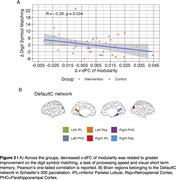 Figure 1
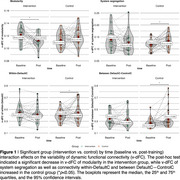 Figure 2
Peer Reviews
No public reviews on file for this paper yet. If you reviewed it on a platform where reviews are public (OpenReview, ICLR, NeurIPS, ICML), you can paste yours below so the community can read it here.
Videos
No videos yet. Explain this paper in a talk, walkthrough, or lecture? Add one.
Taxonomy
TopicsFunctional Brain Connectivity Studies · Dementia and Cognitive Impairment Research · Advanced Neuroimaging Techniques and Applications