A probabilistic framework for the diagnostic utility of tau‐PET
Bastiaan G J van Tol, Colin Groot, Elsmarieke van de Giessen, Yolande A.L. Pijnenburg, Emma M. Coomans, Rik Ossenkoppele

TL;DR
This study evaluates how useful tau-PET scans are for diagnosing Alzheimer's disease, showing they are highly accurate and even more so when combined with amyloid-PET results.
Contribution
The paper introduces a probabilistic framework to assess the diagnostic value of tau-PET in Alzheimer's disease, integrating age, amyloid status, and prior diagnostic certainty.
Findings
Tau-PET has high positive predictive value for Alzheimer's, especially in younger individuals with higher prior probability of the disease.
Combining tau-PET with amyloid-PET significantly improves diagnostic accuracy, particularly in older individuals with lower prior probability of Alzheimer's.
Tau-PET's negative predictive value is consistently high, effectively ruling out Alzheimer's across age groups.
Abstract
The tau‐PET radiotracer [18F]flortaucipir enables in vivo detection of tau pathology in Alzheimer's Disease (AD) and has recently been FDA‐ and EMA‐approved for clinical use. To support its implementation, we assessed tau‐PET's positive predictive value (PPV) and negative predictive value (NPV) for clinico‐pathological AD while accounting for age, amyloid‐status, and pre‐PET diagnostic certainty. We computed the PPV and NPV of tau‐PET using a formula that considers two types of false‐positivity: clinico‐pathological (positive tau‐PET, yet tau does not significantly contribute to cognitive decline) and pathological (positive tau‐PET, yet no/low tau is found at autopsy; Figure 1C). A systematic review yielded a weighted sensitivity of 93.6% and specificity of 83.9% for [18F]flortaucipir to detect postmortem Braak V/VI tau pathology (N = 349; Figure 1A). PPV and NPV were calculated across…
Genes, proteins, chemicals, diseases, species, mutations and cell lines named across the full text — each resolved to its canonical identifier and authoritative record.
Click any figure to enlarge with its caption.
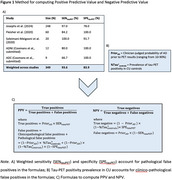 Figure 1
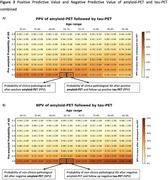 Figure 2
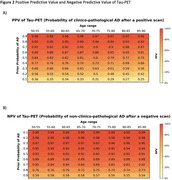 Figure 3
Peer Reviews
No public reviews on file for this paper yet. If you reviewed it on a platform where reviews are public (OpenReview, ICLR, NeurIPS, ICML), you can paste yours below so the community can read it here.
Videos
No videos yet. Explain this paper in a talk, walkthrough, or lecture? Add one.
Taxonomy
TopicsDementia and Cognitive Impairment Research · Alzheimer's disease research and treatments · Schizophrenia research and treatment