Clinical validation of Lumipulse G1200 automated immunoassays for Alzheimer's disease biomarkers in a Quebec cohort
Tevy Chan, Nesrine Rahmouni, Yansheng Zheng, Marina P Gonçalves, Joseph Therriault, Arthur C. Macedo, Lydia Trudel, Kely Monica Quispialaya Socualaya, Seyyed Ali Hosseini, Brandon J Hall, Yi‐Ting Wang, Etienne Aumont, Jaime Fernandez Arias, Gleb Bezgin, Stijn Servaes

TL;DR
This study validates the Lumipulse G1200 immunoassays for detecting Alzheimer's disease biomarkers in blood and spinal fluid, showing strong agreement with PET scans in a Quebec cohort.
Contribution
The study provides clinical validation of the Lumipulse G1200 immunoassays for Alzheimer's disease biomarkers in a real-world population.
Findings
Plasma p-tau217 strongly correlates with amyloid and tau PET scans and outperforms p-tau181 in detecting tau pathology.
Lumipulse G1200 immunoassays show high diagnostic accuracy for Alzheimer's disease biomarkers in both plasma and CSF.
Plasma p-tau217 performs similarly to CSF p-tau181 in predicting amyloid and tau PET positivity.
Abstract
With the anticipated arrival of disease‐modifying treatments for Alzheimer's disease (AD) in Canada, integrating biomarkers into clinical practice is crucial to enhancing diagnostic accuracy and optimizing referrals for treatment. Lumipulse G1200 (Fujirebio) is a fully automated immunoassay instrument that streamlines the analysis of these biomarkers. In this study, we evaluated the diagnostic performance of Lumipulse G1200 plasma and CSF immunoassays in detecting AD pathology within a Quebec population cohort. Plasma and CSF samples of 102 participants from the TRIAD cohort (median age 67 years, 54% female) were analysed. Kruskal‐Wallis with post hoc Benjamini‐Hochberg false discovery rate (BH) correction compared the levels of biomarkers among the diagnostic groups. Discriminative performance for Aβ (18F‐NAV4694) and tau (18F‐MK6240) PET status was assessed using the area under the…
Genes, proteins, chemicals, diseases, species, mutations and cell lines named across the full text — each resolved to its canonical identifier and authoritative record.
Click any figure to enlarge with its caption.
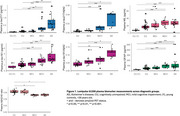 Figure 1
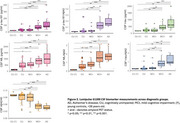 Figure 2
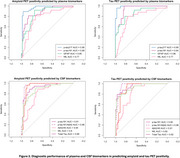 Figure 3
Peer Reviews
No public reviews on file for this paper yet. If you reviewed it on a platform where reviews are public (OpenReview, ICLR, NeurIPS, ICML), you can paste yours below so the community can read it here.
Videos
No videos yet. Explain this paper in a talk, walkthrough, or lecture? Add one.
Taxonomy
TopicsAlzheimer's disease research and treatments · Dementia and Cognitive Impairment Research · Clusterin in disease pathology