Digital Cognitive Markers to Characterize Preclinical Stages of autosomal‐dominant Alzheimer's Disease: A Preliminary Study
Stella Maris Valencia, Juan Pablo Sanchez, David Fernando Aguillón Niño, Ana Y Baena, Natalia Londono, Susana Ramirez, Sandra P. Trujillo, Diana Gomez, Diego Camilo Díaz, Katherine L. Possin, Natalia Trujillo Orrego

TL;DR
This study explores a digital tool called TabCAT-BHA to detect early cognitive changes in people with a genetic risk for Alzheimer's disease before symptoms appear.
Contribution
The study introduces and validates TabCAT-BHA as a scalable digital tool for preclinical Alzheimer's detection.
Findings
TabCAT-BHA detected cognitive differences in memory, visuospatial ability, and language between carriers and non-carriers of the PSEN1-E280A mutation.
The digital tool showed moderate correlation with traditional neuropsychological tests, supporting its concurrent validity.
Non-carriers performed better across cognitive domains, suggesting early preclinical changes in mutation carriers.
Abstract
Alzheimer's disease and related dementias are rising at an alarming rate (>300%), leading to human and economic losses, particularly in resource‐limited low‐ and middle‐income countries. This exacerbates health disparities and underscores the urgent need for scalable early detection tools to support preventive intervention strategies. Emerging digital cognitive assessment tools, such as TabCAT‐BHA, a 15‐minute tablet‐based battery, offer a practical alternative for identifying early cognitive markers. Colombia's autosomal dominant PSEN1‐E280A genetic variant cohort, causative of early‐onset familial AD, provides a unique opportunity to examine preclinical cognitive changes associated with the disease. As the need for innovative cognitive markers rises, evidence on their validity is essential for determining their clinical utility. The objective is to evaluate the validity of TabCAT‐BHA…
Genes, proteins, chemicals, diseases, species, mutations and cell lines named across the full text — each resolved to its canonical identifier and authoritative record.
Click any figure to enlarge with its caption.
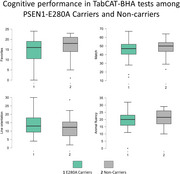 Figure 1
Peer Reviews
No public reviews on file for this paper yet. If you reviewed it on a platform where reviews are public (OpenReview, ICLR, NeurIPS, ICML), you can paste yours below so the community can read it here.
Videos
No videos yet. Explain this paper in a talk, walkthrough, or lecture? Add one.
Taxonomy
TopicsDementia and Cognitive Impairment Research · Alzheimer's disease research and treatments · Phosphodiesterase function and regulation