Sleep apnea moderation of cortical amyloid‐β and plasma p‐tau217 in ethnically diverse older adults
Shannon Y. Lee, Olivia M Emanuel, Emily F Matusz, Wei‐en Wang, Franchesca Arias, Shellie‐Anne Levy, Idaly Velez‐Uribe, Warren W Barker, Monica Rosselli, David E. Vaillancourt, Melissa J. Armstrong, Rosie E Curiel Cid, David A. Loewenstein, Ranjan Duara, Glenn E. Smith

TL;DR
This study finds that sleep apnea strengthens the link between brain amyloid and a blood marker for Alzheimer's, but this effect is only seen in non-Hispanic/Latino individuals.
Contribution
The study reveals that sleep apnea moderates the relationship between amyloid and plasma p-tau217, with ethnic differences in this moderation.
Findings
Sleep apnea strengthens the association between amyloid burden and plasma p-tau217 levels.
This moderation effect is only observed in non-Hispanic/Latino participants.
The effect is not influenced by sex or APOE e4 carrier status.
Abstract
Sleep apnea is a potential risk factor for Alzheimer's Disease (AD). Associations between sleep apnea and elevated AD biomarkers like amyloid beta (Aβ) and p‐tau have been reported, but it is unclear if or how sleep apnea influences the connection between the two. The link between sleep apnea and AD also has not been extensively studied in the context of relevant demographic, sociocultural, and common genetic factors. Therefore, we assessed the moderating effects of sleep apnea on the association between Aβ‐PET and plasma p‐tau217 and whether this moderation differed based on sex, ethnicity, or APOE e4 carrier status. We studied 1Florida ADRC participants (N = 288) with normal cognition, mild cognitive impairment, or dementia (Table 1). Presence or absence of sleep apnea was determined from the National Alzheimer's Coordinating Center Health History. All participants had plasma samples…
Genes, proteins, chemicals, diseases, species, mutations and cell lines named across the full text — each resolved to its canonical identifier and authoritative record.
Click any figure to enlarge with its caption.
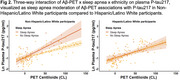 Figure 1
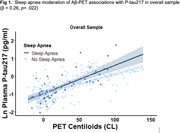 Figure 2
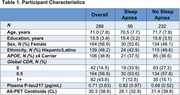 Figure 3
Peer Reviews
No public reviews on file for this paper yet. If you reviewed it on a platform where reviews are public (OpenReview, ICLR, NeurIPS, ICML), you can paste yours below so the community can read it here.
Videos
No videos yet. Explain this paper in a talk, walkthrough, or lecture? Add one.
Taxonomy
TopicsObstructive Sleep Apnea Research · Sleep and related disorders · Sleep and Wakefulness Research