APOEε4 Does not increase rate of amyloid accumulation or tau phosphorylation in adults with Down Syndrome
Omar Abdelmoity, Julie K. Wisch, Benjamin L Handen, Bradley T Christian, Mark Mapstone, H. Diana Rosas, Florence Lai, Joseph H. Lee, Sharon J. Krinsky‐McHale, Frederick A Schmitt, Jordan P. Harp, Christy L. Hom, Ira T. Lott, Sigan L Hartley, Shahid Zaman, Lauren Ptomey

TL;DR
APOEε4 does not accelerate amyloid or tau buildup in adults with Down Syndrome, though a possible effect on tau in mid-40s is suggested.
Contribution
This study is the first to longitudinally examine APOEε4's impact on amyloid and tau in Down Syndrome using plasma pTau217 and PET scans.
Findings
APOEε4 carriers with Down Syndrome showed similar baseline amyloid and pTau217 levels compared to non-carriers.
The rate of amyloid and pTau217 accumulation did not differ significantly between APOEε4 carriers and non-carriers.
A potential APOEε4 effect on tau phosphorylation was observed in individuals aged 45-50, near symptom onset age.
Abstract
Down syndrome (DS) represents a genetic form of Alzheimer's disease (AD) with an earlier expected symptom onset compared to late onset AD (LOAD). It is thought that the extra copy of the Amyloid Precursor Protein (APP) gene, located on chromosome 21 contributes to the earlier onset due to increased amyloid deposition in the brain. Hyperphosphorylation of tau protein is also thought to be elevated in the beginning stages of AD pathology within DS. Although APOEε4 has been associated with greater AD risk in LOAD, prior cross‐sectional investigations into the effects of APOEε4 in DS have suggested that there is no additional impact of APOEε4 on the accumulation of amyloid. We aimed to extend this work by examining the associations between longitudinal plasma pTau217 and amyloid PET as a function of APOEε4 status. Participants with DS were recruited from the Alzheimer's Biomarker…
Genes, proteins, chemicals, diseases, species, mutations and cell lines named across the full text — each resolved to its canonical identifier and authoritative record.
Click any figure to enlarge with its caption.
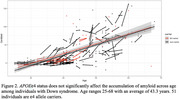 Figure 1
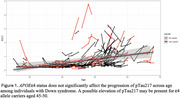 Figure 2
Peer Reviews
No public reviews on file for this paper yet. If you reviewed it on a platform where reviews are public (OpenReview, ICLR, NeurIPS, ICML), you can paste yours below so the community can read it here.
Videos
No videos yet. Explain this paper in a talk, walkthrough, or lecture? Add one.
Taxonomy
TopicsDown syndrome and intellectual disability research · Alzheimer's disease research and treatments · Diabetes Management and Research