Calibration of multi‐site raters for prospective visual read of amyloid PET scans acquired across the ADRC Consortium for Clarity in ADRD Research Through Imaging (CLARiTI)
David N. Soleimani‐Meigooni, Ganna Blazhenets, Renaud La Joie, Zoe Lin, Carol Soppe, Derek R. Johnson, Mary Ellen I. Koran, Jonathan E. McConathy, Ilya M. Nasrallah, Jeremy A. Tanner, Victor L. Villemagne, Charles C. Windon, Michael Zeineh, Elizabeth C. Mormino

TL;DR
This study develops a calibration method to ensure accurate amyloid PET scan readings across multiple sites and raters in a large Alzheimer's research project.
Contribution
The novel contribution is a calibration process for multi-site raters using diverse imaging tools and amyloid tracers to ensure reliable visual reads.
Findings
Calibration scans showed 97% concordance and almost perfect agreement between readers (κ=0.932).
Intra-rater agreement was 98% with almost perfect agreement (κ=0.966).
Discordant scans were mostly borderline cases with Centiloid values between 8-21.
Abstract
PET visual reads for multi‐center studies are conducted centrally by one or a few experts. In CLARiTI, a broader network of raters will perform the reads, necessitating methods to ensure their accuracy and reliability. All ADRC sites (N = 37) will prospectively acquire amyloid PET scans for 800 cognitively unimpaired and 1200 cognitively impaired participants. Each site can use one of four amyloid PET tracers ([18F]florbetaben, [18F]florbetapir, [11C]PIB, [18F]NAV4694). PET scans will be visually interpreted by ten PET neuroimaging experts located across eight ADRCs, using their preferred hardware, software, and file format (DICOM, NIFTI). Calibration requires readers to perform blinded, independent visual interpretation of 180 amyloid PET scans (30 unique and 15 duplicate scans per tracer), previously read and selected by an expert (Table 1). An even mix of visually non‐elevated and…
Genes, proteins, chemicals, diseases, species, mutations and cell lines named across the full text — each resolved to its canonical identifier and authoritative record.
Click any figure to enlarge with its caption.
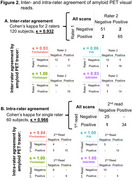 Figure 1
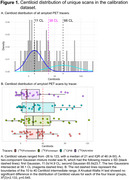 Figure 2
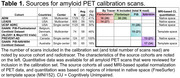 Figure 3
Peer Reviews
No public reviews on file for this paper yet. If you reviewed it on a platform where reviews are public (OpenReview, ICLR, NeurIPS, ICML), you can paste yours below so the community can read it here.
Videos
No videos yet. Explain this paper in a talk, walkthrough, or lecture? Add one.
Taxonomy
TopicsDementia and Cognitive Impairment Research · Functional Brain Connectivity Studies · Alzheimer's disease research and treatments