Impact of Cytokine Genes on TMD and QoL in Construction Workers
André Miquilussi Moreira, Samantha Schaffer Pugsley Baratto, Débora Cristina Cardozo Bueno, Gisele Maria Correr, Cristiano Miranda de Araujo, Christian Kirschneck, Bianca Cavalcante-Leão, Erika Calvano Küchler, Flares Baratto-Filho, Michelle Nascimento Megerx

TL;DR
This study found that genetic variations in interleukin genes affect the quality of life in construction workers with temporomandibular disorders.
Contribution
The study links specific interleukin gene polymorphisms to oral health-related quality of life in TMD patients.
Findings
Heterozygous AG in IL1B rs1143629 increased physical pain and disability in TMD patients.
Homozygous CC in IL6 rs1800796 was linked to higher handicap scores in TMD individuals.
Genetic polymorphisms in IL1B and IL6 are associated with OHRQoL in TMD patients.
Abstract
Temporomandibular disorders (TMD) include changes related to the presence of orofacial pain, limited mouth opening, and inflammatory issues. These inflammatory issues are related to interleukins, which are inflammatory mediators. Thus, the presence of genetic polymorphisms in genes that encode interleukins could impact TMD. Therefore, this cross-sectional study aimed to assess the impact of genetic polymorphisms in the genes encoding interleukins on the oral health-related quality of life (OHRQoL) of individuals with TMD. A total of 230 male construction workers were evaluated regarding the presence of TMD with or without pain, as well as changes in the temporomandibular joint (TMJ), using the Research Diagnostic Criteria for Temporomandibular Disorders (RDC/TMD). OHRQoL was assessed using the 14-item Oral Health Impact Profile (OHIP-14). DNA extracted from saliva was used to evaluate…
Genes, proteins, chemicals, diseases, species, mutations and cell lines named across the full text — each resolved to its canonical identifier and authoritative record.
Click any figure to enlarge with its caption.
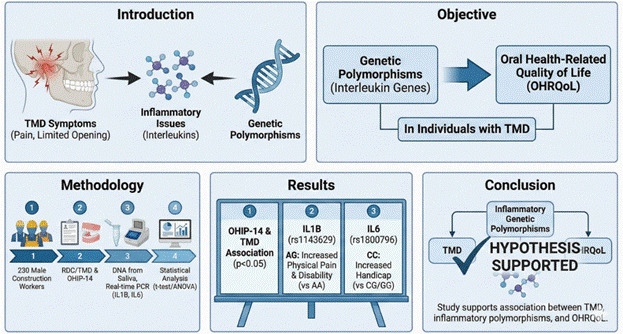 Figure 1
Peer Reviews
No public reviews on file for this paper yet. If you reviewed it on a platform where reviews are public (OpenReview, ICLR, NeurIPS, ICML), you can paste yours below so the community can read it here.
Videos
No videos yet. Explain this paper in a talk, walkthrough, or lecture? Add one.
Taxonomy
TopicsTemporomandibular Joint Disorders · Oral microbiology and periodontitis research · Obstructive Sleep Apnea Research
Introduction
Temporomandibular disorders (TMDs) encompass a heterogeneous group of musculoskeletal conditions affecting the temporomandibular joint (TMJ), masticatory muscles, and associated structures. Characterized by symptoms such as orofacial pain, joint noises, and restricted jaw movement, TMDs can significantly impair essential functions such as chewing and speech 1 ^,^ 2. Consequently, these disorders often have a detrimental impact on an individual's Oral Health-Related Quality of Life (OHRQoL), affecting psychological well-being and social functioning 3 ^,^ 4 ^,^ 5. The etiology of TMDs is multifactorial, involving a complex interplay of biological, psychosocial, and environmental factors, including genetic predispositions 2.
A standardized assessment is essential for both clinical management and research consistency. To this end, the Research Diagnostic Criteria (RDC/TMD) provides a validated dual-axis system. Axis I focuses on the clinical diagnosis of physical conditions based on a standardized physical examination, while Axis II assesses psychosocial status and pain-related disability, recognizing the biopsychosocial complexity of these disorders 3 ^,^ 6.
To quantify the functional and psychosocial consequences of TMD, validated instruments are used to measure patient-reported outcomes. The Oral Health Impact Profile (OHIP) is a widely used questionnaire for this purpose. The 14-item version (OHIP-14) is a self-administered tool that efficiently assesses seven domains of OHRQoL: functional limitation, physical pain, psychological discomfort, physical disability, psychological disability, social disability, and impairment, providing a comprehensive measure of patient-perceived burden 5 ^,^ 7.
Underlying the clinical manifestations of painful TMD is a complex pathophysiology, in which inflammation is recognized as a key mechanism. In joint conditions such as disc displacement and degenerative joint disease, the local accumulation of inflammatory mediators is the primary trigger for pain 8. These inflammatory processes are coordinated by cytokines, particularly pro-inflammatory interleukins, which mediate cartilage and bone degradation. Specifically, elevated concentrations of interleukin-1 beta (IL-1β) and interleukin-6 (IL-6) have been identified in the synovial fluid of patients with TMD, directly implicating them in the progression of joint pathology 9.
Individual susceptibility to such inflammatory conditions is increasingly understood to have a genetic basis. Functional polymorphisms in genes encoding pro-inflammatory cytokines, such as IL1B and IL6, can alter mediator production and modulate the intensity of the inflammatory response, thus influencing the risk and severity of TMD 9. Specific populations, such as male construction workers, have genetic profiles that may predispose them to TMD symptoms, making them a relevant population for investigating these associations 10.
Given the interplay between inflammatory mediators, genetic predisposition, and the significant impact of TMD on daily life, this study was designed to address specific gaps in a high-risk occupational group. Therefore, the primary objective was to evaluate the impact of TMD-related pain on OHRQoL in male construction workers. The secondary objective was to investigate the association between specific genetic polymorphisms in IL1B (rs1143627 and rs1143629) and IL6 (rs1800795 and rs1800796) and the OHRQoL domains, measured by the OHIP-14, in this population.
Materials and methods
Ethical Considerations
This cross-sectional study was conducted at the Dental Clinic of the Social Service of the Civil Construction Industry of the State of Paraná (SECONCI-PR), located in southern Brazil. The project was approved by the Human Research Ethics Committee under protocol number 2.802.708 (CAAE: 94262618.4.0000.0093).
Study Design
Male construction workers were recruited consecutively between 2018 and 2019. Following an initial consultation where study objectives and procedures were explained, written informed consent was obtained from all enrolled participants.
The inclusion criteria specified healthy male workers aged 18 years or older. Exclusion criteria were: 1 use of analgesic or anti-inflammatory medication within the preceding six months; 2 presence of any systemic comorbidities; and 3 illiteracy, which precluded the ability to provide valid written consent. The design and reporting of this study adhere to the STROBE (Strengthening the Reporting of Observational Studies in Epidemiology) statement and its STREGA extension for genetic association studies 11.
Clinical Variables
All clinical examinations were performed by a single, senior dentist, certified and experienced in the diagnosis of temporomandibular disorders (TMDs). Participants were diagnosed according to the Axis I physical assessment protocol of the Research Diagnostic Criteria for Temporomandibular Disorders (RDC/TMD).
The Axis I examination protocol included palpation of the masticatory muscles and temporomandibular joints using standardized pressures of 1.0 kg and 0.5 kg, respectively. Mandibular range of motion and the presence of pain during jaw function were also assessed. Based on these findings, participants were classified into diagnostic subgroups. Muscle dysfunctions were categorized as myofascial pain, with or without limitation of mouth opening. Joint dysfunctions were assessed bilaterally and classified as arthralgia, defined as joint pain on palpation, or osteoarthritis, identified by the presence of joint crepitus during function in the absence of concomitant pain.
Evaluation of OHRQoL
OHRQoL was assessed using the OHIP-14 questionnaire. This instrument measures seven domains: functional limitation, physical pain, psychological discomfort, physical disability, psychological disability, social disability, and handicap. Responses were coded on a five-point Likert scale (0 = never, 1 = rarely, 2 = sometimes, 3 = often, 4 = always). The score for each domain, ranging from 0 to 8, was calculated by summing the scores of the two corresponding items. The total OHIP-14 score, obtained by the summation of all domain scores, ranged from 0 to 56, with higher scores indicating poorer OHRQoL
Genetic Analysis
For genetic analysis, saliva was collected from all participants in 15 mL Falcon tubes and stored at -20°C. Genomic DNA extraction from saliva was performed as previously described 12. Genetic polymorphisms in IL1B (rs1143627 and rs1143629) and IL6 (rs1800795 and rs1800796) were investigated using real-time polymerase chain reaction (RT-PCR) on the StepOnePlus Real-time PCR System (Applied Biosystems, USA) with the TaqMan assay (Applied Biosystems, Foster City, CA, USA). Table 1 presents the candidate genes and genetic polymorphisms.
For reactions, a total volume of 3 μL (1.425 μL of water, 1.5 μL TaqMan PCR master mix, 0.075 μL SNP assay; Applied Biosystems, Foster City, CA) and 4ng of DNA per sample was used. The thermal profile was configured as follows: pre-incubation cycle at 95°C (10 min) and 40 amplification cycles at 92°C (15 s) and 60°C (1 min). Two negative controls were included on each plate. An internal consistency test was conducted by randomly reprocessing 10% of all samples, resulting in 100% consistency.
Statistical analysis
The data was analyzed as a continuous variable, and normality was tested using the Kolmogorov-Smirnov test. As the data followed a normal distribution, the Student's t-test was used to compare inflammatory disorders with OHIP-14 domain scores when there were two groups, while one-way analysis of variance (ANOVA) was employed when there were three groups. ANOVA was also used to investigate variations in the mean scores of each OHIP-14 domain, genotypes, and phenotypes, such as myofascial pain and inflammatory disorders. When ANOVA indicated a significant difference, the Tukey post-hoc test was conducted for pairwise comparisons. All analyses were performed using the statistical software Jasp, version 0.14.1, with a significance level set at 5%.
A test for deviation from the Hardy-Weinberg equilibrium was performed with the chi-square test. The post-hoc power calculator was performed using the clinclac.com.
Table 1. Candidate genes e polymorphisms.GeneGenetic polymorphismPositionType of alterationMutant alleleMAFGenotypes n(%) **H-W p-value Homozygous dominantHeterozygousHomozygous recessive
IL1B (Interleukin 1 beta)rs1143627Chromosome 2: 112836810 (GRCh38)Transcript VariantG/A0.4768 (33.3)85 (41.7)51 (25.0)0.021rs1143629Chromosome 2: 112835941 (GRCh38)Intron VariantA/G0.4877 (37)77 (37)54 (26)0.0003 IL6 (Interleukin 6)rs1800795Chromosome 7:22727026 (GRCh38)Intron VariantC/G0.14114 (53.0)78 (36.3)23 (10.7)0.089rs1800796Chromosome 7: 22726627 (GRCh38)Transcript VariantC/G0.31131 (63.6)67 (32.5)8 (3.9)0.877Obtained from database: https://www.ncbi.nlm.nih.gov/snp/ MAF minor allele frequencyH-W Hardy-Weinberg
Results
A total of 230 male individuals were included in the study. Ages ranged from 18 to 77 years, and the mean age was 37.8 ± 11.0 years. A total of 31 individuals reported bruxism, and 36 reported clenching.
Linear regression analysis was not performed, as the study's focus was on comparing mean differences across groups using ANOVA, rather than modeling continuous associations. Table 2(a and b) shows the variables studied and the OHIP-14 domains. A significant association between the OHIP-14 (total scale and all domains) and the TMD variables was observed (p < 0.05). An association between the presence of pain and the domains of the total scale, physical pain, psychological discomfort, physical, psychological, and social disability, and handicap (p < 0.001; p = 0.028; p = 0.005; p = 0.045; p < 0.001; p = 0.007; p = 0.034, respectively) was also observed. The presence of inflammatory disorders was also associated with the domain of total scale, physical pain, psychological discomfort, psychological and social disability (p = 0.001; p = 0.044; p = 0.001; p = 0.013; p = 0.002, respectively). Right and left side inflammatory disorders were classified into inflammatory absence, arthralgia, osteoarthritis, and osteoarthrosis. On the right side, joint pain, arthralgia, was associated with the domain of total scale, psychological discomfort, and social disability (p = 0.003; p = 0.004; p = 0.001, respectively). On the left side, there was an association between the absence of inflammation and arthralgia in the domain of total scale, functional limitation, psychological and social disability (p = 0.008; p = 0.044; p = 0.024; p = 0.019, respectively). In the psychological discomfort domain, there was an association between the absence of inflammation and osteoarthritis (p = 0.013).
The association between OHIP-14 scores and genetic polymorphisms in IL1B (rs1143627 and rs1143629) and IL6 (rs1800795 and rs1800796) is summarized in Tables 3 and 4, respectively. In Table 3, individuals’ heterozygous AG in rs1143629 showed increased values in domains 2 (physical pain) and 4 (physical disability) compared to AA homozygotes (p = 0.035; p = 0.042, respectively). It was also possible to observe an association in Table 4 between individuals homozygous for the C allele at rs1800796, who demonstrated higher values in domain 7 (handicap) compared to heterozygous CG and homozygous GG individuals (p = 0.007).
The post-hoc power ranged from 60% to 3%.
Table 2aComparison of OHIP-14 scores between myofascial pain, inflammatory disorder, and right and left inflammatory disorder variables OHIP-14 Total Scale Functional limitation Physical pain Psychological discomfort VariablesMean (SD) p valueMean (SD) p valueMean (SD) p valueMean (SD) p valueMyofascial Pain Absence6.39 (6.11)^a^ < 0.0010.27 (0.93)^a^ 0.6920.91 (1.44)^a^ 0.0281.72 (1.91)^a^ 0.005Pain12.50 (7.01)^b^ 0.44 (1.04)^a^ 1.88 (1.81)^b^ 3.00 (2.14)^b^ Pain with limitation11.00 (1.41)^ab^ -1.00 (1.41)^ab^ 4.50 (0.70)^ab^ Inflammatory disorder Absence6.14 (6.26)0.0010.27 (0.96)0.7230.87 (1.45)0.0441.61 (1.91)0.001Presence9.28 (6.19)0.32 (0.87)1.33 (1.56)2.58 (1.94)Right inflammatory disorder Absence6.15 (6.19)^a^ 0.0030.30 (1.00)^a^ 0.3390.88 (1.44)^a^ 0.0701.61 (1.90)^a^ 0.004Arthralgia11.44 (7.81)^b^ 0.50 (1.04)^a^ 1.33 (1.41)^a^ 2.94 (2.15)^b^ Osteoarthrosis8.21 (6.16)^ab^ 0.05 (0.22)^a^ 1.05 (1.50)^a^ 2.31 (1.76)^ab^ Osteoarthritis9.15 (3.57)^ab^ -1.92 (1.93)^a^ 2.92 (1.93)^ab^ Left inflammatory disorder Absence6.30 (6.19)^a^ 0.0080.26 (0.93)^a^ 0.0440.95 (1.50)^a^ 0.5121.65 (1.89)^a^ 0.013*Arthralgia11.78 (8.52)^b^ 0.92 (1.49)^b^ 1.35 (1.39)^a^ 2.57 (2.65)^ab^ Osteoarthrosis7.85 (5.91)^ab^ 0.14 (0.47)^ab^ 0.85 (1.38)^a^ 2.38 (1.74)^ab^ Osteoarthritis9.20 (3.88)^ab^ -1.50 (1.65)^a^ 3.30 (1.82)^b^
Table 2bComparison of OHIP-14 scores between myofascial pain, inflammatory disorder, and right and left inflammatory disorder variables OHIP-14 Physical disability Psychological disability Social disability Handicap VariablesMean (SD) p valueMean (SD) p valueMean (SD) p valueMean (SD) p valueMyofascial Pain Absence0.96 (1.84)^a^ 0.0451.43 (1.54)^a^ < 0.0010.72 (1.01)^a^ 0.0070.38 (0.98)^a^ 0.034Pain2.11 (2.37)^b^ 2.83 (1.29)^b^ 1.38 (0.91)^b^ 1.05 (1.58)^b^ Pain with limitation0.50 (0.70)^ab^ 2.50 (0.70)^ab^ 2.00 (0.00)^ab^ 0.50 (0.70)^ab^ Inflammatory disorder Absence0.94 (1.84)0.1241.40 (1.56)0.0130.67 (0.99)0.0020.39 (1.00)0.279Presence1.39 (2.05)2.00 (1.50)1.16 (1.02)0.57 (1.17)Right inflammatory disorder Absence0.94 (1.83)^a^ 0.1231.40 (1.56)^a^ 0.0560.66 (0.98)^a^ 0.0010.40 (1.00)^a^ 0.288Arthralgia2.05 (2.31)^a^ 2.22 (1.76)^a^ 1.50 (0.85)^b^ 0.88 (1.53)^a^ Osteoarthrosis1.21 (2.29)^a^ 2.00 (1.41)^a^ 1.10 (1.28)^ab^ 0.47 (1.17)^a^ Osteoarthritis0.92 (1.44)^a^ 2.00 (1.15)^a^ 1.15 (0.80)^ab^ 0.30 (0.63)^a^ Left inflammatory disorder Absence0.98 (1.85)^a^ 0.1421.40 (1.54)^a^ 0.0240.69 (0.98)^a^ 0.019*0.38 (0.98)^a^ 0.095Arthralgia2.14 (2.38)^a^ 2.35 (1.86)^b^ 1.35 (1.08)^b^ 1.07 (1.68)^a^ Osteoarthrosis1.14 (2.19)^a^ 1.90 (1.48)^ab^ 1.04 (1.20)^ab^ 0.57 (1.16)^a^ Osteoarthritis0.60 (0.84)^a^ 2.40 (0.96)^ab^ 1.30 (0.82)^ab^ 0.20 (0.42)^a^
Table 3. Comparison of OHIP-14 scores with IL1B polymorphisms (rs1143627 and rs1143629)OHIP-14IL1B polymorphisms / genotypes Mean (SD) ** p-value** Total scalers1143627AA5.58 (± 5.12)0.071GA7.84 (± 7.00)GG7.82 (± 7.37)rs1143629AA5.92 (± 5.40)0.118AG6.89 (± 6.16)GG8.31 (± 8.13)Functional limitationrs1143627AA0.27 (± 1.02)0.592GA0.38 (± 1.11)GG0.21 (± 0.70)rs1143629AA0.32 (± 1.00)0.969AG0.28 (± 1.05)GG0.29 (± 0.86)Physical painrs1143627AA0.70 (± 1.13)0.064GA1.05 (± 1.59)GG1.35 (± 1.73)rs1143629AA0.72 (± 1.13)a0.035AG0.94 (± 1.58)abGG1.40 (± 1.72)bPsychological discomfortrs1143627AA1.63 (± 1.76)0.393GA2.07 (± 2.12)GG1.80 (± 2.05)rs1143629AA1.71 (± 1.73)0.536AG2.03 (± 1.98)GG1.74 (± 2.20)Physical disabilityrs1143627AA0.72 (± 1.48)0.154GA1.24 (± 2.14)GG1.33 (± 2.14)rs1143629AA0.83 (± 1.59)a0.042AG0.89 (± 1.84)abGG1.63 (± 2.37)bPsychological disabilityrs1143627AA1.29 (± 1.27)0.205GA1.69 (± 1.66)GG1.74 (± 1.82)rs1143629AA1.29 (± 1.28)0.160AG1.54 (± 1.54)GG1.83 (± 1.93)Social disabilityrs1143627AA0.72 (± 0.87)0.314GA0.96 (± 1.08)GG0.76 (± 1.19)rs1143629AA0.72 (± 0.91)0.621AG0.88 (± 1.01)GG0.75 (± 1.21)Handicaprs1143627AA0.30 (± 0.83)0.310GA0.49 (± 1.19)GG0.60 (± 1.18)rs1143629AA0.36 (± 0.88)0.159AG0.39 (± 1.01)GG0.70 (± 1.36)Note: ANOVA and Tukey’s post hoc test were used.
Table 4. Comparison of OHIP-14 scores with IL6 polymorphisms (rs1800795 and rs1800796)OHIP-14IL6 polymorphisms / genotypes Mean (SD) ** p-value** Total scalers1800795CC7.04 (± 4.83)0.777CG6.53 (± 5.86)GG7.21 (± 7.10)rs1800796CC11.00 (± 9.81)0.198CG6.71 (± 6.56)GG6.76 (± 6.28)Functional limitationrs1800795CC0.04 (± 0.20)0.404CG0.29 (± 0.79)GG0.34 (± 1.15)rs1800796CC0.75 (± 1.75)0.358CG0.23 (± 0.79)GG0.28 (± 0.96)Physical painrs1800795CC1.17 (± 1.55)0.640CG0.87 (± 1.44)GG1.02 (± 1.52)rs1800796CC2.00 (± 1.85)0.081CG1.11 (± 1.78)GG0.86 (± 1.29)Psychological discomfortrs1800795CC1.78 (± 2.25)0.939CG1.84 (± 1.87)GG1.92 (± 2.00)rs1800796CC0.75 (± 0.88)0.058CG1.52 (± 1.72)GG2.05 (± 2.11)Physical disabilityrs1800795CC1.34 (± 1.79)0.668CG0.94 (± 1.77)GG1.09 (± 2.04)rs1800796CC2.37 (± 3.11)0.079CG1.22 (± 2.16)GG0.89 (± 1.72)Psychological disabilityrs1800795CC1.73 (± 1.42)0.451CG1.35 (± 1.52)GG1.60 (± 1.62)rs1800796CC2.37 (± 1.92)0.298CG1.44 (± 1.50)GG1.55 (± 1.61)Social disabilityrs1800795CC0.52 (± 0.79)0.411CG0.83 (± 0.98)GG0.82 (± 1.11)rs1800796CC1.12 (± 1.88)0.628CG0.85 (± 1.07)GG0.77 (± 0.97)Handicaprs1800795CC0.60 (± 0.94)0.669CG0.38 (± 0.91)GG0.45 (± 1.17)rs1800796CC1.62 (± 1.84)a0.007*CG0.40 (± 1.01)bGG0.40 (± 1.02)cNote: ANOVA and Tukey’s post hoc test were used.
Discussion
OHRQoL refers to the impact on the QoL related to individuals' oral health and includes physical, social, and psychological aspects that affect individuals' daily activities 13. In the sample of this study, the presence of TMD, especially related to pain, was shown to impact the individuals' OHRQoL. Previous studies have also shown that the experience of pain and discomfort can affect mood, sleep quality, and the ability to perform daily activities 14 ^,^ 15 ^,^ 16.
Most TMD patients experience chronic pain conditions that affect daily activities, including eating, chewing, and speaking. This aspect can result in compromised social behavior and psychological health. Among the subgroups of TMD, disorders of muscular origin and inflammatory and degenerative disorders of joint origin may be related to the presence of pain and also limited function, which can significantly affect the QoL of this group of patients. Two systematic reviews regarding QoL and TMD demonstrate that individuals with TMD have a negative impact on OHRQoL 4 ^,^ 17.
The questionnaire used in this research, OHIP-14, evaluates seven dimensions (functional limitation, physical pain, psychological discomfort, physical disability, psychological disability, social disability, and handicap) 18. The measuring instrument can measure the perception of the impact that an oral health problem can have on an individual's health 13. In this study, using the OHIP-14 to measure the impact on OHRQoL, the presence of myofascial pain was related to higher averages in the total index of this questionnaire and is statistically significant when compared to the group with no pain, representing a greater impact on QoL and agreeing with several studies that evaluated myofascial pain 13 ^,^ 14 ^,^ 15 ^,^ 16 ^,^ 19.
In relation to the OHIP-14 domains, the presence of pain had a higher mean and statistically significant impact on OHRQoL related to the presence of myofascial pain in the domains physical pain, psychological discomfort, physical disability, psychological disability, social disability and handicap, these results which agreed with a study carried out on the impact on QoL related to the TMD subgroup 14 ^,^ 20 ^,^ 21.
The presence of joint inflammatory disorder impacted QoL indices, denoting higher values in relation to the domains of physical pain, psychological discomfort, psychological disability, social disability, and total score. This scenario reflects the impact of pain on QoL, since inflammatory changes must be accompanied by pain. These results can be seen in other studies that evaluated the presence of joint inflammatory changes and QoL indices 14 ^,^ 5 ^,^ 20 ^,^ 21.
The investigation into OHRQoL and genetic polymorphisms is still limited. Several studies have described associations between genetic polymorphisms and quality of life (QoL), indicating that variations in DNA could act as biomarkers for QoL. Studies have shown that genetic polymorphisms in genes related to cytokines and inflammation are associated with symptoms of physical well-being, pain, fatigue, and social disadvantage 22 ^,^ 23 ^,^ 24 ^,^ 25 ^,^ 26 ^,^ 27. In this context, in this study, we explore the hypothesis that construction workers may have their OHRQoL affected.
According to the GENEQoL Consortium, the initiative to investigate potential biological pathways, genes, and genetic variants involved in OHRQoL has produced reviews on the biological and genetic mechanisms associated with symptoms that are related to OHRQoL 28. In our study, we observed statistical associations between the genetic polymorphism in IL1B (rs1143629) and the physical pain and physical disadvantage domains, and the statistical associations between the genetic polymorphism in IL6 (rs1800796) and the handicap domain. Our findings corroborate the findings of other previous studies that evaluated QoL and genetic polymorphisms in individuals with lung cancer 23 ^,^ 24 ^,^ 25, patients with dentofacial deformity 5, and dental caries 22. A previous study observed that the polymorphism rs1800795 in the IL-6 gene was associated with gingivitis, and the rs1143627 and rs1143629 in IL-1Bwere associated with dental caries and gingivitis 29. Interestingly, the study from Ersig et al. (2017) observed that the rs1143629 was associated with observed distress in children undergoing a medical procedure 30.
The present study has characteristics that should be discussed here. The first point to be highlighted is the fact that the sample was made up only of male construction workers. We know that TMDs affect women more when compared to men in a ratio of 2:1; however, although this condition affects more females, the nature of this condition in males should also be studied. Another important aspect to be mentioned is ethnic factors, as the sample is composed only of Brazilians. One important limitation is that by investigating only two genetic polymorphisms per gene, the study may have missed other functional or causative variants located elsewhere in the gene or in regulatory regions that could influence the phenotype. Therefore, to ensure the robustness of the results presented, future studies in other populations must be tested.
Conclusion
Our study supported the hypothesis that TMD is associated with a negative impact on OHRQoL, demonstrating that men are also affected and may have limitations related to QoL when they present with myofascial pain and inflammatory disorders. The genetic polymorphisms rs1143629 in IL1B and rs1800796 in IL6 were associated with the domains of physical pain, physical disability, and handicap.
The reference list from the paper itself. Each links out to its DOI / PubMed record.
- 1Zielinski G Pajak-Zielinska B Ginszt M A Meta-Analysis of the Global Prevalence of Temporomandibular Disorders J Clin Med 202413510.3390/jcm 13051365 PMC 1093158438592227 · doi ↗ · pubmed ↗
- 2Ferreira CL Silva MA Felicio CM Signs and symptoms of temporomandibular disorders in women and men Codas 201628117212707418410.1590/2317-1782/20162014218 · doi ↗ · pubmed ↗
- 3Schiffman E Ohrbach R Truelove E Look J Anderson G Goulet JP Diagnostic Criteria for Temporomandibular Disorders (DC/TMD) for Clinical and Research Applications: recommendations of the International RDC/TMD Consortium Network* and Orofacial Pain Special Interest Groupdagger J Oral Facial Pain Headache 20142816272448278410.11607/jop.1151 PMC 4478082 · doi ↗ · pubmed ↗
- 4Qamar Z Alghamdi AMS Haydarah NKB Balateef AA Alamoudi AA Abumismar MA Impact of temporomandibular disorders on oral health-related quality of life: A systematic review and meta-analysis J Oral Rehabil 20235087067143707871110.1111/joor.13472 · doi ↗ · pubmed ↗
- 5Sebastiani AM Dos Santos KM Cavalcante RC Pivetta Petinati MF Signorini L Antunes LAA Depression, temporomandibular disorders, and genetic polymorphisms in IL 6 impact on oral health-related quality of life in patients requiring orthognathic surgery Qual Life Res 20202912331533233266633410.1007/s 11136-020-02581-8 · doi ↗ · pubmed ↗
- 6Dworkin SF Le Resche L Research diagnostic criteria for temporomandibular disorders: review, criteria, examinations and specifications, critique J Craniomandib Disord 1992643013551298767 · pubmed ↗
- 7Meger MN Gerber JT Azeredo WM Sebastiani AM Deliberador TM Kuchler EC Genetic polymorphisms are involved in oral health-related quality of life in skeletal class III patients submitted to orthognathic surgery Clin Oral Investig 20232741409142110.1007/s 00784-023-04925-336826515 · doi ↗ · pubmed ↗
- 8Slavich GM Irwin MR From stress to inflammation and major depressive disorder: a social signal transduction theory of depression Psychol Bull 201414037748152441757510.1037/a 0035302 PMC 4006295 · doi ↗ · pubmed ↗