Sex‐specific associations between age‐related blood proteins, cognition, and Alzheimer's biomarkers
Luis Felipe Hernández‐Villamizar, Luisa Sophie Braun‐Wohlfahrt, Greta Garcia‐Escobar, Marina De Diego‐Osaba, Helena Blasco‐Forniés, Paula Ortiz‐Romero, Esther Jiménez‐Moyano, José Contador, Isabel Estragués‐Gázquez, Rosa Maria Manero‐Borràs, Irene Navalpotro, Oriol Grau‐Rivera

TL;DR
This study finds that blood proteins linked to aging and Alzheimer's disease show sex-specific patterns in their associations with age, cognition, and biomarkers.
Contribution
The study reveals sex-specific biological pathways connecting blood proteins to Alzheimer's pathology and cognitive decline.
Findings
Osteocalcin and α-Klotho were higher in women, while β2-microglobulin was higher in men.
Higher CCL11 was linked to worse executive function in women only.
α-Klotho correlated with lower AD pathology in men but not in women.
Abstract
Peripheral blood factors influence brain aging in animal models, but their role in humans, particularly in age‐related neurodegenerative diseases like Alzheimer's disease (AD), remains unclear. We investigated whether these blood factors are associated with AD‐related biomarkers and cognitive performance in cognitively impaired patients. This cross‐sectional study measured 10 age‐related blood proteins in 366 participants from the BIODEGMAR cohort (Hospital del Mar, Barcelona), with cognitive impairment (median age of 74.4 years, IQR:70.0‐77.5; 57% women; 44% APOE‐ε4 carriers; 62,8% were CSF amyloid‐positive; Figure 1). Blood proteins and AD‐related biomarkers were quantified using ELISAs, MSD, Simoa or Lumipulse platforms. Linear regression models assessed associations with chronological age, and cognitive performance, considering sex and amyloid status as potential modifiers.…
Genes, proteins, chemicals, diseases, species, mutations and cell lines named across the full text — each resolved to its canonical identifier and authoritative record.
Click any figure to enlarge with its caption.
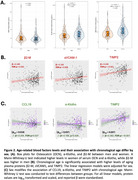 Figure 1
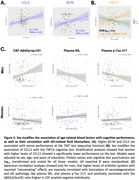 Figure 2
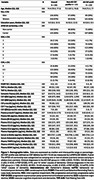 Figure 3
Peer Reviews
No public reviews on file for this paper yet. If you reviewed it on a platform where reviews are public (OpenReview, ICLR, NeurIPS, ICML), you can paste yours below so the community can read it here.
Videos
No videos yet. Explain this paper in a talk, walkthrough, or lecture? Add one.
Taxonomy
TopicsAlzheimer's disease research and treatments · Dementia and Cognitive Impairment Research · Metabolomics and Mass Spectrometry Studies