Sex differences in predictors of pathological resistance to cauTAUstrophe
Maria Carrigan, Colin Birkenbihl, Hannah M Klinger, Oliver Langford, Gillian T Coughlan, Mabel Seto, Jane A Brown, Annie Li, Madison Cuppels, Michael J. Properzi, Jasmeer P. Chhatwal, Julie C Price, Aaron P. Schultz, Dorene M. Rentz, Rebecca E. Amariglio, Harm J. Krugers

TL;DR
This study explores how men and women differ in their resistance to tau buildup in the brain despite similar levels of amyloid-beta accumulation.
Contribution
The study reveals sex-specific differences in predictors of resistance to neocortical tau burden in Alzheimer's pathology.
Findings
Higher tau resistance estimates were observed when using a female-only training sample.
Aβ-PET burden was linked to lower tau resistance in women but not in men.
Male tau resistance was predicted by CDR, education, and hippocampal volume, but not in women.
Abstract
As β‐amyloid (Aβ) accumulates in the brain, the prevailing theory posits that accelerating tau deposition escapes medial temporal (MTL) regions and encroaches upon neocortical areas. Evidence suggests some older adults demonstrate pathological resistance to caTAUstrophe (lower than expected levels of neocortical tau despite abnormal levels of Aβ). Given consistent evidence of higher tau levels in women than men, the aim of this study was to examine sex differences in the operationalization and predictors associated with resistance to neocortical tau burden in the context of Aβ proteinopathy. Employing data from 814 Aβ+ older adults (NTest=536;Table) from three cohorts; A4/LEARN, ADNI and HABS. We calculated tau resistance using our published inverse learning method, which estimates the deviation from a model trained on an expectation sample (here, Aβ‐PET+ older adults with high…
Genes, proteins, chemicals, diseases, species, mutations and cell lines named across the full text — each resolved to its canonical identifier and authoritative record.
Click any figure to enlarge with its caption.
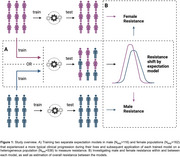 Figure 1
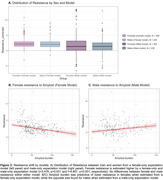 Figure 2
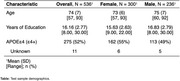 Figure 3
Peer Reviews
No public reviews on file for this paper yet. If you reviewed it on a platform where reviews are public (OpenReview, ICLR, NeurIPS, ICML), you can paste yours below so the community can read it here.
Videos
No videos yet. Explain this paper in a talk, walkthrough, or lecture? Add one.
Taxonomy
TopicsAlzheimer's disease research and treatments · Dementia and Cognitive Impairment Research · Intracerebral and Subarachnoid Hemorrhage Research