Relationship Between CXCL8 and APOE Ɛ4 allele in Cerebrospinal Fluid Samples from Brazilian Older Adults
Júlia de Almeida Barreto, Ivonne Carolina Bolaños Burgos, Carolina Andrade Koehne, Flávia Carolina Lima Torres, Caio Mendes Ribeiro, Giovanna Correia Pereira Moro, Gabriela Tomé Oliveira Engelmann, Ana Caroline Nogueira‐Souza, Joice Coutinho de Alvarenga

TL;DR
This study found that older Brazilian adults with the APOE Ɛ4 allele had lower levels of CXCL8 in cerebrospinal fluid, suggesting a link between this allele and neuroinflammation in Alzheimer's disease.
Contribution
The study identifies a novel negative association between APOE Ɛ4 allele and CXCL8 levels in Brazilian older adults.
Findings
APOE Ɛ4 carriers had significantly lower CSF CXCL8 levels compared to non-carriers.
A negative correlation was found between APOE Ɛ4 allele and CXCL8 levels in cerebrospinal fluid.
Linear regression confirmed a significant negative association between APOE Ɛ4 and CXCL8 after adjusting for age, sex, and education.
Abstract
In Alzheimer's disease (AD), inflammation is a critical factor in disease progression. Among the cytokines involved in AD pathology, Interleukin 8 (CXCL8) has emerged as an important biomarker of neuroinflammation. Recent studies have identified a strong association between CXCL8 and the ApoE gene, particularly in carriers of the Ɛ4 allele, providing valuable insights into the role of these biomarkers in the pathophysiology of Alzheimer's disease. Determine the CXCL8 profile and its relationship with APOE allele Ɛ4 in a cohort of brazilian older adults. One hundred and five older adults were enrolled and grouped based on APOE allele Ɛ4 status: APOE Ɛ4 carriers (n = 41) and non‐carriers (n = 64). Cerebrospinal fluid (CSF) samples were obtained via lumbar puncture, and levels of cytokines were assessed by the Luminex xMAP technique. Kendall correlation test between apoE allele Ɛ4 status…
Genes, proteins, chemicals, diseases, species, mutations and cell lines named across the full text — each resolved to its canonical identifier and authoritative record.
Click any figure to enlarge with its caption.
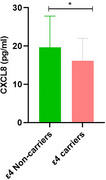 Figure 1
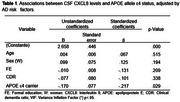 Figure 2
Peer Reviews
No public reviews on file for this paper yet. If you reviewed it on a platform where reviews are public (OpenReview, ICLR, NeurIPS, ICML), you can paste yours below so the community can read it here.
Videos
No videos yet. Explain this paper in a talk, walkthrough, or lecture? Add one.
Taxonomy
TopicsAlzheimer's disease research and treatments · Neuroinflammation and Neurodegeneration Mechanisms · Dementia and Cognitive Impairment Research