Approaches to a center‐specific CSF amyloid ratio cutoff based on PET‐amyloid positivity at the Wake Forest Alzheimer's Disease Research Center
Courtney L. Sutphen, Marc D. Rudolph, Melissa M. Rundle, Christopher T Whitlow, Kiran K. Solingapuram Sai, Timothy M. Hughes, Trey Bateman, Sam N. Lockhart, Xiaoyan Iris Leng, Suzanne Craft, Michelle M Mielke, Thomas C. Register

TL;DR
This study shows that using a specific cutoff for a spinal fluid amyloid ratio improves accuracy in detecting amyloid positivity in a unique population at the Wake Forest Alzheimer's center.
Contribution
The paper introduces a center-specific cutoff for CSF Aβ42:Aβ40 ratio tailored to the Wake Forest ADRC cohort.
Findings
The FDA general cutoffs had 88.5% and 84.1% overall agreement with amyloid PET.
The center-specific cutoff of ≤0.064 achieved 92.0% overall agreement with PET.
The center-specific cutoff will be used to estimate other biomarker thresholds in the same cohort.
Abstract
Variation in demographics and regional influences on AD suggest a need for ADRC center‐specific biomarker cutoffs. The Wake Forest ADRC has a unique community‐based cohort from a recruitment area with high rates of metabolic disease and hypertension. We evaluated the accuracy and utility of the CSF Aβ42:Aβ40 ratio (Lumipulse G1200 platform) to classify participant amyloid positivity using (1) general cutoffs developed for the assay manufacturer for a Breakthrough Device application to the FDA (≤0.058 “positive” and ≤0.072 “likely positive”), and (2) internal amyloid PET visual reads. The FDA cutoffs were developed using 235 Amsterdam Dementia Cohort participants and cross‐validated in 274 cognitively impaired ADNI participants. We evaluated performance of a center‐specific CSF Aβ42:40 cutoff in our unique cohort, which includes cognitively impaired and unimpaired participants, compared…
Genes, proteins, chemicals, diseases, species, mutations and cell lines named across the full text — each resolved to its canonical identifier and authoritative record.
Click any figure to enlarge with its caption.
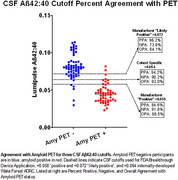 Figure 1
Peer Reviews
No public reviews on file for this paper yet. If you reviewed it on a platform where reviews are public (OpenReview, ICLR, NeurIPS, ICML), you can paste yours below so the community can read it here.
Videos
No videos yet. Explain this paper in a talk, walkthrough, or lecture? Add one.
Taxonomy
TopicsDementia and Cognitive Impairment Research · Alzheimer's disease research and treatments · Amyotrophic Lateral Sclerosis Research