Modulatory effect of glial fibrillary acidic protein (GFAP) levels on the association between plasma p‐tau217 levels and cognitive decline in older adults
Elizabeth Lucia Valeriano‐Lorenzo, Mario Ricciardi, Sonia Wagner, Minerva Martinez, Belén Frades, María Ascensión Zea‐Sevilla, Meritxell Valentí, Teodoro del Ser, Pascual Sánchez‐Juan

TL;DR
This study shows that rising levels of a brain protein called GFAP worsen cognitive decline in older adults with a specific Alzheimer's biomarker.
Contribution
Novel finding that the rate of GFAP increase, not baseline levels, modulates the effect of p-tau217 on cognitive decline in Alzheimer's.
Findings
Participants with high p-tau217 and fast GFAP increase showed significantly faster cognitive decline.
Baseline GFAP levels did not significantly interact with p-tau217 to affect cognition.
GFAP's rate of change modulates cognitive decline independently of age, sex, and ApoE4.
Abstract
Recent studies demonstrate an association between glial fibrillary acidic protein (GFAP) levels and post‐mortem tau pathology and highlighted its role as a link between amyloid and tau pathology in Alzheimer's disease (AD) [Sánchez‐Juan, Pascual, et al., Brain 147.5 (2024): 1667‐1679.]. Additionally, growing evidence suggests that neuroinflammation may modulate the effects of tau spread on cognitive impairment in AD [Peretti, Débora E., et al., Brain 147.12 (2024): 4094‐4104.]. In this context, this study aims to assess the synergistic effect on cognitive decline of plasma levels of GFAP, and p‐tau217, as surrogate biomarkers of reactive astrogliosis and AD pathophysiology respectively. We included 354 cognitively unimpaired individuals (mean age = 74.1±3.6 years; 61.9% women) from the Spanish Vallecas Project, a longitudinal study of elderly volunteers. Plasma GFAP concentrations were…
Genes, proteins, chemicals, diseases, species, mutations and cell lines named across the full text — each resolved to its canonical identifier and authoritative record.
Click any figure to enlarge with its caption.
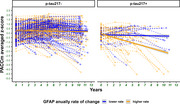 Figure 1
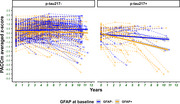 Figure 2
Peer Reviews
No public reviews on file for this paper yet. If you reviewed it on a platform where reviews are public (OpenReview, ICLR, NeurIPS, ICML), you can paste yours below so the community can read it here.
Videos
No videos yet. Explain this paper in a talk, walkthrough, or lecture? Add one.
Taxonomy
TopicsAlzheimer's disease research and treatments · Dementia and Cognitive Impairment Research · Neurological Disease Mechanisms and Treatments