Mapping molecular pathways underlying the relationship between plasma ptau and Alzheimer's disease pathology: an imaging‐transcriptomic study
Min Su Kang, Julie Ottoy, Andrew Clappison, Gleb Bezgin, Thomas K Karikari, Gassan Massarweh, Jean‐Paul Soucy, Serge Gauthier, Mario Masellis, Andrew Lim, Walter Swardfager, Kaj Blennow, Henrik Zetterberg, Sandra E. Black, Pedro Rosa‐Neto, Maged Goubran

TL;DR
This study identifies molecular pathways linking plasma ptau levels to Alzheimer's disease pathology using imaging and transcriptomic data.
Contribution
The novel contribution is the identification of mitochondrial metabolism and synaptic function as key AD-biodomains linked to plasma ptau.
Findings
Mitochondrial metabolism is associated with ptau181-PET relationships.
Synaptic function and cytokine interactions are linked to ptau217-PET associations.
MAPT, SNCA, and intracellular signaling are highlighted as key molecular pathways.
Abstract
Collective evidence suggests that plasma ptau181 and 217 reflect Alzheimer's disease (AD) from the amyloid‐beta (Aβ) to tau pathologies. However, possible molecular pathways underlying the biological mechanisms that relate AD pathology with plasma ptau have not yet been elucidated. We studied 549 participants from two cohorts: ADNI (Aβ‐: 83 CN; Aβ+: 171 CN, 97MCI, 39 AD; Aβ‐PET: [18F]AV45; tau‐PET: [18F]AV1451) and TRIAD (Aβ‐: 26 Young, 62 CN; Aβ+: 29 CN, 30 MCI, 24 AD; Aβ‐PET: [18F]AZD4694; tau‐PET: [18F]MK6240). Both cohorts included plasma ptau181 and 217, which were quantified using the SIMOA/Janssen. All images were processed using Freesurfer or PETsurfer into the DKT atlas. Linear regression models investigated the associations between plasma ptau and Aβ‐PET or tau‐PET, adjusted for age, sex, education, and APOEε4. Partial least squares (PLS) analysis identified a set of…
Genes, proteins, chemicals, diseases, species, mutations and cell lines named across the full text — each resolved to its canonical identifier and authoritative record.
Click any figure to enlarge with its caption.
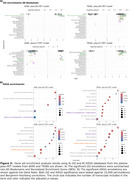 Figure 1
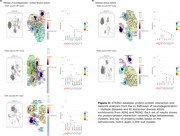 Figure 2
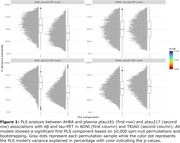 Figure 3
Peer Reviews
No public reviews on file for this paper yet. If you reviewed it on a platform where reviews are public (OpenReview, ICLR, NeurIPS, ICML), you can paste yours below so the community can read it here.
Videos
No videos yet. Explain this paper in a talk, walkthrough, or lecture? Add one.
Taxonomy
TopicsAlzheimer's disease research and treatments · Dementia and Cognitive Impairment Research · Neurological Disease Mechanisms and Treatments