Basal Cell Nevus Syndrome Treated With Laser Therapy: Novel Approach for Young Adults
Giulia Briatico, Camila Scharf, Eugenia Veronica Di Brizzi, Gabriella Brancaccio, Nikola Drmac

Abstract
Genes, proteins, chemicals, diseases, species, mutations and cell lines named across the full text — each resolved to its canonical identifier and authoritative record.
Click any figure to enlarge with its caption.
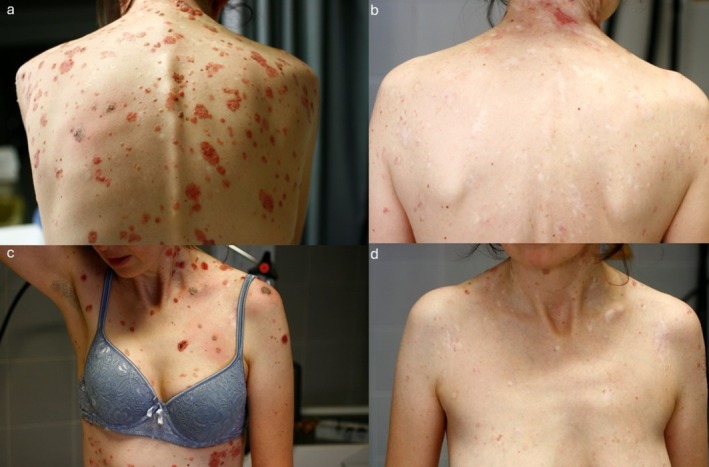 Figure 1
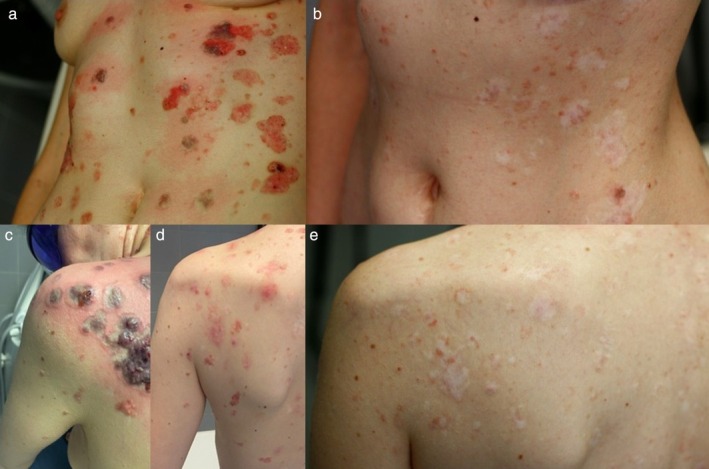 Figure 2
Peer Reviews
No public reviews on file for this paper yet. If you reviewed it on a platform where reviews are public (OpenReview, ICLR, NeurIPS, ICML), you can paste yours below so the community can read it here.
Videos
No videos yet. Explain this paper in a talk, walkthrough, or lecture? Add one.
Taxonomy
TopicsGenetic and rare skin diseases. · Hedgehog Signaling Pathway Studies · Cancer and Skin Lesions
Basal cell nevus syndrome (BCNS), also known as Gorlin‐Goltz syndrome, is a rare inherited disorder with an autosomal dominant pattern that causes early‐onset basal cell carcinomas (BCCs). Its associated features include keratocysts, palmoplantar pits, falx cerebri calcification, skeletal abnormalities, frontal bossing, fibromas (in the heart and ovaries), medulloblastoma, glaucoma, and cleft lip/palate [1]. The syndrome arises from an overactive Sonic hedgehog signaling pathway, promoting tumor growth.
Standard treatments encompass surgery, Mohs surgery, electrodessication, curettage, photodynamic therapy, cryotherapy, radiotherapy, and topical agents such as imiquimod or 5‐fluorouracil. Despite their high efficacy, these methods often lead to scarring, which can affect patients' psychosocial well‐being. The European Association of Dermato‐Oncology (EADO) guideline [2] recommends treating multiple BCCs in BCNS patients with hedgehog pathway inhibitors (sonidegib, vismodegib), shown to reduce the size of existing BCCs and the rate of new surgically eligible BCCs. However, side effects like muscle cramps, dysgeusia, and weight loss, as well as contraindications in pregnancy, restrict their use in young adults. The management of BCNS remains a topic of debate, necessitating a multidisciplinary approach.
Laser therapy has emerged as a promising alternative, with studies supporting the pulsed dye laser (PDL, 595 nm) [3] and the neodymium‐doped yttrium aluminium garnet laser (Nd:YAG, 1064 nm) [4].
A 36‐year‐old woman with genetically confirmed BCNS, diagnosed 15 years earlier, presented in December 2022. She had undergone multiple excisions but refused systemic treatment due to psychological distress and her desire for pregnancy. After signing the informed consent, the proposed treatment included PDL for superficial BCCs and Nd:YAG for nodular ones.
Treatment parameters were based on prior studies:
- PDL (VBeam, Candela Corporation): 7 mm, 0.45 ms, 13 J, Dynamic Cooling Device (DCD) off, treating with a 3 mm margin.
- Nd:YAG (Candela Corporation): 6 mm, 170 J, 3 ms, DCD off.
Each lesion required 1 to 3 treatments, with sessions every 2 months for a total of six sessions over 12 months. The treatment endpoint was achieving gray‐purple purpura after each session, while dermoscopy assessed the absence of BCCs during follow‐up (Figures 1 and 2). PDL caused mild, short‐term pain, whereas Nd:YAG needed local anesthesia. Side effects included erythema, swelling, and crusting. Lesions healed within 2 weeks without infection or bleeding. After 1 year, no scarring was observed; however, diffuse depigmentation did occur. The patient was satisfied with the cosmetic outcomes.
This case highlights the necessity of effective non‐invasive treatments for young BCNS patients concerned about aesthetics. Carbon dioxide (CO_2_) laser ablation was not proposed, as it showed no improved cosmetic outcomes compared to cryotherapy. Additionally, it was not recommended in a systematic review of laser treatments for nonmelanoma skin cancer due to its lower effectiveness compared to Nd:YAG [5].
PDL, commonly used for vascular lesions, may also treat BCCs through an antiangiogenic effect. It disrupts the tumor's blood supply and reduces transforming growth factor‐beta (TGF‐β) expression, fibroblast proliferation, and collagen type III deposition—mechanisms also involved in keloid regression. Nd:YAG, which targets deep dermal lesions, is more effective for nodular BCCs due to its superior penetration depth.
In conclusion, PDL and Nd:YAG lasers present a valuable alternative to surgery for BCNS, offering favorable cosmetic results while postponing systemic therapy. This approach is especially beneficial for patients with aesthetic concerns but could also apply to those with disabilities, coagulopathy, or surgical contraindications. Further large‐scale studies are necessary to validate these findings.
Conflicts of Interest
The authors declare no conflicts of interest.
The reference list from the paper itself. Each links out to its DOI / PubMed record.
- 1G. Briatico , E. Moscarella , A. Ronchi , E. M. Procaccini , and G. Argenziano , “In Situ Melanoma Collision With a Basal Cell Carcinoma in a Patient With Basal Cell Nevus Syndrome: Clinical and Dermoscopic Features,” Dermatology Practical & Conceptual 9, no. 4 (2019): 310–312, 10.5826/dpc.0904 a 16.31723471 PMC 6830545 · doi ↗ · pubmed ↗
- 2K. Peris , M. C. Fargnoli , R. Kaufmann , et al., “European Consensus‐Based Interdisciplinary Guideline for Diagnosis and Treatment of Basal Cell Carcinoma—Update 2023,” European Journal of Cancer 192 (2023): 113254, 10.1016/j.ejca.2023.113254.37604067 · doi ↗ · pubmed ↗
- 3M. Marous , K. Mueller , and F. Tausk , “Multiple Basal Cell Carcinomas in Gorlin Syndrome Treated With Pulsed Dye Laser,” Journal of Cosmetic and Laser Therapy 22, no. 6–8 (2020): 230–231, 10.1080/14764172.2021.1914852.33849368 · doi ↗ · pubmed ↗
- 4A. E. Ortiz and R. R. A. M. Anderson , “1064 Nm Long‐Pulsed Nd:YAG Laser Treatment of Basal Cell Carcinoma,” Lasers in Surgery and Medicine 47, no. 106–10 (2015): 1052.10.1002/lsm.2231025645536 · doi ↗ · pubmed ↗
- 5E. Sharon , I. Snast , M. Lapidoth , et al., “Laser Treatment for Non‐Melanoma Skin Cancer: A Systematic Review and Meta‐Analysis,” American Journal of Clinical Dermatology 22, no. 1 (2021): 25–38, 10.1007/s 40257-020-00562-8.32930983 · doi ↗ · pubmed ↗