White matter hyperintensities are associated with glymphatic impairment and antioxidant pathway in healthy aging
Flavie E. Detcheverry, Fanta Dabo, Manpreet Singh, Alexandra T. Star, Sneha Senthil, Soraya Lahlou, Ali Filali‐Mouhim, Rozie Arnaoutelis, Dumitru Fetco, Jamie Near, Arsalan S. Haqqani, Sridar Narayanan, AmanPreet Badhwar

TL;DR
This study finds that white matter hyperintensities in aging brains are linked to glymphatic system changes and antioxidant activity, suggesting a connection between brain injury and waste clearance.
Contribution
The study reveals a novel interplay between white matter hyperintensities, choroid plexus volume, and antioxidant pathways in healthy aging.
Findings
WMH volume is significantly associated with larger choroid plexus volume and lower glutathione levels.
21 plasma proteins linked to antioxidant activity are associated with WMH volume.
Antioxidant proteins like catalase correlate with brain glutathione levels.
Abstract
White matter hyperintensities (WMHs), a marker of vascular‐brain injury in older adults, constitute an Alzheimer's disease (AD) risk‐factor (Debette et al., 2019). Recent studies in AD associate WMHs to (a) enlarged choroid plexus (ChP) (Hong et al., 2024), a structure involved in glymphatic clearance of AD‐related proteins and waste from the brain (Hauglund et al., 2020), and (b) lower brain levels of glutathione, an antioxidant metabolite (Detcheverry et al., 2024). However, the interplay between WMHs, ChP, and brain metabolites in healthy aging remains poorly understood, which is essential for unraveling their role in dementia progression. We investigated the relationship between WMH volume, ChP volume, brain metabolites, and plasma proteins. 7T‐MRI/MRS and plasma samples were acquired from 83 healthy adults (42W/41M) aged 20‐79. ChP and WMHs were manually segmented on T1‐weighted…
Genes, proteins, chemicals, diseases, species, mutations and cell lines named across the full text — each resolved to its canonical identifier and authoritative record.
Click any figure to enlarge with its caption.
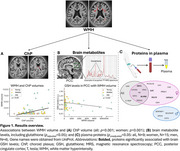 Figure 1
Peer Reviews
No public reviews on file for this paper yet. If you reviewed it on a platform where reviews are public (OpenReview, ICLR, NeurIPS, ICML), you can paste yours below so the community can read it here.
Videos
No videos yet. Explain this paper in a talk, walkthrough, or lecture? Add one.
Taxonomy
TopicsCerebrospinal fluid and hydrocephalus · Dementia and Cognitive Impairment Research · Alzheimer's disease research and treatments