Input‐output curve reveals slope of cortical hyperexcitability in early Alzheimer's disease
Julia H. Cho, Brice Passera, Recep Ozdemir, Martina Upton, Emma Ferry, Daniel Z. Press, Mouhsin Shafi, Peter J. Fried, Stephanie S. Buss

TL;DR
This study shows that early Alzheimer's disease is linked to increased brain excitability, which could be measured using a non-invasive method involving brain stimulation.
Contribution
The study introduces a novel non-invasive method using TMS and EMG to quantify cortical hyperexcitability in early Alzheimer's disease.
Findings
Early Alzheimer's patients showed lower resting motor thresholds compared to healthy controls.
Cortical hyperexcitability in AD was most pronounced at higher stimulation intensities, suggesting involvement of AMPA receptors.
The I/O curve method revealed significant differences in cortical excitability between Alzheimer's and control groups.
Abstract
Alzheimer's disease (AD) is linked to abnormal cortical excitability. Recent studies have suggested that amyloid‐related cortical hyperexcitability may drive faster clinical decline and be related to spreading of tau. However, we lack non‐invasive methods to quickly and directly assay cortical excitability in AD patients. We generate an Input‐Output response curve (I/O Curve) using transcranial magnetic stimulation (TMS) with electromyography (EMG) to investigate mechanisms of cortical excitability in AD. Participants included 52 biomarker‐positive early AD (CDR=0.5‐1, age 70±8, 37% female) and 51 cognitively normal older adults (CN; age 70±6.5, 53% female). Single‐pulse TMS was applied to left motor cortex to measure resting motor threshold (RMT). An I/O Curve was generated by delivering 10 pulses each at eight stimulation intensities (30‐100% maximum stimulator output (%MSO)). We…
Genes, proteins, chemicals, diseases, species, mutations and cell lines named across the full text — each resolved to its canonical identifier and authoritative record.
Click any figure to enlarge with its caption.
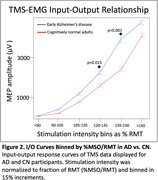 Figure 1
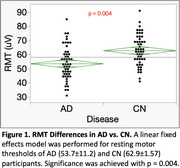 Figure 2
Peer Reviews
No public reviews on file for this paper yet. If you reviewed it on a platform where reviews are public (OpenReview, ICLR, NeurIPS, ICML), you can paste yours below so the community can read it here.
Videos
No videos yet. Explain this paper in a talk, walkthrough, or lecture? Add one.
Taxonomy
TopicsTranscranial Magnetic Stimulation Studies · EEG and Brain-Computer Interfaces · Muscle activation and electromyography studies