Endoscopic ultrasound-guided choledochoduodenostomy as a life-saving salvage therapy for post-transplant acute biliary obstruction
Yiran Song, Bixiong Zhang, Yue Sun, Yue Li

Abstract
Genes, proteins, chemicals, diseases, species, mutations and cell lines named across the full text — each resolved to its canonical identifier and authoritative record.
Click any figure to enlarge with its caption.
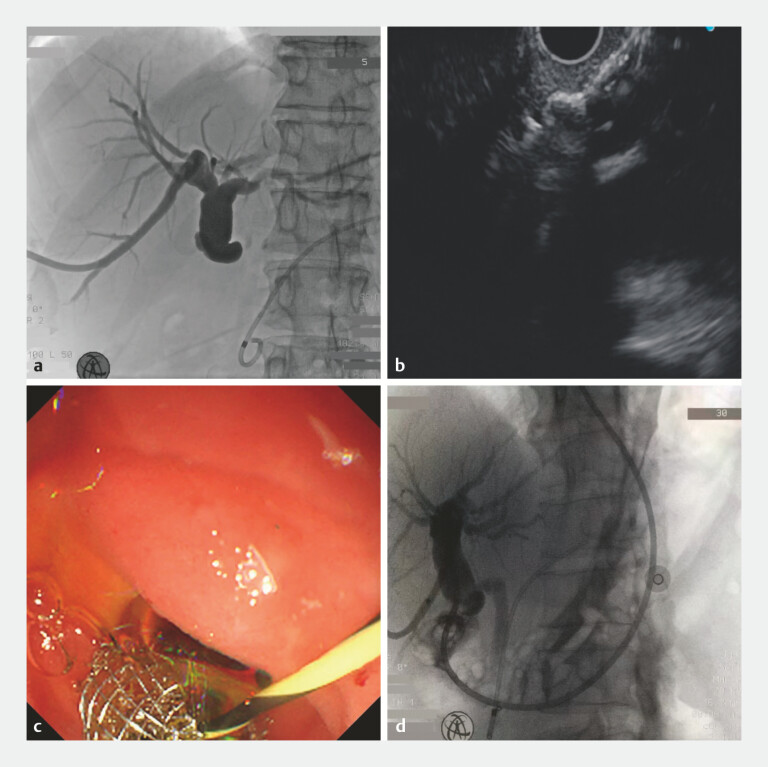 Fig. 1
Peer Reviews
No public reviews on file for this paper yet. If you reviewed it on a platform where reviews are public (OpenReview, ICLR, NeurIPS, ICML), you can paste yours below so the community can read it here.
Videos
No videos yet. Explain this paper in a talk, walkthrough, or lecture? Add one.
Taxonomy
TopicsGallbladder and Bile Duct Disorders · Pediatric Hepatobiliary Diseases and Treatments · Organ Transplantation Techniques and Outcomes
Endoscopic ultrasound-guided biliary drainage (EUS-BD) has become a recognized and effective alternative to conventional retrograde biliary drainage methods, such as endoscopic retrograde cholangiopancreatography (ERCP 1 2 ). While endoscopic ultrasound (EUS) is occasionally employed for diagnosing complications following liver transplantation, the feasibility of EUS-guided interventions for managing post-transplant complications has been documented in only a limited number of case reports 3 4 5 . We report the first case in which endoscopic ultrasound-guided choledochoduodenostomy (EUS-CDS) was successfully utilized as an emergency intervention in a liver transplant recipient with septic shock, following the failure of ERCP.
We report the case of a 61-year-old man who developed cholestatic jaundice and pruritus 1 year after orthotopic liver transplantation. Magnetic resonance cholangiopancreatography revealed a hilar biliary stricture. The patient underwent percutaneous transhepatic cholangiography drainage; however, catheter migration led to inadequate biliary drainage and persistent jaundice. Subsequent ERCP included the placement of a pancreatic duct stent but failed to relieve the biliary obstruction ( Fig. 1 a ). The patient rapidly progressed to septic shock following the procedure. After fluid resuscitation and vasopressor support, EUS-CDS was performed. An 8 mm × 6 mm self-expandable metal stent was deployed between the dilated common bile duct and the duodenal bulb, and an 8.5-Fr naso-biliary catheter was inserted into the bile duct to enable continuous irrigation ( Video 1 , Fig. 1 b–d ).
Endoscopic ultrasound-guided choledochoduodenostomy (EUS-CDS) for post-transplant biliary obstruction. a Endoscopic retrograde cholangiopancreatography (ERCP) failed to place a biliary stent; however, a pancreatic duct stent was placed successfully. b and c EUS-CDS with successful stent deployment. d A naso-biliary catheter was placed in the bile duct through the stent, and fluoroscopy confirmed the absence of leakage.
Procedure of endoscopic ultrasound-guided choledochoduodenostomy using a self-expandable metal stent.Video 1
Within 72 hours following the procedure, procalcitonin fell from >100 ng/mL to 12.7 µmol/L, and C-reactive protein decreased from 122.4 to 20.3 mg/L. Haemodynamic stability was restored, and vasopressors were weaned off. The patient was discharged home in stable condition 2 weeks postoperatively.
To the best of our knowledge, this case represents the first reported instance in which EUS-CDS can serve as a life-saving and minimally invasive rescue therapy for septic biliary obstruction when both conventional ERCP and percutaneous approaches have failed in a post-liver transplant patient. This finding may broaden the indications for EUS-BD in post-surgical patients with altered anatomy and life-threatening sepsis, establishing it as a viable emergent therapeutic option.
Endoscopy_UCTN_Code_TTT_1AS_2AD
The reference list from the paper itself. Each links out to its DOI / PubMed record.
- 1van der Merwe SW Van Wanrooij RL Bronswijk M Therapeutic endoscopic ultrasound: European Society of Gastrointestinal Endoscopy (ESGE) Guideline Endoscopy 20225418520510.1055/a-1717-139134937098 · doi ↗ · pubmed ↗
- 2Khoo S Do NDT Kongkam P Efficacy and safety of EUS biliary drainage in malignant distal and hilar biliary obstruction: A comprehensive review of literature and algorithm Endosc Ultrasound 2020936937910.4103/eus.eus_59_2033318375 PMC 7811708 · doi ↗ · pubmed ↗
- 3Keane MG Devlin J Harrison P Diagnosis and management of benign biliary strictures post liver transplantation in adults Transplant Rev (Orlando)20213510059310.1016/j.trre.2020.10059333388638 · doi ↗ · pubmed ↗
- 4Leung DS 2870 Successful Use of EUS-Guided Choledochoduodenostomy With LAMS in a Post-Liver Transplant Patient With Recurrent Choledocholithiasis and Cholangitis 2022117 e 1871 e 1872
- 5Uchida D Endoscopic ultrasonography-guided drainage of intra-abdominal fluid collection after liver transplantation: a case series of six patients J Med Ultrason (2001)20164342142610.1007/s 10396-016-0720-227234588 · doi ↗ · pubmed ↗