Side-by-side 6-mm multi-hole metal stents more effective than inside plastic stents for reintervention after stent-in-stent placement in malignant hilar biliary obstruction
Hirotsugu Maruyama, Kojiro Tanoue, Yuji Kawata, Tatsuya Kurokawa, Yoshinori Shimamoto, Yuki Ishikawa-Kakiya, Yasuhiro Fujiwara

Abstract
Genes, proteins, chemicals, diseases, species, mutations and cell lines named across the full text — each resolved to its canonical identifier and authoritative record.
Click any figure to enlarge with its caption.
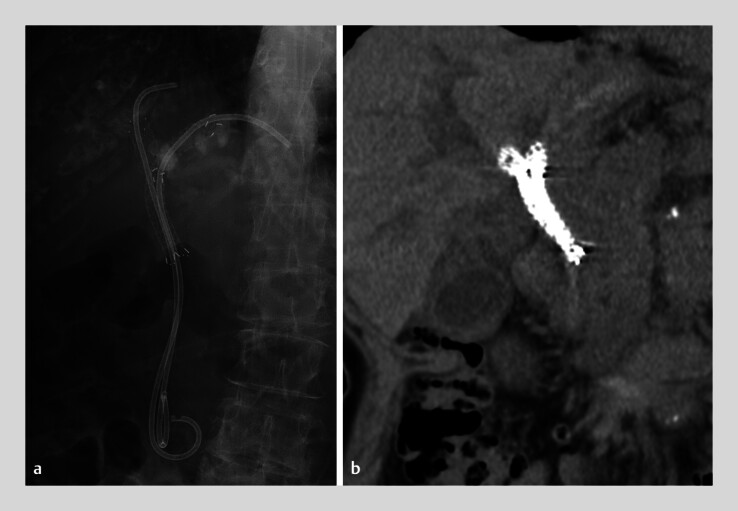 Fig. 1
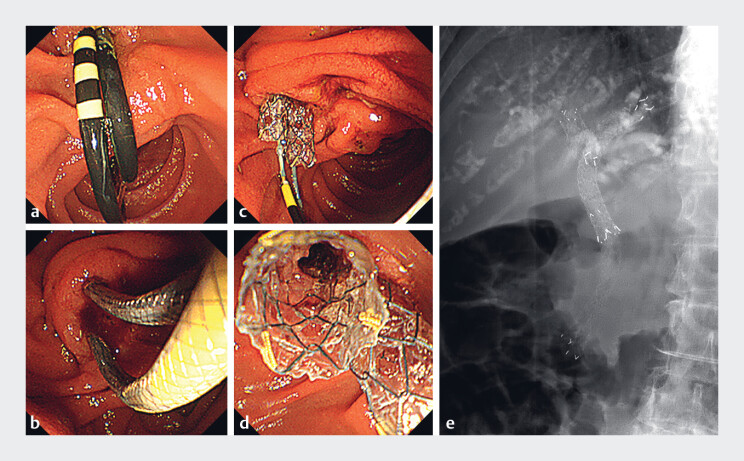 Fig. 2
Peer Reviews
No public reviews on file for this paper yet. If you reviewed it on a platform where reviews are public (OpenReview, ICLR, NeurIPS, ICML), you can paste yours below so the community can read it here.
Videos
No videos yet. Explain this paper in a talk, walkthrough, or lecture? Add one.
Taxonomy
TopicsGallbladder and Bile Duct Disorders · Esophageal and GI Pathology · Pancreatic and Hepatic Oncology Research
Endoscopic reintervention after the stent-in-stent (SIS) placement of self-expandable metallic stents (SEMSs) for unresectable malignant hilar biliary obstruction (MHBO) is challenging 1 . Regarding revisionary stenting, SEMSs have a longer patency than plastic stents (PSs 2 ), but advances in chemotherapy have increased the need for reinterventions, often using removable PSs. Additional uncovered SEMSs (UCSEMSs) can complicate future reinterventions and cannot be removed, limiting endoscopic options. We report a case of MHBO in which the side-by-side placement of the 6 mm multi-hole SEMS (MHSEMS) was effective for reintervention compared with multiple PSs after SIS.
An 84-year-old woman with MHBO, previously treated with the MHSEMS and UCSEMS in SIS placement followed by two PSs, was admitted with cholangitis ( Fig. 1 ). She had experienced repeated stent occlusion over a short period, so we opted to place two removable SEMSs ( Video 1 ). A guidewire (GW) was placed into the left intrahepatic bile duct (IHBD), and both PSs were removed. Another GW was placed into the right IHBD, and two 6 mm MHSEMSs with a slim delivery system were inserted. Insertion into the deep left IHBD was somewhat difficult, so the stents were inserted one by one but deployed simultaneously across the papilla ( Fig. 2 ). No adverse events occurred, and the outcome was favorable.
Pre-treatment images. a A fluoroscopic image showing plastic stents placed after stent-in-stent deployment of metallic stents for malignant hilar biliary obstruction. b A pre-treatment computed tomography image showing dilated intrahepatic bile ducts.
Reintervention using the side-by-side placement of 6 mm multi-hole self-expandable metallic stents after stent-in-stent metal stent placement in malignant hilar biliary obstruction.Video 1
Procedure for reintervention using the side-by-side placement of multi-hole self-expandable metallic stents (MHSEMSs). a An endoscopic image showing two plastic stents placed 1 month ago. b An endoscopic image showing simultaneous insertion of two MHSEMSs with a slim delivery system into the bile duct. c Two MHSEMSs were deployed simultaneously. d and e Endoscopic and fluoroscopic images after MHSEMS deployment.
The advantages of the MHSEMS have no step between the delivery system and the stent and it has an outer diameter of 5.9 Fr. In this case, placement of a 7 Fr PS was difficult and time-consuming due to interference from the existing SEMS; however, the MHSEMS could be placed in a much shorter time. Furthermore, after deployment, the inner diameter is larger than that of a PS, and the two MHSEMSs share each other’s holes, providing a drainage effect equivalent to more than 6 mm. The MHSEMS is also removable 3 , making it a favorable option for reintervention.
Endoscopy_UCTN_Code_TTT_1AR_2AZ
The reference list from the paper itself. Each links out to its DOI / PubMed record.
- 1Guilmoteau T Rouquette O Buisson A Direct comparison of simultaneous and sequential endoscopic metallic bilateral stenting in malignant hilar biliary obstruction World J Gastroenterol 20253110191310.3748/wjg.v 31.i 19.10191340497097 PMC 12146914 · doi ↗ · pubmed ↗
- 2Inoue T Naitoh I Okumura F Reintervention for stent occlusion after bilateral self-expandable metallic stent placement for malignant hilar biliary obstruction Dig Endosc 20162873173710.1111/den.1265727088888 · doi ↗ · pubmed ↗
- 3Maruyama H Ishikawa-Kakiya Y Kawata Y Stent-in-stent deployment across the papilla for malignant hilar biliary obstruction using novel slim multi-hole metal stents Endosc Int Open 202513 a 2714245310.1055/a-2714-245341142262 PMC 12551655 · doi ↗ · pubmed ↗