BrainAge moderates associations between AD biomarkers and cognitive decline: findings from A4/LEARN and the Harvard Aging Brain Study
Jorge Garcia Condado, Hannah M Klinger, Colin Birkenbihl, Iñigo Tellaetxe Elorriaga, Mabel Seto, Gillian T Coughlan, Michael J. Properzi, Hyun‐Sik Yang, Asier Erramuzpe, Dorene M. Rentz, Aaron P. Schultz, Jasmeer P. Chhatwal, Keith A. Johnson, Jesus M Cortes, Reisa A. Sperling

TL;DR
This study shows that brain age, estimated from MRI scans, influences how Alzheimer's biomarkers relate to cognitive decline, suggesting it could improve clinical trial design.
Contribution
The study demonstrates that BrainAge moderates the relationship between AD biomarkers and cognitive decline, offering a novel approach to clinical trial participant selection.
Findings
Higher BrainAgedelta is associated with increased Aβ-PET, Tau-PET, and p-tau217 levels.
BrainAgedelta moderates the effect of AD biomarkers on cognitive decline trajectories.
Using BrainAge could reduce screen fails in clinical trials by prioritizing individuals with worse brain health.
Abstract
BrainAge models estimate biological brain age based on neuroimaging data, providing a measure of brain health. This metric is particularly relevant in Alzheimer's disease (AD), where accelerated brain aging is exacerbated by β‐amyloid (Aβ) and tau accumulation. We investigated the extent to which BrainAge moderates associations between AD biomarkers and longitudinal cognitive decline across two independent cohorts. We examined 1690 participants from A4/LEARN and 349 from HABS (Table 1). Using the Open‐Source tool AgeML within each cohort, we built a BrainAge linear regressor model with 5‐fold cross validation using MRI‐T1 volumetric and FreeSurfer cortical thickness ROIs. We compared predicted ages with chronological age to create a BrainAgedelta. To avoid regressing out sex and APOEε4 variance, separate male/female models were built with data from APOEε4 non‐carriers and applied to…
Genes, proteins, chemicals, diseases, species, mutations and cell lines named across the full text — each resolved to its canonical identifier and authoritative record.
Click any figure to enlarge with its caption.
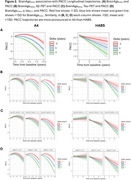 Figure 1
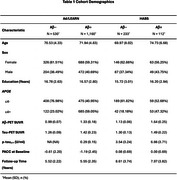 Figure 2
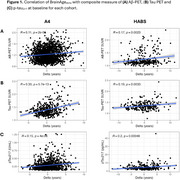 Figure 3
Peer Reviews
No public reviews on file for this paper yet. If you reviewed it on a platform where reviews are public (OpenReview, ICLR, NeurIPS, ICML), you can paste yours below so the community can read it here.
Videos
No videos yet. Explain this paper in a talk, walkthrough, or lecture? Add one.
Taxonomy
TopicsDementia and Cognitive Impairment Research · Alzheimer's disease research and treatments · Functional Brain Connectivity Studies