Classification performance of the Lumipulse® G pTau 217 Plasma assay and Lumipulse® G pTau 217/β‐Amyloid 1‐42 Plasma Ratio in a preclinical cohort
Julie E. Oomens, Rachael E. Wilson, Ramiro Eduardo Rea Reyes, Martie Marshall, Nathaniel A. Chin, Sanjay Asthana, Henrik Zetterberg, Sterling C Johnson

TL;DR
This study evaluates two blood tests for detecting Alzheimer's disease markers in a preclinical cohort, finding both are accurate for amyloid and tau status.
Contribution
The study provides empirical validation of the Lumipulse® G pTau 217 and pTau 217/β-Amyloid 1-42 assays for preclinical Alzheimer's detection.
Findings
The pTau217 assay achieved 86% accuracy for amyloid PET and 88% for tau PET.
The pTau217/β-Amyloid 1-42 ratio achieved 90% accuracy for amyloid PET and 68% for tau PET.
Plasma pTau217 levels showed a strong correlation (Spearman r = 0.92) between assays.
Abstract
The Lumipulse®G pTau217 assay is among the highest performing plasma assays available for detecting amyloid pathology. Recently, Fujirebio has submitted the Lumipulse® G pTau 217/β‐Amyloid 1‐42 Plasma Ratio to the FDA. The aim of the current study was to assess the utility of these assays for classifying amyloid and tau PET status in a risk‐enriched preclinical Alzheimer's disease cohort. 190 plasma samples from the Wisconsin Registry for Alzheimer's Prevention and the Wisconsin Alzheimer's Disease Research Center were selected and analyzed using the Lumipulse®G pTau 217 Plasma assay. Another set of 451 plasma samples were selected and analyzed using the Lumipulse® G pTau 217/β‐Amyloid 1‐42 Plasma Ratio. 38 samples were analyzed using both assays. Amyloid and tau positivity were determined based on visual reads of [C‐11]PiB and [F‐18]Florquinitau PET scans, respectively. We used ROC…
Genes, proteins, chemicals, diseases, species, mutations and cell lines named across the full text — each resolved to its canonical identifier and authoritative record.
Click any figure to enlarge with its caption.
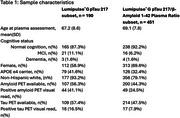 Figure 1
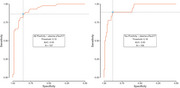 Figure 2
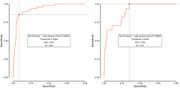 Figure 3
Peer Reviews
No public reviews on file for this paper yet. If you reviewed it on a platform where reviews are public (OpenReview, ICLR, NeurIPS, ICML), you can paste yours below so the community can read it here.
Videos
No videos yet. Explain this paper in a talk, walkthrough, or lecture? Add one.
Taxonomy
TopicsAlzheimer's disease research and treatments · Dementia and Cognitive Impairment Research · S100 Proteins and Annexins