Lower Antemortem [18F]flortaucipir PET retention in Males and Older Individuals is Explained by Lower Postmortem Tau Tangle Density
Emma M. Coomans, Ruben Smith, Daria Pawlik, Kevin Oliveira Hauer, Sebastian Palmqvist, Michael Pontecorvo, Sergey Shcherbinin, Vikas Kotari, Geidy E Serrano, Thomas G Beach, Erik Stomrud, Niklas Mattsson‐Carlgren, Annemieke J.M. Rozemuller, Wiesje M. van der Flier

TL;DR
Older age and being male are linked to lower tau PET scans in Alzheimer's due to fewer brain tangles at autopsy.
Contribution
This study explains sex and age differences in tau PET scans using postmortem tangle density data.
Findings
Older age and male sex correlate with lower tau PET uptake and prevalence due to reduced tangle density.
Tau PET sensitivity decreases with age and in males, but specificity remains high for Braak V/VI neuropathology.
PET-to-autopsy analyses confirm consistent relationships between PET and tangle density across age and sex.
Abstract
Older age and male sex have been associated with lower Tau‐PET uptake in symptomatic Alzheimer's disease. We investigated the PET‐to‐neuropathological correlates of age‐ and sex‐effects on tau in independent PET (N = 680), autopsy (N = 947), and PET‐to‐autopsy (N = 84) analyses. Tau‐PET‐analyses included amyloid‐positive participants with MCI or dementia who underwent [18F]flortaucipir‐PET. Autopsy‐analyses included MCI or dementia cases with moderate‐to‐frequent CERAD scores and available Braak and tangle density data. PET‐to‐autopsy‐analyses included cases who had undergone Tau‐PET during life, died, and had undergone autopsy, including Braak staging (PET‐to‐post‐mortem‐interval: 8.5±14.1 months). In independent PET‐ and autopsy‐analyses, we investigated age‐ and sex‐effects on Tau‐PET, Braak‐V/VI‐level tau neuropathology and tangle density. In PET‐to‐autopsy analyses, we assessed…
Genes, proteins, chemicals, diseases, species, mutations and cell lines named across the full text — each resolved to its canonical identifier and authoritative record.
Click any figure to enlarge with its caption.
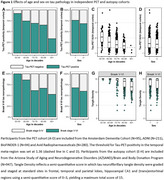 Figure 1
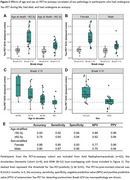 Figure 2
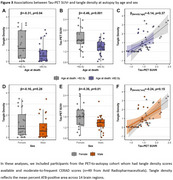 Figure 3
Peer Reviews
No public reviews on file for this paper yet. If you reviewed it on a platform where reviews are public (OpenReview, ICLR, NeurIPS, ICML), you can paste yours below so the community can read it here.
Videos
No videos yet. Explain this paper in a talk, walkthrough, or lecture? Add one.
Taxonomy
TopicsDementia and Cognitive Impairment Research · Alzheimer's disease research and treatments · Autopsy Techniques and Outcomes