Defining tau PET positivity grey zones for MK6240 and Flortaucipir quantification
Guilherme Povala, Bruna Bellaver, Guilherme Bauer‐Negrini, Emma Ruppert, Marina Scop Medeiros, Livia Amaral, Firoza Z Lussier, Pamela C.L. Ferreira, Carolina Soares, Dana L Tudorascu, Quentin Finn, Joseph C. Masdeu, Hwamee Oh, Juan Fortea, David N. Soleimani‐Meigooni, Val J Lowe

TL;DR
This study defines 'gray zones' for tau PET thresholds using two tracers, showing how confidence in tau positivity changes across a continuous scale.
Contribution
Introduces a standardized method using Uniτ to define tau PET positivity gray zones across different tracers.
Findings
Uniτ gray zones showed consistent thresholds between MK6240 and Flortaucipir tracers.
Higher TVR+ probabilities corresponded to increased Uniτ values for both tracers.
More participants fell into the gray zone for Flortaucipir compared to MK6240.
Abstract
Tau PET measures are inherently continuous and applying dichotomized thresholds introduces conceptual and analytical idiosyncrasies. Understanding the limitations in the transition from tau‐negative to tau‐positive classifications is crucial for the effective use of these thresholds. This study aims to determine the confidence levels of tau PET thresholds of abnormality for different tau PET tracers by characterizing their “gray zone” using the universal tau PET scale (Uniτ, www.unitau.app). We evaluated 485 individuals across the aging and AD spectrum from the HEAD study, with head‐to‐head scans for MK6240 and Flortaucipir. Uniτ estimates were derived from the Meta‐Temporal ROI. Tau positivity (T+) was defined as Uniτ values exceeding the mean plus 3 SD of individuals younger than 28 years (n = 24). Two physicians independently performed a visual assessment of tau positivity for each…
Genes, proteins, chemicals, diseases, species, mutations and cell lines named across the full text — each resolved to its canonical identifier and authoritative record.
Click any figure to enlarge with its caption.
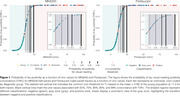 Figure 1
Peer Reviews
No public reviews on file for this paper yet. If you reviewed it on a platform where reviews are public (OpenReview, ICLR, NeurIPS, ICML), you can paste yours below so the community can read it here.
Videos
No videos yet. Explain this paper in a talk, walkthrough, or lecture? Add one.
Taxonomy
TopicsMedical Imaging Techniques and Applications · Radiomics and Machine Learning in Medical Imaging · Dementia and Cognitive Impairment Research